Insurance Network Participation: Knowing When to Opt In or Out?

Have you every wished there was an easy way to make sense of the labyrinth of insurance networks out there?

Should you be in? Should you opt out?

Below is a guide for you and your staff to follow to help you decide whether pursuing a specific insurance contract, and staying in, is worth your time and investment.

First, determine which companies you are in network with. Do you have a contract? What are your obligations as a provider? Are you getting reimbursed what the contracted fee schedule says it will reimburse? Do you have a profile set up with the National Council for Affordable Quality Healthcare (CAQH) universal provider database and is the information current, and reviewed and attested quarterly? There is no charge to create and maintain your profile in this credentialing database.

Second, make sure you know if you are currently enrolled in Medicare and if you are a participating or non-participating provider. Are you also currently enrolled as a provider in your state’s Medicaid program? Is your organization/group also enrolled?

Third, audit your patient demographic. Run a report in your practice management software.

  • What percentage of your reimbursement is coming from insurance?
  • What percentage is coming directly from patients?
  • Which payers are you mainly seeing patients from?
  • Are you finding that patients are requesting you be in network with a certain company?
  • Who are the main employers in your area insured with?
  •  Are you enrolled as a provider with the Veteran’s Administration in your area?

Fourth, make a list of Insurance Networks you are with to clarify if questions arise later regarding participation. Review if you have fee schedules and contracts on file.

Once you have a grasp on the above, you’re ready to determine if you need to pursue network participation with additional companies. Treating this like a sales or business venture, you’ll want to have insurance companies coming to you and requesting you to be in their network. Remember, it is to their benefit and their obligation to keep their paying policyholders happy. Patients should feel free to call their insurer requesting you be on their plan. Patients have done this, and outcomes have been successful. Why?

Because the worst phone call that an insurance company can receive is from an upset policyholder who can’t afford to see their favorite doctor who is helping them because the doctor is not on the plan.

Things to consider prior to enrolling in a plan include:

  • What is the reimbursement rate?
  • What percentage of the approved charges are taken out for contract discounts?
  • Is there a fee to join?
  • What are your obligations as a provider?
  • Do they want you to participate in their workers compensation, PI programs? (In our experience, opting in to the WC and PI products means no steerage to you, and cut reimbursements).
  • Are there pre-authorizations required prior to care?
  • Is there a visit limit?
  • What is the initial credentialing and re-credentialing process?

Now, you are on all the plans that are making your pocketbook and your patient happy. What do you need to do to maintain your in-network status? You will need to notify a payer with updated clinic information anytime there is a change in information you submitted at enrollment. This includes address change or adding a new provider to the office.

Many of the larger commercial payers such as Blue Cross, Humana, United Healthcare/Optum Physical Health, use CAQH to approve your re-credentialing. Those who do not will send a written communication via mail or email letting you know your recredentialing is coming due and will include the applications and instructions. Make sure to track these dates in your insurance spreadsheet.

You will also need to make sure you are tracking re-credentialing timeframes for each insurance company. Typically, the recredentialing process for commercial payers is every three years but since your enrollments with each payer fall on different dates, your re-credentialing due dates will vary. Your Medicare re-credentialing is every five years for both individual and group enrollments. Re-validation with Medicaid programs is typically every three to five years, depending on your state’s standards. For example, it is every three years in WI and every five years in MI.

We’ve just touched the surface of network plans and credentialing. Email me for assistance with how these processes work for your practice.

You may reach me at lisa@pmaworks.com

Lisa

Ask Lisa
Increasing your collections through better billing and documentation

Ask Lisa: Benefits Verification: Because Guessing Is Expensive

chiropractic assistant verifying insurance benefits for patient

In today’s healthcare landscape, verifying a patient’s insurance benefits is more than an administrative step – it is a critical safeguard for both the patient and you. Benefits verification ensures that coverage details such as eligibility, co-payments, deductibles, and authorization requirements are clearly understood. When done accurately and promptly, this process lays the foundation for transparent care, financial clarity, and trust.

For your patients, unverified benefits can lead to unexpected bills, delayed treatment, or denied claims long after services are rendered. These surprises not only often create stress at moments when patients are already vulnerable, but become a compliance issue with regards to the No Surprises Act. Verifying benefits in advance also empowers patients with accurate information about their financial responsibility, preventing fears about surprise charges.

From your perspective, benefit verification reduces claim denials, improves your revenue cycle management, and supports effective, functional operations. It bridges the gap between clinical care and financial responsibility, ensuring that your services provided align with billing requirements. Ultimately, verifying benefits is not just about reimbursement, it is about protecting patients, strengthening provider-patient relationships, and promoting a more transparent and sustainable practice.

The best time to verify benefits in the chiropractic office is either 1) before the new patient’s Day 1 if you obtained their insurance information when they called or came in to schedule, or 2) After the patient’s Day 1 visit and prior to their Day 2 visit. This fosters continued trust and adequate time for your one-on-one financial consultation. You’ll also want to verify benefits if the patient has a change in insurance during the year.

Best Verification Methods: How to Verify Benefits

  • EHR/Clearinghouse: For a minimal extra monthly fee, verification of benefits feature is available for immediate output through your EHR or clearinghouse.
  • Insurance Payor Portals: Using specific payer websites provides the most up-to-date, detailed, and accurate benefit information, often surpassing phone checks.
  • Phone: The most reliable method for complex or high-cost services, enabling confirmation of specific benefits, authorization requirements, and obtaining a first name and reference number for the call.

Be ready to provide the following information:

  • Patient Name
  • Date of Birth
  • Member ID
  • Group Number (if applicable)

Some Coverage Questions/Criteria:

  • In-network or out-of-network status of provider
  • Annual or visit limits (if any)
  • Deductible amount and remaining balance
  • Co-payment or coinsurance
  • Is prior authorization required
  • CPT codes
  • Effective date of coverage and if calendar year or policy year coverage

If an appeal is needed:

When you need to appeal a benefits verification that mismatches the reimbursement on your EOB, the best method is to call the payer regarding the specific issue and provide the call reference number and representative’s name if you originally called to verify. If you used your EHR/clearinghouse or the payer’s portal, provide the information stated on the printout to the appeals representative. Focus on what you need for resolution, such as, “It appears your claims system miscalculated what we are to be reimbursed. We are expecting $XX remaining, and are requesting you resend the claim(s) to process per the member’s policy coverage.” If they paid correctly on another DOS, let the rep know this.

You may want to inform the patient of your appeal as well. Sometimes the patient will need to ultimately call to sort out a coverage dispute. If they signed your financial agreement, they’ll be more than willing to call their insurance company if they were expecting their insurer to pay a portion for their care.

Need an insurance verification form for use or to compare what you currently use in your office? Click HERE for an insurance verification form. On the house.
Questions? Just Ask… Lisa

Ask Lisa: Front Desk and Insurance Departments Hook Up for Start of New Year!

balance scale between aesthetics and your bottom line in the chiropractic profession

Balance Between Aesthetics and Your Bottom Line

Greetings!

I’m condominium and cat sitting from December into January and am looking out of a window of natural beauty. If you are familiar with the Kettle Moraine areas of Wisconsin, affectionately referred to as “The Kettles”, you’ll deeply appreciate the beauty balanced with serene livability. The Condo complexes are built on a solid but interesting foundation of intertwining drumlins and kames of deposit sediment from glacial melts, making it challenging to keep your footing if you hike these.

Which brings me to you, and the balance between the sometimes hilly, lose-your-footing areas of your office and the beauty of it when you help a patient return to their own footing. And such is the time for your Front Desk and Insurance Department roles to intertwine at the start of the New Year!

Here is a simple New Year Checklist for your front office and your insurance departments to maintain balance of beauty and your bottom line:

1)  Obtain all patient’s insurance cards and make a copy for scanning into your practice management software. This is also the time to verify patient’s current address, cell phone number, and email address. Both areas of your office – front desk and insurance, need this information, and need it to be current. Maintain a pleasant, aesthetic reception area that is welcoming for patients and creates an amicable environment for patients, who will now be more likely to be kinder in providing you their personal insurance information. I know the difficulty this request can pose.

2)  Team up to discuss and decide who will be holding patient financial consultations post-insurance verifications on new patients or change of insurances. Remember these need to be done at the very minimum, in a semi-private, to fully-private area. Will it be the front desk? Will it be an insurance staff? CT? Will it be you, the doctor, conducting these in the treatment area? We’ve seen it done all four ways and sometimes combined. Whatever works best, with the framework of respecting and staying compliant with the patient’s privacy and finances.  What have you done regarding communicating benefits to patients up until now? Has it worked? If so, keep doing it. If not, how can you tweak this process to make it better for you and the patient? See last month’s article* on process improvement while not necessarily focusing on efficiency improvement.

3)  Working and following up on Patient Receivables. As with financial consultations, it needs to be done. Your prep work is to decide who will do the patient receivables follow-up: front desk, insurance, a combination? Consider updating your office policies to almost always collect at time of service to prevent the need for future follow-up on aged receivables.  Insurance follow-ups are best done by your insurance department. Consider sourcing out your insurance billing to someone who will do the insurance follow ups for you if you do not have internal insurance staff.  And…

4)  Make it a great, serene start to 2026!

And I have more great news for you! Our newly updated Welcome to Wellness* program is ready for purchase. As a special bonus this version includes:

  • 15 minute telephone consultation with the author, Dave Michel, on how to implement this class in your office. This includes sample versions of the most recent classes.
  • 90 Day Subscription to thePMA Members Library of over 500, helpful, customizable documents and articles.  You can read more about it here. [LINK]
  • Additional add on services for the Welcome to Wellness are also available.

We are currently in the process of updating our Patient Financial Consultation Kit for early Spring delivery.

Just Ask…

Lisa
920-334-4561
lisa@pmaworks.com

Ask Lisa – Compliance 201: Your Shield Against Bad Risk

compliance in the health care field for chiropractorsAs a follow-up to our previous compliance articles, I thought what I’d do this month is put together a FAQ list for my dear readers and call it Compliance 201. Keep reading to learn about upcoming new requirements in the compliance/cybersecurity world to keep you at least safe-guarded when you are hit with a cybersecurity incident. Special thanks and credit goes out to ChiroArmour and Dr. Scott Muensterman for his research and presenting at the Chiropractic Society of Wisconsin Fall Experience last month on some of the content in my FAQ.

Q: What is HIPAA and HITECH?
A: HIPAA is the acronym for Health Insurance Portability and Accountability Act of 1996, in which uniform standards and requirements for the electronic transmission of certain health information were put into place and made into law. HITECH is the acronym for Health Information Technology for Economic and Clinical Health Act of 2009, a countrywide adoption and standardization of information technology to securely support the sharing of clinical data.

Q: What is Cybersecurity?
A: Cybersecurity is the practice of protecting digital systems, networks, and data from malicious attacks, damage, and unauthorized access.

Q: Is there a checklist available to ensure we are in compliance?
A: Yes. Current and Active PM&A clients have access to our HIPAA/HITECH compliance checklist, on the PMA Members Site, and compliance services are included upon request from the client.  If you are currently inactive or not a client, we can provide you with the checklist for a nominal fee. Please keep in mind your staff are already very busy, so ask yourself who is going to take on ensuring compliance at your office and going through the checklist? We can help.

Q: Isn’t it a matter of IF a cyberattack at my office occurs, not WHEN as you stated above?
A: On average there are 11 to 12 cyberattacks happening per minute in the US. So in today’s world yes, it is a matter of when, not if. And after research, it has been found that small businesses are more of a target for an attack than large organizations mainly because large organizations can put more dollars into security measures.

Q: What does Windows 10 and Windows 11 have to do with compliance?
A: Windows 10 no longer supports the security patches it used to support, effective 10/25/2025, so all of your computers must be operating on Windows 11 at minimum by this time. You CAN extend your Windows 10 protection for 1, 2, or 3 years at a significant price, but your software vendor may not honor the upgrade.

Q: I heard that there is something called an OIG Exclusions report – what is this and does it affect me and my practice?
A: The OIG Exclusions database is a reporting site listing every individual who is prohibited from seeing Medicare/Medicaid patients due to prosecution of a criminal activity, which can include being found guilty of fraud against Medicare/Medicaid, non-compliance of court-ordered child support payments, and illegal drug convictions. It is and will be a requirement to run a report MONTHLY on every person in your office including owners, subcontractors, and upon a new hire.

Here’s the link to check names: https://exclusions.oig.hhs.gov/
If you don’t see your name, that’s a good thing. Some of you are already running and checking this report due to insurance contract requirements. Save or print and file the results page.

Q: How can I confirm if my practice management program is fully compliant?
A: The website for verifying compliant healthcare software programs is down as of this writing, so for peace of mind if you are not 100% certain, call your software company or IT person.

Q: When do changes/new requirements occur?
A: As of now, no date has been set by HHS, but if you are doing the above steps and have written policies in place, you should not worry, but watch for future communications. You can subscribe to HHS email notifications here: https://cloud.connect.hhs.gov/subscriptioncenter

Q: What does Medicare documentation have to do with cybersecurity?
A: To avoid a documentation audit and subsequent potential visit from the OIG to further audits on compliance with HIPAA and your cybersecurity policies, keep your documentation and billing practices solid per Medicare chiropractic documentation standards, and make sure to securely send your notes to Medicare upon audit (and any other payer group who requests) to ensure you are staying HIPAA compliant.

Q: Can my staff be our Security officer?
A: By law, yes, but you as the doctor owner are always ultimately responsible for any attack or breaches, and payments to the government, so it is strongly recommended that the doctor owner be the compliance security officer for the business.

That concludes our FAQ for now. I know you’ll have additional questions. Feel free to reach out with those we’ll respond within three calendar days!

Stay Secure,

Lisa

References: ChiroArmour


cards

Powered by paypal

Ask Lisa: Cracking the Code – ICD-10 Code Revisions Start on October 1

lock and key cracking the code of ICD-10 insurance codes

Diagnostic coding is the translation of written descriptions of diseases, illnesses and injuries into codes from a particular classification. In medical classification, diagnosis codes are used as part of the clinical coding process alongside intervention codes for proper reimbursement. The translation is called the International Classification of Disease codes, or ICD-10-CM*. There are annual updates which may include deleting codes, adding codes, and minor edits to existing codes.  Keep reading for information regarding ICD-10 changes for 2026.

Although there are very few changes in 2026 relevant to chiropractic coding, the updates contain 487 new, 28 deleted, and 38 revised codes. The 2026 ICD-10 codes will be used for patient encounters from Oct. 1, 2025, through Sept. 30, 2026.

The new codes listed below may be relevant to your patient encounter:

  • Pelvic Pain
  • R10.20 Pelvic and perineal pain unspecified side
  • R10.21 Pelvic and perineal pain right side
  • R10.22 Pelvic and perineal pain left side
  • R10.23 Pelvic and perineal pain bilateral
  • R10.24 Suprapubic pain

And new codes related to socioeconomic circumstance:

  • Z56.6 Other physical and mental strain related to work
    • Workplace stress
  • Z56.89 Other problems related to employment
    • Furloughed
    • Underemployed
  • Z59.02 Unsheltered homelessness
    • Lives in a homeless encampment
  • Z59.19 Other inadequate housing
    • Poor housing weatherization
  • Z59.86 Financial insecurity
    • Z59.861 Financial insecurity, difficulty paying for utilities
    • Difficulty paying for electricity
    • Difficulty paying for heat
    • Difficulty paying for oil
    • Difficulty paying water bill
    • Utility disconnect notice due to inability to pay
      • Excludes2: inadequate housing utilities (Z59.12)
    • Z59.868 Other specified financial insecurity
      • Bankruptcy
    • Z59.869 Financial insecurity, unspecified

Coding and Billing Tips:

  • Make sure if you use a new code listed above, you relate it in your SOAP note to the patient’s condition and why they are seeking care.
  • If you bill a 98941: 3-4 region adjustment, make sure you have at least three ICD-10 subluxation codes (The M99.0X series) on the claim.
  • If you bill a 98942: All 5 regions adjustment, make sure you have at least five ICD-10 subluxation codes (again the M99.0X series) on the claim.

If you are interested in obtaining the entire file of new/updated/deleted ICD-10 Codes, click this link from the Centers for Medicare and Medicaid Services:

https://www.cms.gov/medicare/coding-billing/icd-10-codes#CodeFiles

And, BTW… we still make house calls!  Not collecting what you are owed? Something just doesn’t seem right with collections and your deposits? Give us a call to discuss if an onsite visit or video conference is right for your office.

Happy Birthday Chiropractic! Celebrate the entire month of October!

Lisa

920-334-4561

*CM refers to the ICD-10 coding system used in the United States.Sources:

Sources:

ChiroCode
Center for Medicare and Medicaid Services (CMS)

Why Clear Roles Build a Stronger Chiropractic & Healthcare Practice

team players wearing staff hats front desk billing promotion marketing

Better teamwork, smoother operations, and improved patient care all start with clarity.

Years ago, I visited a chiropractic office where the doctor was frustrated: patients weren’t keeping appointments, and he blamed his front desk staff, “Sue.” The problem wasn’t effort—Sue was polite and friendly—but she had no clear job description, no checklist, and no real understanding of her responsibilities.

Once we clarified her role, outlined simple procedures, and scheduled regular reviews, the practice quickly improved. Patients kept their appointments, and both the doctor and Sue felt more confident and motivated.

This is a common issue: when roles are vague, results suffer. But when roles are clear, teams thrive.

The Three Elements of Every Role

According to the Goal Driven System, each role should include:

  1. Purpose – Why the role exists.
  2. Outcome – The measurable result it should achieve.
  3. Procedures – The specific actions to reach the outcome.

Example – Front Desk Role:

  • Purpose: Help patients achieve health goals by ensuring they stay on schedule.
  • Outcome: Patients consistently keeping appointments.
  • Procedures:
    • Greet every patient with a smile.
    • Answer the phone warmly.
    • Confirm each patient leaves with their next appointment scheduled.

 Action Steps for Your Practice

  1. Have every team member list their roles.
  2. Define the purpose, outcome, and 5–10 key procedures for each.
  3. Add measurable indicators (e.g., % kept appointments, total visits).
  4. Review and rehearse roles regularly, just like a winning sports team practices.

Clear roles create accountability, boost morale, and drive better patient care. Keep it simple, keep it consistent, and keep it fun.

Stay Goal Driven,

Ed

Ask Lisa:What’s up with BCBS and Therapies Reimbursement?

Within the last two years, Blue Cross Blue Shield started requiring precertification (precert or pre-auth) on select plans for therapy codes. This came about because by Insurance Equality law they can’t require precertification for chiropractic services 98940, 41, 42, and 43, so they got around that by requiring it for many therapy codes regardless of the provider type.

If you call to verify coverage for “chiropractic”, the customer service representative (CSR) may tell you that there is no precert required for chiropractic. They may or may not understand that they have separate precerts for physical therapy codes. You’ll need to give the CSR the specific codes you want verified for coverage and limits.  You can also verify benefits and usually are able to request authorization for therapies using Availity: https://www.availity.com/providers/

Specific Claim Tips for billing BCBS: 

1)  Qualifier 431: Make sure you are entering in Box 14 OR 15, the 431 qualifier to indicate onset date within a treatment plan.

2)  Taxonomy code for chiropractic, which is 111N00000X, in Box 33. Some states’ BCBS plans require the use of a ZZ prefix before the taxonomy. Please ask when verifying benefits with your patient’s state plan what their billing requirements are. For example, is the ZZ required in front of the taxonomy code? You can add the taxonomy code for specific payers by going into your Maintenance application in your practice management software, and once added to the payer information, it will automatically generate the claim form with this information defaulted.

3)  Modifiers: I understand some of you are using XS GP for therapies and are getting paid. Great! But use this with caution. The XS modifier indicates a separate and distinct service done by a different provider than the one billing under. Better to use GP and 59 for accurate billing if one licensed provider did the therapy and chiropractic adjustment. Your 59 modifier indicates a separate, distinct service but does not distinguish between providers.

What about 98940-98941-98942? For your Medicare Advantage plan patients, make sure to use AT modifier indicating the treatment was active care vs. maintenance/supportive. BCBS usually will not pay for the GA modifier use indicating maintenance/supportive care services were provided. You’ll want to advise the patient ahead of time they will be financially responsible for their maintenance/supportive care, while presenting your cash options or packages offered. Use AT when billing BCBS Medicaid plans, all states, while the patient is under a care plan.

Where are the preauthorization requirements headed?

Here’s a recent (June 2025) article from Blue Cross Blue Shield regarding precertification requirements going forward:  BCBS News

Here’s what it states: 

“Reducing prior authorizations:

BCBS companies routinely review their prior authorization requirements, and many have taken steps to reduce the volume of prior authorization requirements in recent years. We will build on these efforts and commit to reduce in-network prior authorization for medical services as appropriate for the local market each plan serves with demonstrated reductions by Jan. 1, 2026.”

Reach out to us lisa@pmaworks.com or dave@pmaworks.com, and we can give more “boots on the ground” info for your specific state.

Lisa

920-334-4561

Please share this newsletter with your colleagues so they may benefit from this information too!

Ask Lisa: PMA’s New “911 Clinic Rescue” Program

clinic rescue life preserveAre you struggling with collections, insurance demands, and general demands on your time? Or know anyone who is?

We can help. This past weekend in Chippewa Falls, WI, we introduced our 911 Clinic Rescue program.

What can our onsite programs do for you? Here is a sample list of the areas Clinic Rescue can address and help you navigate:

  • Low Reimbursement Rates
  • Coverage Restrictions and extra administrative demand such as pre-authorization requirements and records requests
  • Other Administrative Burdens distracting you from patient focus
  • Patient Affordability
  • Network Participation
    o Evaluating if an insurance contract is worth signing
    o Evaluating the risks and benefits of dropping insurance networks
  • Insurance Changes and keeping up with the latest payer information
  • Technology gaps and insurance processes

Reimbursement and Revenue:

  •  Negotiate better reimbursement rates with insurers
  • Appealing denied claims
  • Evaluating transition to a patient self-pay practice to reduce insurance reliance

Billing and Administration:

  • Reducing time spent on insurance paperwork and billing
  • Analyzing common coding errors, and how to avoid them
  • Evaluating affordable billing software and/or outsourcing options

Audits and Compliance:

  • Ensuring documentation meets insurance and Medicare standards
  • Insurance audit triggers, and how to prepare

Patient Costs:

  • Helping patients understand their insurance benefits and costs
  • Providing affordable care options for patients with poor coverage

Interested in learning more? Want to chat about your clinic-specific concerns? Call Lisa, 920-334-4561 or email lisa@pmaworks.com

Ask Lisa: Blue Cross Blue Shield Antitrust Settlement – Action Needed

Are You Eligible?
If you or your clinic provided care, equipment, or supplies to any Blue Cross Blue Shield (BCBS) patient between July 24, 2008, and October 4, 2024, you are likely included in this settlement.

What’s This About?
A $2.8 billion settlement has been reached in a lawsuit alleging BCBS companies limited competition and underpaid providers.

Your Options:
• File a Claim: To receive any payment, you must file a claim by July 29, 2025.
• Do Nothing: You will not get any money and cannot sue BCBS over these issues later.
• Opt Out: If you want to sue BCBS on your own, you must have opted out by March 4, 2025.

How Much Will You Get?
The fund will be split: 92% to hospitals/facilities, 8% to professionals (including chiropractors). The exact amount depends on how many claims are filed.

How to File:
Go to the official provider settlement website and click “Submit a Professional Claim” to file online.

Questions?
For more details, visit the BCBS Provider Settlement website.

Key Deadline:
July 29, 2025 – Last day to file your claim. Don’t miss out.

Citations:
Settlement Information:https://www.bcbsprovidersettlement.com/Home
Application: https://www.bcbsprovidersettlement.com/Home/ClaimantAccount

Ask Lisa: Are you fully informed about your patient’s injury?

doctor taking patient health assessment

The importance of understanding your patient’s condition

A 2013 Journal of Chiropractic Medicine article discussed a patient with benign neck and upper back pain. However, the patient had recently sustained a “hangman’s fracture” from a drunken fall but did not inform the doctor. A C2 fracture was detected through an x-ray and from further questioning.

The conclusion of the study states:

“Historical experience with similar [cervical pain] clinical presentations in established patients can influence health care providers to assume a benign causation of symptoms. Conscious effort must be exerted to treat established patients with typical presentations with the same diligence as those of new patients to a chiropractic clinic. This case illustrates that an unstable fracture and hematoma can present to a chiropractic clinic as a seemingly benign problem.”

Getting the full story of presentation to the office with your patient is critical for both the SOAP note and eventual third-party reimbursement, particularly with current pre-authorization requirements and patient reporting of subjective symptoms.

Subjective data includes the patient’s perception of their symptoms. You can begin collecting subjective data as soon as the patient first calls in for an appointment, and the doctor following up gathering this information through conversations and patient self-reports on Day One and Day Two.

Your practice management software will have an area to free-form type in a note, and here is where you can indicate why the patient is calling the office to schedule an appointment. The doctor will see this note when they pull up the patient on their computer, or you can verbally relay the information.

It is also critical upon existing patient re-exams to ask and document an additional story of what brings the patient into the office, i.e., any additional mechanism of injury. We all have them as part of this wonderful thing called Life.

Not completely confident with what the patient is subjectively presenting with? Follow your innate instincts and confirm through objective testings.

Email us for a free medicare documentation checklist. services@pmaworks.com

Need further assistance? We can help. Email “Clinic Rescue” in the subject line, to Lisa@pmaworks.com

Lisa
920-334-4561

References:
Fogeltantz, Kay, Ditty, Mark, Pursel, Kevin, (2013 September) Hangman’s fracture presenting to chiropractic clinic as benign neck pain: a case report.  Journal of Chiropractic Medicine 2013 Sep;12(3):201–206, PubMeb


Ask Lisa: Day One and Day Two Best Practice Procedures

Greetings…
You asked for this … we heard you and have got you covered.

Here at PM&A, we consistently recommend the use of checklists, and establishing and documenting your Day 1 and Day 2 procedures is no exception. Keep reading for a comprehensive checklist to make your Day 1 and Day 2 run seamless.

Day One Upon New Patient Arrival

___1. Introduce yourself, what you do, and welcome the Patient.
___2. Provide office tour
___3. Check for questions, problems, and clear up questions as needed.
___4. Doctor Sees patient, does a thorough consultation by the use of objective tools
and history of patient such that the patient feels they were completely
understood, and all relevant facts that might relate to the patient’s current
condition(s) is learned. Adjustment is performed if appropriate and is part of your
typical clinical Day 1 process.
___5. CA does insurance/third-party benefits verification using the insurance verification
form and prepares for the financial consultation on Day 2, using worksheet.

Day Two

___6. Doctor thoroughly reviews the patient’s x-ray/objective findings before the report
of findings
___7. Doctor goes over with the patient the written Report of Findings and the patient
also receives an initial treatment plan with the necessary amount of visits and
treatments (adjustments and therapy) as best suited for the patient’s condition.
___8. Doctor reiterates “Time, Repetition, and Effort” as necessary to patient’s
successful treatment program and provides folder/packet to the patient.

In a private area away from other patients… the CA works with the new patient to:
___9.   Go over schedule of care and completes multiple appointment card.
___10. Stress keeping appointments.
___11. Communicate missed appointment make-up procedure and any fee associated
with no call, no show.
___12. Confirm doctor has discussed health care class, and invite patient and spouse.
___13. Discuss financial arrangements. This is your financial consultation with the
patient. Written financials are completed beforehand and made available to the
patient as part of their packet.
___14. Verify all needed paperwork in the packet.
___15. Stress that the patient review the written ROF from doctor.
___16. Go over check-in / check-out procedures, i.e., does the patient sign in using a
kiosk? Is the kiosk located at the front desk, or in the treatment area? Check-out
would include making sure their next appointment is on the schedule and
collecting any patient payments due.
___17. Validate patient’s desire for care & treating doctor’s skill.
___18. Ask the patient if there is anyone else in their family they would like to schedule
a complimentary consultation and exam, and if so, write down their names, and
follow up
___19. Provide educational pamphlets to give to the patients.

___20. Ask the patient if they thought of any further questions, and wrap-up, reminding the patient of their next scheduled visit.

After the patient has completed their care plan, the doctor recommends wellness care to each patient that achieves maximum chiropractic improvement, and the patient accepts the wellness care program.

Email us at services@pmaworks.com to request scripting examples for financial consultations.

Looking for additional information on how to customize the above checklist to your office? Give us a call – we’re here to help!

Lisa
920-334-4561

Ask Lisa: Managing Your Coordination of Benefits

insurance benefits

YOUR GUIDE TO COORDINATION OF BENEFITS AND WHO PAYS FIRST

Having issues with getting reimbursed due to reimbursement disputes between payer groups? Wondering who to bill first?

This question comes up a lot in the field, which tells me, dear reader, that you may be experiencing frequent circumstances in which your Medicare beneficiary patients fall into one or more of these categories:

  • The patient is not working and is 65 and older and carries retirement insurance
  • The patient has been in an accident resulting in personal injury
  • The patient carries a straight Medicare policy with a secondary insurance policy
  • The patient carries a straight Medicare policy with a supplemental insurance policy
  • The patient has been injured at work
  • The patient or patient’s spouse is working and carries group health insurance

In each of the above situations, Coordination of Benefits kicks in, which is the theme of our September article.

According to eHealth, Coordination of Benefits by definition is: “When a person is covered by two health plans, coordination of benefits is the process the insurance companies [payers] use to decide which plan will pay first for covered medical services and what the second plan will pay after the first plan has paid. Coordination of Benefits prevents duplicate payments for the same service on the same date of service, and helps keeps the cost to the patient affordable.”

Let’s look at each of the above circumstances, with resolution for proper claims processing and reimbursement according to the Centers for Medicare and Medicaid Services:

1.)  The patient is not working and is 65 and older:
Medicare Pays First if the patient has Retiree health coverage and is not
working

2.) The patient has been in an accident resulting in personal injury
The patient’s no-fault insurance or liability insurance pays first and Medicare
pays second for services related to the accident or injury. *

3.)The patient carries a straight Medicare policy with a secondary insurance policy
Medicare is billed first and will forward their remittance to the secondary payer if the services are billed with AT (Active Treatment) modifier.

They may or maynot forward to the secondary if the services are billed with a GA modifier (indicating service was a maintenance adjustment), and will not forward if a GZ modifier is billed (indicating a maintenance adjustment but no signed
Advanced Beneficiary Notice (ABN) is on file), since you cannot bill the patient
for a maintenance adjustment without an ABN.

You may need to file the secondary claim for adjudication on the GA adjustment directly to the secondary payer.

==============================================
Do you have questions or need help with:
insurance audits
credentialing new providers
debugging complex insurance issues
customizing billing systems to improve collections,
practice appraisals, and more.
Ask Lisa
Call Lisa: (920) 334-4561 (mobile)
https://pmaworks.com/lisa-barnett/

============================================

4) The patient carries a straight Medicare policy with a supplemental insurance policy
The same applies as with a secondary policy: Medicare is billed first and will
forward their remittance to the secondary payer if the services are billed with
AT (Active Treatment) modifier.

They may or may not forward to the secondary if the services are billed with a GA modifier (indicating service was a maintenance adjustment), and will not forward if a GZ modifier is billed (indicating a maintenance adjustment but no signed Advanced Beneficiary Notice (ABN) is on file), since you cannot bill the patient for a maintenance adjustment without an ABN.

You may need to file the secondary claim for adjudication on the GA adjustment directly to the secondary payer.

5) The patient has been injured at work
Workers’ compensation pays first for items or services related to the workers’
compensation claim. However, Medicare may make a conditional payment if the
workers’ compensation insurance company denies reimbursement. In this case
the patient is financially responsible but Medicare may pay pending the
insurance company’s review of your claim.

6) The patient and/or patient’s spouse is working and carries group health insurance

    • Medicare pays first in both circumstances if the Employer has fewer than 20 Employees.
    • The group health carrier pays first in both circumstances if the Employer has greater than 20 Employees
    • If the patient has a disability and that patient or spouse is currently employed at an Employer with 100 or more employees, the group health plan pays first
    • If the patient has a disability and that patient or spouse is currently employed at an Employer with less than 100 employees, Medicare pays first

What about in non-Medicare situations where there is a minor child listed as a dependent on dual-spouse or parent policies?
The “birthday rule” is commonly applied for children covered by two employer group health plans. In this situation, the plan covering the parent whose birthday falls first in the year will pay primary on the children; the other parent’s plan becomes the secondary payer.

I hope that this gives you guidance as you navigate through the payer world of coordination of benefits. Have further questions? We can help. Reach out:
lisa@pmaworks.com
920-334-4561

For more info on insurance:

*The exception would be if the case is being handled by attorney representation and a settlement is forthcoming. You may bill the liability carrier and seek renumeration, in which case the patient is responsible for repaying the carrier (or Medicare) for services rendered at your office, after receiving settlement. You may bill the patient for their care up front, in which case they would need to wait for their settlement monies.

References:
1) https://www.medicare.gov/health-drug-plans/coordination/who-pays-first
2) https://www.medicare.gov/publications/11546-Medicare-Coordination-of-Benefits-Getting-Started.pdf
3) https://www.ehealthinsurance.com/resources/individual-and-family/coordination-of-benefits

Revenue Cycle Management (RCM)

Revenue Cycle Management (RCM)

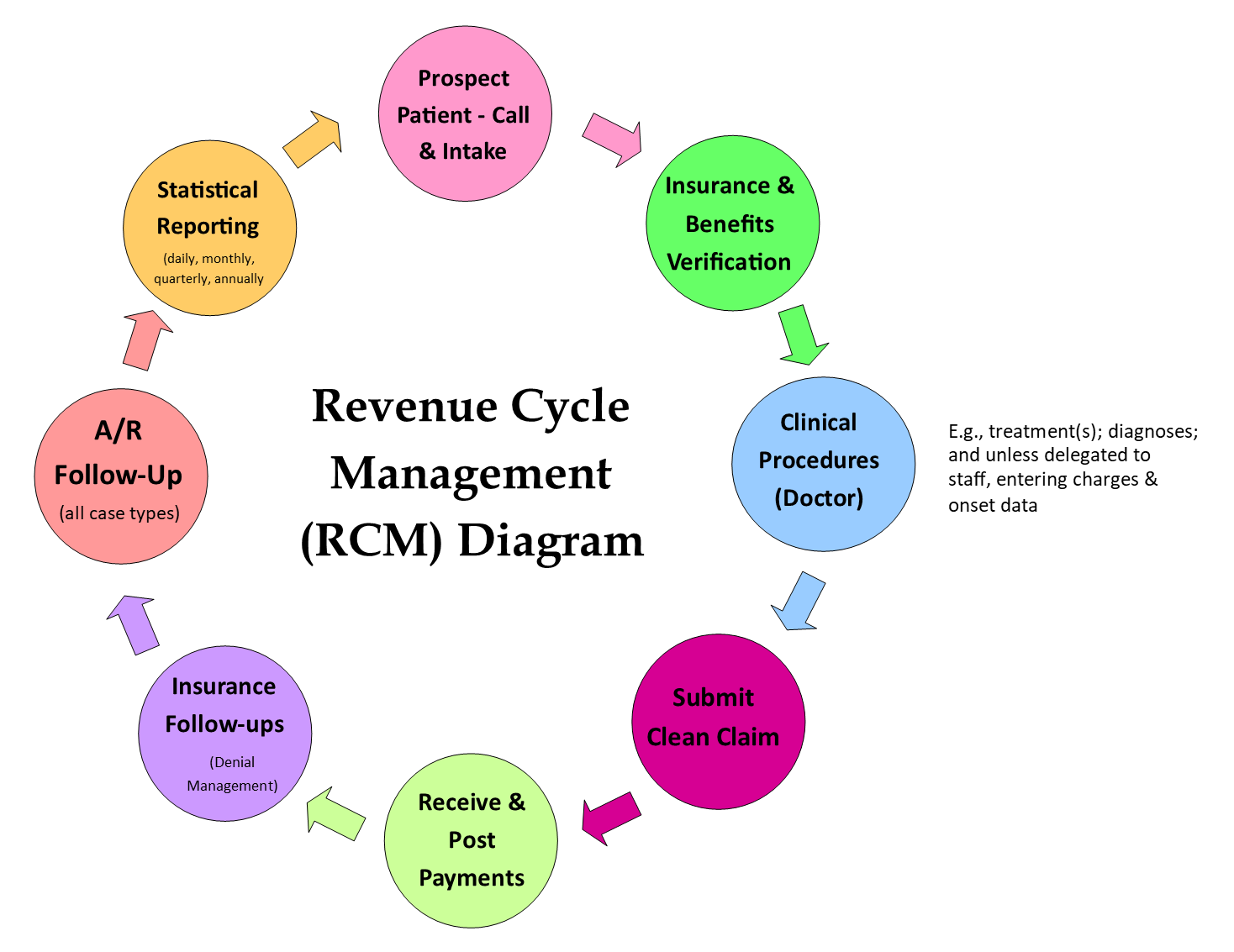
Two weeks ago we hosted a webinar, How to make insurance work for your office using six components. Since then, there has been interest in learning more about revenue cycle management or RCM. You asked, and here it is delivered.

According to TechTarget*, revenue cycle management is the financial process facilities use to manage the administrative and clinical functions associated with claims processing, payment, and revenue generation. The below diagram will give you a visual. The diagram consists of eight elements, listed here:

  1. Prospective patient calls inquiring about services, and making appointment. This is where your revenue cycle begins. Proper intake sets the stage for future revenues.
  2. Insurance eligibility and benefits verification, is critical for you and the patient to determine best estimates.
  3. Clinicals (doctor treatment(s); diagnoses; and entering charges which can be done by doctor or staff, depending on your office procedures.
  4. Clean Claims submission: Mistakes can happen here, but once you are aware of what needs to be done to create a clean claim, you’ll know what to watch for when you review your claims batches prior to sending.
  5. Payment Receipt or denial from remittances, & Payment Posting
  6. Insurance follow-ups on denials/records requests
  7. A/R Follow Ups
  8. Statistical Reporting (we recommend running: Daily Collections; and then monthly/quarterly/annually running stats on New Patients, Patient Visits, Services-Charges, and Collections.

Revenue Cycle Management (RCM) Diagram

The important thing here is to be consistent, meaning every step and each element of the flow must align with the goals and mission of the clinic. For example, a pediatric/wellness practice will have different polices each step of the way for RCM than a sports medicine clinic would. If you are having issues, you need to examine which step in your RCM is bottlenecked, or which step is not in alignment.

Ed’s book, The Goal Driven Business, will help you ground your practice goals and develop and maintain the consistency needed to keep your goals in alignment with the cycle.

Oh, and if you are leaning towards planning for less insurance participation, watch for details on our next upcoming class, Converting to a Patient Self-Pay Model — Preparing for Your Future Practice.

Happy Fourth of July!

Lisa

PS: Download the RCM Diagram

References:
*https://www.techtarget.com/searchhealthit/definition/revenue-cycle-management-RCM

UPDATE: Change Healthcare Cyber Attack

Lisa recently had a phone conversation with United Healthcare for an update on the Change Healthcare Cyber Attack Update Regarding United Healthcare Payments & Remittances.  UHC advises that they are close to a resolution on getting all of the clinic remittances available on the provider clearinghouses, and troubleshooting improper denials.

For general inquires regarding payments and posting, clinics can email  client_assistance@optum.com

Ask Lisa: There’s Good News and There’s Bad News When It Comes To Insurance Networks

picture of a woman
There’s an old joke in credentialing providers. “The good news is you’re now in-network! The Bad news? You’re now in-network.”

Should you be “in-network” with a payer group, or out? It’s a tough choice and not a one-size-fits-all. So what do you do? First, ignore consultants that insist you must be or must NOT be an in-network provider.

Next, determine which companies you are in network with and assess. Do you have a contract? What are your provider obligations? Are you getting reimbursed what the contract’s fee schedule says it will reimburse? Are you currently enrolled in Medicare, and are you a participating or non-participating provider. Are you also currently enrolled as a provider in your state’s Medicaid program?

Make sure you have a profile set up with the national Council for Affordable Quality Healthcare (CAQH) universal provider database that the information is current, and re-attested quarterly. There is no charge to create and maintain your profile in this credentialing database.

Third, audit your patient demographic. Run a report in your practice management software. What percentage of your reimbursement is coming from insurance? What percentage is coming directly from patients? Which payers are you mainly seeing patients from? Are you finding that patients are requesting you be in network with a certain company? Who are the main employers in your area insured with? Are you enrolled as a provider with the Veteran’s Administration in your area?

Fourth, develop a spreadsheet called “Insurance Networks” to help you and your insurance department keep the information organized and up to date.

Once you have a grasp on the above, you’re ready to determine if you need to pursue network participation with additional companies. Treating this like a sales or business venture, you’ll want to have insurance companies coming to you and requesting you be in their network. Remember, it is to their benefit and their obligation to keep their paying policyholders happy. Patients should feel free to call their insurer requesting you be on their plan. Patients have done this, and outcomes have been successful. Why? Because the worst phone call an insurance company can receive is from an upset policyholder who can’t afford to see their favorite doctor who is helping them (that’s you!) because the doctor is not on the plan.

Additional items to consider prior to enrolling in a plan include:, What is the reimbursement rate? What percentage of the approved charges are taken out for contract discounts? Is there a fee to join? What are your provider obligations? Do they want you to participate in their workers compensation, PI programs? (In our experience, opting in to the WC and PI products means no steerage to you, and cut reimbursements). Are there pre-authorizations required prior to care? Is there a visit limit? What is the initial credentialing and re-credentialing process?

Now, you are on all the plans that are making your pocketbook and your patient happy. What do you need to do to maintain your in-network status? You will need to notify a payer with updated clinic information anytime there is a change in information you submitted at enrollment. This includes phone number change, address change, and adding a new provider to the office.

You will also need to ensure you track re-credentialing timeframes for each insurance company. Typically, the recredentialing process for commercial payers is every three years, but since your enrollments with each payer fall on different dates, your re-credentialing due dates will vary. Your Medicare re-credentialing is every five years. Re-validation with Medicaid programs is typically every three to five years, depending on your state’s standards. For example, it is every three years in WI and every five years in MI.

Many of the larger commercial payers such as Blue Cross, Humana, United Healthcare/Optum Physical Health, use CAQH to approve your re-credentialing. Those who do not will send a written communication via mail or email letting you know your recredentialing is coming due and will include the applications and instructions. Make sure to track these dates in your insurance spreadsheet.

We’ve just touched the surface of network plans and credentialing. PM&A can provide specialized and unique advice on making the choice of which networks to join, which to be out of network, and which to run away from!

Email me for assistance with how these processes work for your practice. You may reach me at lisa@pmaworks.com
Increasing your collections through better billing and documentation

Ask Lisa: Payer Notes Request: Now What Do I Do?

stack of medicare insurance paperwork


picture of a womanWith the increase in notes requested from third party payers, more recently Medicare secondary plans, it is good time to review the process once you receive a request.

First, do not ignore the notes request. You can call the payer acknowledging receipt of their request, or simply print or export the SOAP notes from your practice management program and send them to the payer. It is also highly recommended to include the initial patient intake form, or New Episode patient form, exam form(s), and care plan schedule including treatment goals which can simply be specific ADL functions pre-injury.

I also recommend looking to see what the most current Onset date is in your patient profile. Many recurring notes requests are due to the onset date going back two years and more. If this is the case, the patient is due for a re-exam and more than likely a new set of diagnosis codes, and you can include this information in your response to the payer.

If you need a review on what exactly to include in a SOAP note, click on this link HERE to access the checklist that complies with Medicare documentation requirements.

I use this checklist when I conduct onsite documentation reviews.

Questions? Need help with a documentation audit? Ask Lisa – I can help!

920-334-4561

lisa@pmaworks.com

Bravery in Your Chiropractic Office

bravery but funny goal drivenBravery is one of the themes of our practice manager training program.

Brave, Not Perfect is the title of an excellent book by Reshma Saujani, and also from her TED talk with the same title. She states that our culture influences girls to be perfect while boys can be wilder, take risks, and make more mistakes. She encourages women to be braver.

I think this can apply to us all.

Practice Manager Success Story

But this newsletter is about a success story. A story of bravery and integrity. It is also to boast about one of our managers who recently graduated from our Goal Driven Practice MBA program for chiropractic and healthcare offices and demonstrated these values.

As the practice manager, she also does the billing in this office. The chiropractic doctor had treated a patient who had suffered a motor vehicle accident. She submitted the bill to a 3rd party, reducing the what was owed slightly as the doctor agreed to discount some of the services.

The 3rd party company came back and said they could only pay 70% of the bill.

This was the manager’s response:

“Good morning,

“Thank you for letting us know.

“We provided 100% of the care that our patient needed; therefore, we require 100% payment of our services we provided. The original discounted offer of $X,XXX is no longer valid.

“We have decided to pursue the full amount plus interest, along with any court/attorney fees if we haven’t received payment in the full amount of $Y,YYY by March 7th.”

“Thank you,

[Signature]

“Manager of Chiropractic Health Clinic”

She received the full amount before March 7th.

Be Brave — with Integrity and Humor

Be nice, be fair, but first, be brave.

This can apply to scheduling patients at the front desk. It applies to reporting on the patient’s condition and treatment plan options. It applies to promotions and advertising. It can apply to training and coaching for you and your team.

It takes courage to become a doctor, to start a business, and even to work as a professional in an independent healthcare clinic. It takes even more to succeed at doing so.

But hey, it can be fun. And it helps to have some humor.

Our manager made a copy of the correspondence with the claims company with a copy of the check. She gave it as a surprise to her clinic director, who sent me a text with the image of what she gave him. On the copy of the email, she included a handwritten quote from the classic comedy movie Princess Bride:

“NEVER GO AGAINST A SICILIAN WHEN DEATH IS ON THE LINE.”

Stay Brave and Goal Driven — and Have Fun.

Ed

P.S. Our next management and leadership training program begins this summer. We have been retooling it and upgrading it. Only 7 students will be accepted. If you are interested, please get on the Wait List, and I will contact you soon with more information. Click here for Wait List for our next Practice MBA

—————————————————-

If your practice building efforts aren’t taking you to your goals,

there are reasons — many of which are hidden from you.

Find out what they are and how to sail to your next level by getting and implementing my new book, The Goal Driven Business.

goal driven business book for CEO and Office Managers by Edward W Petty.

The Goal Driven Business, By Edward Petty

Goal driven order now button

Ask Lisa – Introduction

Lisa Barnett practice appraisals credentialing and

Lisa J. Barnett

HI!

I’m Lisa with Petty, Michel and Associates.

I’ve been with this wonderful company for nine years and have worked in the chiropractic profession for 17 years.

Do you need help with:

• credentialing new providers and/or your tax ID?
• debugging complex insurance issues?
• documentation/insurance audits?
• practice appraisal?

Would you like these projects completed without you or your team spending time doing it on your own?

Let me do it for you!

Contact me. Because some practice issues shouldn’t wait.

lisa@pmaworks.com

920-334-4561

Find out more about me here

== == ==

“I Give PMA Two Thumbs Up!
Lisa was incredibly helpful and created huge value and peace of mind when she came face to face to my clinic and looked over everything. There are core competencies when it comes to dealing with Medicare and Petty Michel and Associates knows the process and what Medicare will be looking for if you get a notes request or an audit request.

PMA proved to be a huge value and I am thrilled they were able to help my clinic become compliant, which makes seeing Medicare and Medicaid patients more enjoyable and less worrisome. I give PMA two thumbs up.

Matt Kingston D.C.
Madison Chiropractic Solutions

Medicare Providers Re-validation Update Announced

UPDATED FROM JANUARY 24th, 2022

Dear Chiropractors, Office Managers, and Insurance Personnel:

“The Center for Medicare & Medicaid Services is continuing to populate providers’ re-validation due dates from a ‘TBD’ date to an actual due date.

Per CMS (data.cms.gov):

  1. The re-validation data was last refreshed on August 01, 2022.
  2. ‘Adjusted’ Re-validation Due Dates for October 2022 have been added.
  3. The next data refresh is tentatively scheduled for September 1, 2022.
  4. Affiliations now include reassignments as well as Physician Assistant(PA) employment relationships.”

https://data.cms.gov/tools/medicare-revalidation-list

=====

January 24th, 2022

As you may be aware, the Center for Medicare and Medicaid (CMS) made an accommodation during the pandemic regarding your doctor re-validation due date with Medicare. As such, CMS will be adjusting doctors’ re-validation due dates in phases starting this quarter. The Medicare Enrollment online tool, PECOS, has shared information on their homepage that enrollment re-validation has resumed in a phased approach for active providers.

What this means for you: It is critical that you check your re-validation due date and re-validate your Medicare enrollment prior to your due date. If you don’t re-validate, claims will most likely deny when their software program catches a mismatch to enrollment due dates, and you may lose your billing privileges. If you reassign your benefits to your group/Type 2 NPI, you will need to re-validate the group enrollment as well. The re-validation requirement holds regardless of if you are a participating or non-participating provider. There is no fee to re-validate.

CMS has stated they will notify providers via email on file, or mail, approximately three to four months prior to their adjusted due date. You can check your re-validation due date here:
https://data.cms.gov/tools/medicare-revalidation-list

Once you open the page, you will see two due date boxes. You may disregard the original due date shown on that page. The box to pay attention to is the “Adjusted Due Date”. If it states TBD, keep checking every couple of weeks to see if that field has been populated to show your adjusted due date.

How do you re-validate? Use online PECOS (the preferred method), linked here: https://pecos.cms.hhs.gov/pecos/login.do#headingLv1

Or submit a paper 855i application, found here: https://www.cms.gov/Medicare/CMS-Forms/CMS-Forms/downloads/cms855i.pdf

References:
Please see the initial communication here:
https://pecos.cms.hhs.gov/pecos/login.do#headingLv1

Additional related links:
https://www.cms.gov/Medicare/Provider-Enrollment-and-Certification/Revalidations

https://www.cms.gov/files/document/provider-enrollment-relief-faqs-covid-19.pdf

Contact us if you have any questions – we’ve got you covered!
(This includes if you can’t get into your PECOS account because it’s been so long, or because of staff changes, or because you forget your password, call us and we can help you.)

Lisa Barnett
920-334-4561
Petty, Michel & Associates

Email: lisa@pmaworks.com, dave@pmaworks.com