 ICD-10 Code Revisions Start Today October 1
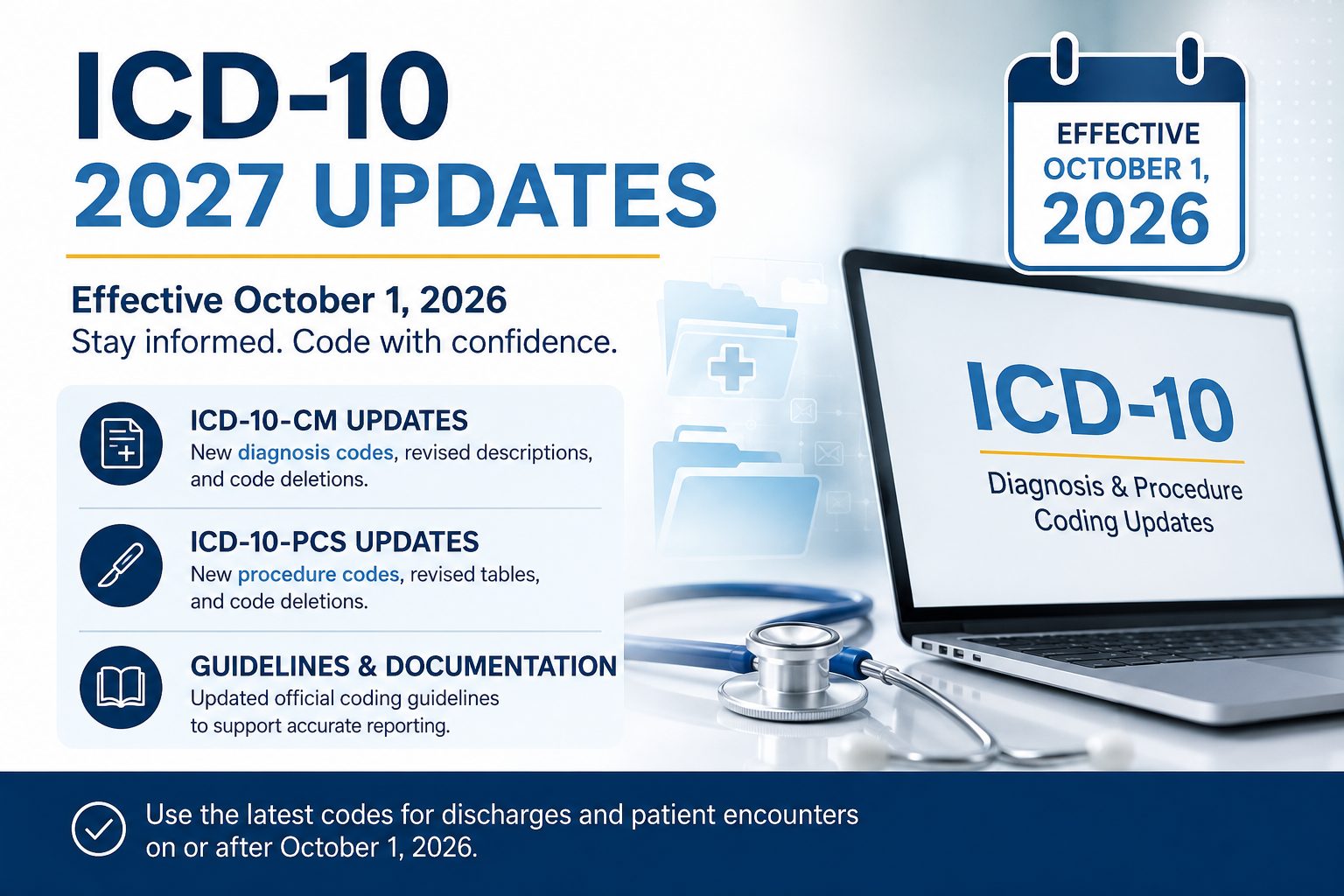
Diagnostic coding is the translation of written descriptions of diseases, illnesses and injuries into codes from a particular classification. In medical classification, diagnosis codes are used as part of the clinical coding process alongside intervention codes for proper reimbursement. The translation is called the International Classification of Disease codes, or ICD-10-CM*. There are annual updates which may include deleting codes, adding codes, and minor edits to existing codes. Keep reading for information regarding ICD-10 changes for 2027.
Although there are only a couple of changes for 2027 directly relevant to chiropractic coding, the diagnostic updates contain 190 new, 30 deleted, and 4 revised codes. The 2027 ICD-10 codes will be used for patient encounters from Oct. 1, 2026, through Sept. 30, 2027.
The updated codes listed below may be relevant to your patient encounter and can be included on your claim form depending on payer group:
1. Plantar Fasciitis Current: M67.A
New subcategories distinguishing right from left foot: M67.A01 (right foot), M67.A02 (left foot); M67.A09 (unspecified/do not use if you get the information from the patient)
2. Plantar fascial fibromatosis Current: M72.2
New M72.20 (right), M72.21 (left), M72.22 (unspecified/do not use if you get the information from the patient)
3. The following Sprain codes could impact your Auto Claims:
Sprain of sternoclavicular joint or ligament
Deleted S23.420, S23.420A, S23.420D, and S23.420S
New: S43.61XA: Sprain of right sternoclavicular joint, initial encounter
S43.62XA: Sprain of left sternoclavicular joint, initial encounter
S43.60XA: Sprain of unspecified sternoclavicular joint (do not use if you learn from the patient which side)
4. M99.01 through M99.05 (segmental and somatic dysfunction) – No Changes
5. M54.2, M54.50, M54.51, M54.59 (cervicalgia and low back pain) – No Changes
Coding and Billing Tips:
- Make sure if you use a code listed above, you relate it in your SOAP note to the patient’s condition as to why they are seeking care.
- If you bill a 98941: 3-4 region adjustment, make sure you have at least three ICD-10 subluxation codes for Medicare and Medicaid (The M99.0X series) on the claim.
- If you bill a 98942: All 5 regions adjustment, make sure you have at least five ICD-10 subluxation codes (again the M99.0X series) on the claim for Medicare and Medicaid.
- Make sure your procedure codes and diagnosis codes align, so you can prove:
- What was done (the treatment procedure)
- What was wrong (the specific diagnoses)
- Why the care was medically necessary
If you are interested in obtaining the entire file of new/updated/deleted ICD-10 Codes, click this link from the Centers for Medicare and Medicaid Services:
https://www.cms.gov/medicare/coding-billing/icd-10-codes#CodeFiles
If you have questions on how these new codes can be implemented in your practice, reach out!
And, BTW… we still make house calls! Not collecting what you are owed? Something just doesn’t seem right with collections and your deposits? Give us a call to discuss whether an onsite visit or video conference works best for your office.
*CM refers to the ICD-10 coding system used in the United States.
Happy National Chiropractic Month! Celebrate the entire month of October!
Lisa
Credits:
- ChiroCode
- Center for Medicare and Medicaid Services (CMS)
- chiropractorbillers.com


 While at my desk on my physio ball, I was reading Chiropractic Economics annual Salary and Expense Surveys and took a deep dive into the Billing & Collections (B&C) category. I was jarred by a pattern over the past five years which makes me continue to fear that we are falling behind. The surveys in B&C category are a wake-up call that proves we can no longer ignore the impact of decreasing third-party reimbursements.

 As a follow-up to our previous compliance articles, I thought what I’d do this month is put together a FAQ list for my dear readers and call it Compliance 201. Keep reading to learn about upcoming new requirements in the compliance/cybersecurity world to keep you at least safe-guarded when you are hit with a cybersecurity incident. Special thanks and credit goes out to ChiroArmour and Dr. Scott Muensterman for his research and presenting at the Chiropractic Society of Wisconsin Fall Experience last month on some of the content in my FAQ.