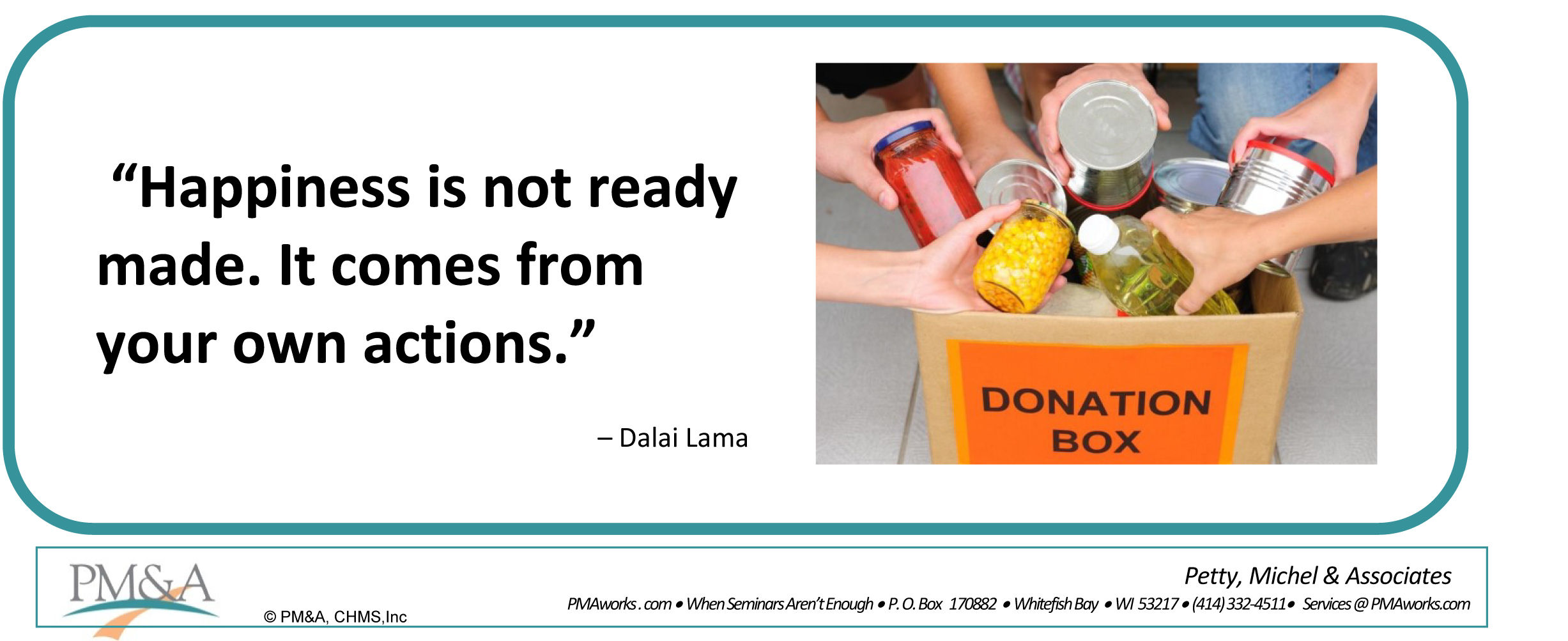
“Find your voice, and inspire others to find theirs. Don’t ignore that longing to make a difference”
~Stephen Covey
For a printable copy of this tent poster click the link. [LINK]
“Find your voice, and inspire others to find theirs. Don’t ignore that longing to make a difference”
~Stephen Covey
For a printable copy of this tent poster click the link. [LINK]
“Dreams are free.
Goals have a cost. Time, effort, sacrifice, and sweat.
How will you pay for your goals?”
~Usain Bolt
For a printable copy of this tent poster click here email us.
Petty, Michel and Associates recently attended the Chiropractic Society of Wisconsin’s Annual Fall Summit. The Fall Summit is a great time to get together with others in the profession and share stories of the lives we change on a daily basis.
We always manage to have some team camaraderie also. Saturday as the sessions began to wind down we held our annual Petty, Michel and Associates photo session. Shown below are a few of our favorite shots.
Unlike many of the offices we work with our team is scattered across the country which makes it challenging to physically come together as a team. This year we were able to accomplish having everyone present, and a few extras, for cocktails at the Kalahari’s Diamond Cut and our team dinner at Wally’s House of Embers in the Dells. Lots of chatter, laughter and love shared with all!
Those Blues Bros…. sure know how to treat their team!
Thanks Dave and Ed!
Linda
Team PM&A (Petty, Michel and Associates) recently attended the Chiropractic Society of Wisconsin Fall Summit at the Kalahari in Wisconsin Dells.
We are pleased to announce the winner of our succulent dish (door prize): Dr. Chelsea Poland. She is following in her father’s footsteps and she practices in Wausau. Congratulations Dr. Chelsea!
The weekend was filled with meeting and greeting chiropractors and their staff. It was fun to see so many of our clients, some of whom I had not yet had a face to a name, meet new docs and their teams, and reconnect with old friends and colleagues to share hugs and spread the love of our profession.
A doctor once told me that no other practice(experience) will ever be the same as my first. I’ve found this to be very true. We hang on to those memories of that first practice. This weekend I was able to reconnect with the first associate Dr. Culp(my first practice) brought into his office, circa 1987. We reminisced of the “old days” and brought each other up to date on our journeys over the past 3 decades.
All in all, it was wonderful to see everyone again and share the weekend with you!
“The world is changed by your example, not by your opinion.”
~Paulo Coehlo
For a printable copy of this tent poster click here. [LINK]
“Champions aren’t made in gyms.
Champions are made from something they have deep inside them – a desire, a dream, a vision.
They have to have the skill, and the will. But the will must be stronger than the skill.”
~Muhammad Ali – 1942-2016
For a printable copy of this tent poster email us.
“I have just three things to teach: Simplicity, patience, compassion. These three are your greatest treasures.” ~Lao Tzu
For a printable copy of this tent poster click here [LINK]
Download a PDF of this article
Hello Friends in Chiropractic!
Hope you had an awesome summer and took several opportunities to soak in some UV and Vitamin D.
This month I’d like to both expand on my July Medicare Documentation article and coach you on self-auditing evaluation and management (E/M) coding for reimbursement. Are you consistently under-coding your E/M services? It is not benefiting you to do this because more than likely you’re meeting required elements and not getting the best reimbursement available.
So, what exactly does an auditor, be it Medicare or a Commercial Payer look for in determining reimbursement for your evaluation and management services? It is pretty simple and based on both quality and as it turns out, more importantly, quantity of certain elements. Let’s look in depth how you can self-audit your E/M services*:
First, a coding history and review. In 1992, the current E/M codes were introduced as a result of a ten-year study by CMS(Centers for Medicare and Medicaid Services) and the AMA(American Medical Association). Then in 1995 and 1997, CMS and the AMA developed documentation guidelines (DG) for use of these E/M codes.
Without re-inventing the wheel, let’s lay out how you determine which code to use for your patient evaluations and management of care. To review,
Charting out information from CMS and ACA’s ChiroCode book, here is what we have as quantifiable elements to determine which code to bill for. Keep in mind that Necessity of Care drives our discussion below.
History, Exam, Complexity of decision-making are the three main elements in the evaluation and management note.
Let’s now diagram out for you each code and corresponding description of each element, using both New Patient and Established Patient criteria. What differences do you see? Which descriptions share commonality?
NEW PATIENT
| CODE | HISTORY | EXAM |
COMPLEXITY OF DECISION-MAKING |
| 99201 | Focused/Minor severity | Focused | Straightforward |
| 99202 | Expanded/Low-to-moderate severity | Expanded | Straightforward |
| 99203 | Detailed/Moderate Severity | Detailed | Low |
| 99204 | Comprehensive/Moderate to high severity | Comprehensive | Moderate |
| 99205 | Comprehensive | Comprehensive | High |
ESTABLISHED PATIENT
| CODE | HISTORY | EXAM |
COMPLEXITY OF DECISION-MAKING IN MANAGEMENT OF CARE |
| 99211 | No key component(s) required | No key component(s) required | No Key component |
| 99212 | Expanded/Low-to-moderate severity | Expanded | Straightforward |
| 99213 | Detailed/Moderate severity | Detailed | Low |
| 99214 | Comprehensive/Moderate to high severity | Comprehensive | Moderate |
| 99215 | Comprehensive | Comprehensive | High |
Building on that, here are the quantified components indicating the minimum number of each component’s required presence in the note to code appropriately and at the maximum level:
NEW PATIENT
| HISTORY | EXAM |
COMPLEXITY OF DECISION-MAKING |
||||||
| Code | Chief Complaint | HX of Present Illness | Review of Systems | Past Family/ Social HX | Exam (1997 DG) | Diagnoses | Data to be reviewed; # of Complaints | Risk Factors |
| 99201 | 1 | 1 | N/A | N/A | 1 in affected body area | 1 | 1 | Minimum |
| 99202 | 1 | 1-3 | 1 | N/A | 1-5 | 1 | 1 | Minimum |
| 99203 | 1 | 4+ | 2-9 | 1 | 6-11 | 2 | 2 | Low |
| 99204 | 1 | 4+ | 10+ | 2-3 | 12+ | 3 | 3 | Moderate |
| 99205 | 1 | 4+ | 10+ | 2-3 | All components | 4 | 4 | High |
All 3 elements are required in the new patient note to consider reimbursement: History, Exam, Complexity
ESTABLISHED PATIENT
| HISTORY | EXAM |
COMPLEXITY OF DECISION-MAKING |
||||||
| Code | Chief Complaint | HX of Present Illness | Review of Systems | Past Family/ Social HX | Exam (1997 DG) | Diagnoses | Data to be reviewed; # of Complaints | Risk Factors |
| 99201 | 1 | N/A | N/A | N/A | N/A | N/A | N/A | N/A |
| 99202 | 1 | 1-3 | N/A | N/A | 1-5 | 1 | 1 | Minimum |
| 99203 | 1 | 1-3 | 1 | 1 | 6-11 | 2 | 2 | Low |
| 99204 | 1 | 4+ | 2-9 | 2+ | 12+ | 3 | 3 | Moderate |
| 99205 | 1 | 4+ | 10+ | 2+ | All components | 4 | 4 | High |
Two (2) out of the 3 elements are required in the established patient note to consider reimbursement: History, Exam, Complexity
As you may deduce from the above established patient table, 99211’s are rarely used in chiropractic offices. Can you see why?
Additionally, give your current score an extra two points for management of care, i.e., reviewing old records and summarizing in the note stability/worsening of condition, or, two points for obtaining history from someone other than the patient. Add one point for diagnostics performed and reviewed, (i.e., x rays).
Finally, make sure to attached your -25 modifier on all E/M codes if you are giving a CMT on the same DOS.
Have a specific patient in mind and you’d like to find out if you coded and billed at the most appropriate and highest level? Contact me on how you can qualify for a complimentary audit! Call 920.334.4561 or email lisa@pmaworks.com
Sincerely in Chiropractic,
Lisa Barnett,
PM&A Coach and Consultant
Where Managing by Numbers and Progress Says It All.
My purpose is to be the Best Chiropractic Advocate in the World
*EHR systems may already have built-in features to automate the components for you via their macros/templates.References:
List of Components:
History of Present Illness – Elements:
Location (example: left leg); Quality (example: aching, burning, radiating pain); Severity (example: 90 on a scale of 1 to 100); Duration (example: started 3 days ago); Timing (example: constant or comes and goes); Context (example: lifted large object at work); Modifying factors (example: better when ice/heat is applied); and Associated signs and symptoms (example: numbness in toes)
Review of Systems:
Constitutional Symptoms (for example, fever, weight loss); Eyes; Ears, Nose, Mouth, Throat; Cardiovascular; Respiratory; Gastrointestinal; Genitourinary; Musculoskeletal; Integumentary (skin and/or breast); Neurological; Psychiatric; Endocrine; Hematologic/Lymphatic; and Allergic/Immunologic
Past Family/Social History:
Past history includes experiences with illnesses, surgeries, injuries, and treatments/medications. Family history includes a review of medical events, diseases, and conditions that may place the patient at risk. Social history includes an age-appropriate review of past and current lifestyle activities.
To download the article in it’s entirety click the here [LINK]
“Train people well enough so they can leave… treat them well enough so they don’t want to.”
-Sir Richard Branson business magnate, investor and philanthropist.
For a printable copy of this tent poster click: [LINK]

We know all too well how keeping abreast of all the changes in the insurance world can sometimes be overwhelming for your practice so we wanted to simply help you out by sharing some recent information regarding ICD-10 codes.
ChiroCode Institute recently published the changes to ICD-10 Codes that are going into effect October 1st. While there are thousands of code changes, we have listed below the codes most relevant to chiropractors. To download a printable copy of this list click here [ICD-10-Changes-Oct-2016]
ICD-10 Reference:
Gwilliam, Evan M, DC MBA BS CPC CCPC NCICS CPC-I CCCPC MCS-P CPMA, ChiroCode Institute
If you have any questions regarding these changes Petty, Michel and Associates would be glad to help guide you in the right direction. Please email to services@pmaworks.com or call us at 414-332-4511. We are here to help!
“People are like bicycles…they can keep their balance only as long as they keep moving.”
~Albert Einstein
For a printable copy of this tent poster visit: Einstein Bicycle balance
“The way we’re running the company, the product design, the advertising– it all comes down to this: let’s make it simple, really simple.” Steve Jobs (Walter Isaacson) 1.
If you could simplify your business even more than it is, you would make more money and have less stress.
There is a direct relationship between simplicity and productivity, and an inverse relationship between complexity and productivity.
The most successful businesses have capitalized on this fact. This was one of Apple computer’s unique selling propositions – to focus on the simple and eliminate what wasn’t essential.
From its inception, the Apple Macintosh computer was designed with simplicity in mind. Other companies have focused on simplicity: McDonalds order via drive-through, Ikea with its simple design, and Amazon with one-click ordering.
Siegal-Gale is an international marketing firm that has studied simplicity in business and has been able to profile and rank businesses according to their simplicity. They call this the Global Brand Simplicity Index and have found that those companies that rank the highest, also outperform companies that rank as more complex. Their report states (2):
You want to simplify the experience your chiropractic (or other) patient has in your office. From the first phone call, first appointment, examination, report of findings, patient finances, and scheduling, discover ways to simplify your procedures.
Your intake forms may be redundant or complicated, there may be too many rote statements or “scripts” for your staff to say to patients, or there can be extra pathways that your patients have to travel, like so many rabbit trails, where they can get confused and the flow slows down. Staff, or doctors, may have too many decisions to make at each visit.
For example – what extra therapy should the patient receive? Not knowing, I have heard support staff simply ask the patient what therapy they wanted today, as if they were ordering a latte. And as we know, there are definitely too many codes and documentation rules to follow for the doctor. Going total cash is one solution, but intelligent software, dictation, and scribes are other solutions.
Many, if not a majority of the more profitable offices that I have worked with over the years practiced what could be called “straight” chiropractic. The straight practice (no additional modalities) works well, when it does, because its procedures and flow are simple. It is usually more profitable because extra overhead hides in the complicated.
Steve Jobs again: “People think focus means saying yes to the thing you’ve got to focus on. But that’s not what it means at all. It means saying no to the hundred other good ideas that there are. You have to pick carefully. I’m actually as proud of the things we haven’t done as the things I have done. Innovation is saying no to 1,000 things.”— Steve Jobs, WWDC 199(3)
I am not advocating no supplements, no exercise physiology, no electrical therapy. But to be honest, how much of this gets used in your office? I know offices — right now, and have known hundreds more, that have equipment lying around unused or bottles of vitamins collecting dust on overlooked shelves.
You have to embrace first only those unique outcomes that you can deliver. Work backwards and add only the most critical steps. “Begin with the end in mind”, as Stephen Covey observed in high producers.
For a chiropractor, this means adjust. (For other professions: what is your core function?) One of the first doctors I worked with when I moved to Wisconsin in 1988 worked closely with Clarence Gonstead. His license plate read: I ADJUST. He had a full practice, chuckled a lot, and seemed to make a nice living.
Start with this first, and then add additional services carefully – if you want.
Secondly, educate. Educate your patients, your team, and your community. But your education has to be simple. Your message has to be concise. One doctor we have worked with over the years has a waiting list practice, with nonstop patient, and even some MD, referrals. He doesn’t do a 4-day report of findings and he doesn’t do a 2-day report of findings on new or reactivated patients.
He just very intently adjusts and talks about the adjustment and what he is adjusting. From there, he then also gets into other health topics such as toxins (vaccinations), nutrition and weight, and exercise.
This is a good model: start with your core service and move out from there. For chiropractic education, you can use simple metaphors like “pinched nerve,” “garden hose,” “rusty gate hinge”, and how the body fighting toxins creates heat (inflammation), etc.
And keep educating your patients with care classes, lending library, table talk, movie nights, special speakers, case histories, and testimonials.
And do this first and continually with your support team. This is not done enough!
One method to discover what to simplify is to regularly practice your procedures. For example, do a rehearsal of what happens when a new patient comes into your office on their first day, 2nd day, 3rd day, etc. You will flush out confusions, redundancies, and extra motions that complicate the patient experience.
Outside of your office, the same applies. Educate your community on what you do. What is your simple selling proposition that people want?
For example, someone asks you “what do you do?”: “Well…
we help to improve your health, we relieve your pain,
and we increase your game – naturally!
No drugs, no surgery, and we guarantee you have fun in the bargain.”
How’s that? A simple and a desirable unique selling proposition (USP). (You can use this in all your marketing communications – no charge!)
Lastly, there is fun. You can and should have fun doing this. And so should your patients and support crew.
Patients will mostly remember how they feel after leaving your office. Was it a pleasant, enjoyable experience? Was it fun?
Practice life can often bring about a kind of serious hue over the office. Administrative errors, missed appointments, a dissatisfied patient, a staff member out for the day, too many bills – all of this can create an extra layer of anxiety or seriousness in the office.
Fight this by being grateful for all the wonderful outcomes of your patients. Work on having a “the gratitude attitude.”
And as you simplify your processes, you will find that everyone’s attention becomes freer to enjoy helping each other — to help the patients.
Simple is more fun and profitable.
So here is a question for you: Which comes first, the fun or the smile?
Well, you can kick things off right now… right now with a smile. Actually, smiling is simpler and requires less muscles than frowning.
Frowning is complex, so start right now by smiling.
Try it.
See? Already your business and life is simpler and better – and funner.
-Ed
(To help you keep things simple, you can order two magnets of the above image for your office, courtesy of PM&A while quantities last. Click here to order. We will mail them to you at no charge.)
For a printable copy of this article click [The Power of Simplicity]
(Download a PDF of this article)
Most attention is usually put on marketing procedures. That is fine but when marketing fails, it is usually because the procedures just didn’t get done, or only half done. And this is because no one was put in charge of them and given the time to execute them. Pretty obvious, but easily overlooked. This was the essential theme of the Marketing Manager System I published in 2000. It is out of print now but much of the info is on our PM&A Member’s site.
And underneath it all is motivation. Who really wants to do the marketing? You may get excited from a seminar or about an event you have planned. But motivation can dissipate quickly and too often we are not active enough in keeping ourselves and our teams passionate and determined about providing more and better service.
So all three levels or echelons of marketing need to be in place. What follows is a brief list to help you set up effective marketing activities for the next 4 months.
QUALITY SERVICE AND CARE COMES FIRST
It goes without saying but it needs to be said – from an executive point of view, quality care and service comes first. Ultimately, an office that gives “WOW” service and produces extra-ordinary outcomes generates enough word of mouth to create a waiting list practice. Think of Clarence Gonstead.
MOTIVATION
Plan weekly motivational talks at your team meetings and major motivational activities each month. These can be discussing case successes, watching Doctored, or doing a free clinic for the underprivileged. Keep the saw sharpened. Keep reminded of WHY you all are doing what you are doing and your greater purposes. This is the fire that drives the engine of your practice.
MARKETING MANAGEMENT
Someone to Coordinate
Delegate someone to be the marketing coordinator. You could have someone for just internal and someone for external events. These roles are only a few hours per week as coordination jobs. The actual work is delegated as separate duties so that everyone on your team has a role in marketing. Your entire office is the marketing department but it helps to have duties assigned just like you do for the front desk or billing dept.
So Many Procedures, Which Should You Pick?
Select the marketing activities that have worked for you in the past and add a few at a time. Pilot each and see what works better for you. Marketing is all about testing. Find out what works and then put it in a system. Keep it simple. Get your marketing systematized and departmentalized and delegated.
Time to Plan
Part of marketing management is setting aside time to plan and coordinate upcoming events. At least monthly, schedule time aside to review past promotions and plan new marketing for the next few months.
Calendar
Make sure you have a large calendar to post all of your upcoming promotions.
MARKETING PROCEDURES
COMMUNICATION CHANNELS
All your marketing does no good unless it is communicated. Marketing IS communication, so keep the communication going – in and out of the office. Make sure each month you promote via team members, “table talk”, e-newsletters, posters, Facebook, etc.
Recurring Procedures
The most important marketing activities are your usual, recurring procedures that you do on a daily and weekly basis. Many of these are already embedded in your routine procedures. Because they are done routinely, the usual and everyday procedures can be overlooked or not given the importance needed. For example, just answering the phone can make a big difference. Don’t let the routine become the mundane. Practice new ways to have fun with your recurring procedures.
Community Services
This is what I call the free or discounted services you provide in your community. Health screenings, workshops, networking events, setting up alliances with dentists, for example, or just conspicuously showing up at the Lions Club breakfast. I would delegate this to one person and give them 4-6 hours per week to schedule events and to help coordinate who attends these events. There is a good deal of administration in this role. I have seen events scheduled a year in advance that generated new patients and referrals from alliances that come in years after they were initially set up because the relationship was well maintained.
Internal Workshops.
Internally, you can also schedule special classes over the next 4 months, including “Natural Approaches to Flu Prevention”, “New Healthy Ways to Lose Weight and Get Fit This Winter,” etc.
Google Reviews
If you get 4-5 star reviews on Google, you will get new patients. This is proven. It is true. Assign it to someone and do it. Now. It may take a few months, but if you do it, they will come.
Patient Education: Table Talk and the New Patient Care Class
In my opinion, educating your patients is more important than adjusting or treating them. Not all patients are easy to educate, but all can be gradually persuaded to understand the value of your services: what they do, how they work, and why they are important. Educated patients refer more. They stay with you longer. They are more enjoyable to care for. And, most importantly they are healthier. Table talk is an excellent practice with each patient. But your new patient care class is a proven winner. It just takes your intention to do it. Two times per month. Do with the fervor of a Sunday sermon or with the frankness of a fireside chat with old friends. It will boost your practice and you. And… how much does it cost? That’s right… nothing.
Care to Share
There are many ways to do this program but I like it because it encourages your patients to help you get the word out about their successes so that others do not have to suffer as long as they did. It gets them to help their community. It taps into their greater purposes and gives them an opportunity to help others. Set up a monthly drawing and give away a modest prize or two. Enter the drawing by submitting a Google review, by bringing someone into the office for a no charge consultation, or by getting a workshop set up in their place of employment. Run the program monthly or every other month.
Special Promotions
These are the big events that can be fun and energizing which you hold in your office every couple of months or so. I list some ideas below.
OCTOBER
October is National Chiropractic Health Month. (The International Chiropractic Association and the American Chiropractic Association once recognized October as Spinal Health Month, but now it is simply called Chiropractic Health Month.) This can give you a reason to do many different promotions. For example:
Child Health Day
Under a Joint Resolution of Congress, the President of the United States has proclaimed National Child Health Day every year since 1928. It was originally celebrated on May Day, May 1, each year until 1960, when the date was moved to the first Monday in October. Use this as a great opportunity to have a Kid’s Day. (Google it. Many differen sites offer suggestins.)
National School Lunch Week
National School Lunch Week takes place on the second Sunday in October (http://www.nea.org/tools/lessons/48412.htm ) You could have a workshop on fast and nutritious meals for kids targeting parents and moms.
Awareness Weeks
If workshops aren’t your thing, then set aside one week to focus on a particular condition, such as headaches and call it “Headache Awareness Week”, or “Pinched Nerve Awareness Week”, “Neuropathy Awareness Week”, etc. Schedule one a month where possible for the next 5 months as part of your Community Education Program. Detail procedure with posters in your Marketing Manager System Toolkit and on your PMA Members site under: “Community Education.” Offer free consultation, screening, and information regarding the condition.
Crazee Dayz
Select a day and make it special for your patients. Only one day a week is necessary otherwise it’s not special. It can be once per month or every week. Serve extra treats. You can have the staff dress out of uniform coordinated to the day. This can add some extra fun to the office and help with retention and long term referrals.
Chiropractic Opportunity Week (“The doctor is having a COW.”) (patient referrals and advertising new patients) Free consultation, exam, and x-ray if needed.
Hair Dresser/Beauty Salons/Spas
Kids and Halloween Party
With Casper as inspiration, a kid’s Halloween party with a friendly ghost theme has the right mix of tricks and treats. Invite the young ghouls to come dressed up, but you can also have them make ghastly masks as part of the fun. Other ideas include spooky decorations, scary snacks and a friendly ghost hunt.
NOVEMBER
Thanksgiving Turkey Drawing Poster
Thank a Veteran Day
Veterans Day – November 11. It is no secret that the physical and mental health support veterans receive is inadequate. This good time to set up a promotion honoring those who served. Special promotions including free or discounted services or donations to local Veterans organization. (More info: http://en.wikipedia.org/wiki/Veterans_Day )
Donation Drives (patient referrals, advertising new patients)
Holiday time always brings an increased demand for helping those less fortunate. Within your office set up a collection area for any of the following programs and promote it in your newsletter.
Deer Widows Week
During hunting season or first week of December offer complimentary massage for your patients who refer in a new patient
Girl’s Night Out
This is a shopping/gift exchange that can take place in your office. Have patients who have little businesses set up booths in your office and stipulate that they have to bring guests. Supply some refreshments and promote as great way to “Shop Local” for Christmas presents. Enlist the help of massage therapist, local spas and direct marketing consultants. You can provide free screenings.
DECEMBER
Holiday Coupons – Gifts Certificates (patient referrals)
Poinsettia Give Away
Give away free poinsettias, one per family. Include in the cards a gift certificate for family members or friends. (See Member’s site for gift card)
Saturday with Santa
Appreciation to External Referral Sources
Deliver a fruit basket or other present personally during December with a card of thanks and mention how you are looking forward to another year working together. This would go to any location where you had an external community services type of event, such as a screening or workshop. Include: “Looking forward to working with you next year.”
Health Never Takes a Holiday
Post a sign in your office in December that “Health Never Takes a Holiday” and review and re-schedule patients through December to January.
Giving Tree/Angel Tree
The Giving Tree/Angel Tree Project is a great way to bring community awareness to your office. It is a simple project that gets your patients be involved to help others where they might not otherwise have the opportunity to do so.
JANUARY AND FEBRUARY
Winter Workshops and Movie Nights – Internal
These, of course, can be done anytime of the year. Whether it is how to make organic soup for the week, or a talk on vaccinations with an MD, winter has been a good time for internal events. Weight loss, fitness, and food have seemed to be popular. These should be planned by December or even November. Ideally, plan your workshops with a guest speaker such as a holistic MD, biological dentist, midwife, etc.
We have a great deal of information on our PMA member’s site for those of you who are active clients, much of it compiled from the Marketing Manager System I published quite a few years ago. There you can find readymade posters and detailed information on how to do many of these projects.
Yes, I know some of the posters are old but we are not in the graphic arts business and neither are you. But they are on Word files and can be easily changed. A simple graphic and title is all you need with the specifics in bullet points. Depending on the level of your program, we can also put together simple posters to help promote your particular project.
If you are not active with PM&A, you can still find a great deal of info on our web site at www.pmaworks.com/observations.
With shared intentions to get more people healthier and smarter about their health!
Ed Petty
September, 2016
Welcome back to Wisconsin Phyllis!
We are excited to have Phyllis returning to Wisconsin to join us at the Chiropractic Society of Wisconsin Fall Summit.
The Fall Summit will be held October 21st through the 23rd at the Kalahari Resort in Wisconsin Dells.
Are you and your team registered? If not you will want to as Phyllis will be presenting to doctors and staff all day Friday. She will be covering the following topic:
“The Secrets of Referrals and Retention”
What’s the secret? The pixie dust? The magic potion to creating patients that stay pay and refer for a lifetime?
In this class you will walk away with what makes a patient pay and value their chiropractic care. This interactive class will help you create great customer service and learn easy, solid systems and procedures that will take your practice to the next level. Included is low stress, low cost marketing ideas that you can implement on Monday morning.
For more information on Phyllis visit: Our Experts
To register for the CSW Fall Summit visit: CSW Fall Summit 2016
“You can make more friends in two months by becoming interested in other people…
…than you can in two years by trying to get other people interested in you.”
~Dale Carnegie, How to Win Friends and Influence People
For a printable copy of this tent poster visit: Making Friends
Actually, seems much longer as our relationship goes back to the great and honorable Dr. Gaylord Culp of Lake Geneva. And what a grand privilege that was – he was a master Chiropractor.
And then I bumped into you again as the office manager at the renown Wheelock Clinic in Burlington. WI. A dynamic multiple-doctor office that is still going strong.
You certainly had good experiences with solid chiropractic with these doctors and at these offices so there was no doubt in my mind as to your credentials. You were Chiropractic Assistant of the Year here in Wisconsin too… back a few years it was!
A person can have credentials and training but these are minor compared to the exceptional and outstanding qualities of character that you have demonstrated. It is too rare to find people who have the personal ethics and courage and selflessness to continue to provide support services through thick and thin, day and night, when needed, as needed, year after year.
In a quiet corner of the world your industriousness has been unflagging…and directly and indirectly because of you and your work, hundreds if not thousands of people are living better lives through better chiropractic offices.
You are always ready to provide us consultants, our clients, and our company with fast service any time.
We don’t say this enough, but your continued support has made a difference to all of us and so many others. But here it is, on your 15th Anniversary:
Thank You Linda. We love you.
🙂
Mexico Surfing Trip with Chiropractors from around the globe!
A little movie from bits of video casually taken, and below, some photos as well.
Gracias!
June, 2016
REMINDER: Wisconsin License Renewal Credentialing Requirements
Doctors of Chiropractic (DCs):
Starting in October 2016 and prior to December 14th, renew online: DC Renew
Chiropractic Technicians (CTs):
Starting in October 2016 and prior to December 14th, renew online: CT Renew
Chiropractic Radiological Technicians (CRTs):
Starting in October 2016 and prior to December 14th, renew online at: CRT Renew
TIP: Keep your transcripts and file them safely, in the event of a continuing education audit.
All licenses (DC, CT, CRT) expire on December 14, 2016 at midnight.
Questions? Contact Lisa Barnett, PM&A Consultant, at 920-334-4561
~~~~
Links
DC Approved Courses: https://dsps.wi.gov/Default.aspx?Page=b74564c8-7d6c-4258-9809-cd118336a9f5
DC Renew: https://online.drl.wi.gov/UserLogin.aspx
CT Approved Course Listing:http://dsps.wi.gov/Default.aspx?Page=830a2718-a0f7-414c-8e97-2481f983bc78
CT Renew: https://online.drl.wi.gov/UserLogin.aspx
CRT Approved Course Listing: https://dsps.wi.gov/Default.aspx?Page=bcfb3543-eb0a-46bf-ba89-8f1fe6d84325
CRT Renew: https://online.drl.wi.gov/UserLogin.aspx
Printable Version of this quick checklist of requirements. [LINK]
HIPAA, Covered Entity, OSHA, HITECH – – Compliance. What’s happening in the world of compliance and why do you as a chiropractor need to be educated and remain in the know? Find out below . . .
First and foremost, according to the Health and Human Services (HHS), chiropractors are included in the covered entity category, and this is regardless of whether or not you have received Electronic Health Records incentive monies. Covered entities are required by federal law to comply with all areas of protected health information and employee safety standards. Impact of non-compliance? In February 2016, a covered entity was fined $239,800 for non compliance.
Further, according to a March 2016 survey among small practices designated as covered entities, 60 percent of the 900 plus professionals surveyed are still unaware of pending compliance audits, and 58 percent have not appointed a securities/privacy officer in their practice. Audits to our profession are forthcoming, and we cannot opt out. Keep reading on how to safeguard yourself and your practice. Also keep in mind that it takes approximately 40 to 50 hours to develop and secure a compliance program.
The three main areas of compliance you need to be aware of, educated in, and be an active participant include: HIPAA, OSHA, and IT Securities.
Health Insurance Portability and Accountability Act
The Health Insurance Portability and Accountability Act (HIPAA) law of 1996 was enacted to improve the portability and accountability of health insurance coverage, and it brought individual privacy rights to patients and requires that we notify them of their rights. It also serves to eliminate fraud, waste, and abuse in healthcare. The focus here is to safeguard your practice by securing personal (patient) health information (PHI) and personal identifiers, be it paper or electronic (ePHI). This can include data encryption, secure messaging, compliant Cloud storage, compliant software, and unique password setups. One of the areas I assess when I visit a clinic is locating where the patient paper files are kept and if they are well out of viewing from others.
Your HIPAA requirements to be compliant at the clinic level include:
OSHA
The United States Occupational Safety and Health Administration (OSHA) Act was signed by President Nixon in December 1970. It is designed to protect worker safety and promote healthy work environments. Some of you Docs have been involved in workplace safety and onsite workplace assessments in factories. Kudos to you! You were advocating OSHA’s mission by: Educating your client and their employees on workplace safety by conducting posture and ergonomic assessments, and finding the best ways for workers’ compensation patients to get back to work and continue contributing safely and appropriately within their restrictions.
At the clinic level (can be delegated), your requirements to meet OSHA requirements include:
Information Technology (IT) Security/HITECH
The Health Information Technology for Economic and Clinical Health (HITECH) Act, enacted as part of HIPAA and the American Recovery and Reinvestment Act of 2009, was signed into law on February 17, 2009, to promote the adoption and meaningful use of health information technology. Section 1176(a) of the Social Security Act was revised during this timeframe to allow for significant monetary penalties up to $1.5 million for breaches/violations of protected health information. However, an interim revision (later known as The Omnibus Rule) set prohibitions on enforcing such significant monetary penalties if it was found in investigation that the covered entity did not know and with the exercise of reasonable diligence would not have known of the violation. In these cases, the breaches were punishable under the lowest tier of penalties, and further, prohibited the imposition of penalties for any violation corrected within a 30-day time period, as long as the violation was not due to willful neglect. A final ruling in January 2013 reiterates all of the above standards.
Your responsibilities to get IT Securities compliant include:
Impact of non-compliance? Another covered entity was fined $25,000 for posting patient information online.
Feeling overwhelmed? We can help. Contact me on how you can get an initial Compliance Assessment and a Medicare Documentation Assessment with a Report of Findings sent to you, for a ridiculous low price of $299!*
References:
*Mileage cost may apply.
I just watched Vaxxed, a new movie about the relationship between vaccinations and autism, the CDC (a federal agency, the Center for Disease Control and Protection), and Big Pharma. It has limited showing across the U.S. and is currently playing in Milwaukee until today (June 30th). (Downer Theater)
Most of the film quotes M.D.’s and PH.D’s, except for a few stories by the parents of vaccine injured kids. Some of the clips show M.D.’s over time as they discover a link for themselves.
A key element in the film centers around an admission of the key research scientist, Dr. William Thompson who, after working for the CDC, claims that he is now a whistleblower. He says that data was manipulated and evidence was destroyed to cover-up a direct link between certain vaccination protocols and autism. “I have a boss who is asking me to lie… The higher ups wanted to do certain things and I went along with it…” [paraphrased]
After the movie I did a fast Google and found: “Autism rates soar, now affects 1 in 68 children…” from USA Today, 2014. It occurs 4-5 times more in boys than in girls, according to Wikipedia. In 1995 it was 1 in 500, and back in 1975 it was 1 in 5000. (autismspeaks.org)
Vaccine rates have also soared – 49 doses of 14 vaccines before age 6. CDC schedule. 2 With both numbers soaring, there is at least a correlation.
But my attention is on the money. It is no secret how many Big Pharma lobbyists work in Washington (about 2 to 1 for every member of Congress) – or how profitable the pharmaceutical industry is, or how much they spend to influence government, doctors, and the public.
And it is also not an odd coincidence that the head of the CDC when Dr. Thompson was doing research on vaccinations, Julie Gerberding, gets hired by Merck. She was put in charge of Merck’s vaccine division. Big surprise! Merck had or has 12 vaccines on the market, including Gardasil – a vaccine India is suing Merck for in the deaths of girls. It is hard to tell how much she is making, but one report shows that she just cashed in Merck stock for over 2 million dollars.
You may remember Merck, the company that produced Vioxx that killed 38,000 Americans, maybe more. Merck finally pulled the drug in the early 2000’s. And there were cover-ups and whistleblowers back then too. Dr. David Graham who worked in the FDA, (Food and Drug Administration) testified that “Nearly 60,000 people may have died.” After his testimony, Graham was publicly criticized by the FDA. He later sought help from a whistleblower protection organization. It is dangerous to be a whistleblower or to go against powerful interests!
But you don’t need to be a whistleblower to connect the dots. From cigarettes to finally aspartame, people are gradually seeing that what is popular is not always what is healthy or in their best interest.
Yet, with enough money, consent can be manufactured through Big Data and Big Marketing. It can do it subtly and in a thousand different ways. Public Relations is a science and is becoming more sophisticated every day and unless you do your homework and have an open mind, and QUESTION AUTHORITY and CONVENTION, you may be like someone who supported invading Iraq because Sadam Hussien caused 9/11. ( Even two years after 9/11: “Nearly seven in 10 Americans believe it is likely that ousted Iraqi leader Saddam Hussein was personally involved in the Sept. 11 attacks…” USA today, 9/6/2003)
So, yes, I recommend the movie Vaxxed and draw your own conclusion, but more importantly and always… question authority.
“You don’t need a weatherman – To know which way the wind blows.” Bob Dylan