“People are like bicycles…they can keep their balance only as long as they keep moving.”
~Albert Einstein
For a printable copy of this tent poster visit: Einstein Bicycle balance
“People are like bicycles…they can keep their balance only as long as they keep moving.”
~Albert Einstein
For a printable copy of this tent poster visit: Einstein Bicycle balance
“The way we’re running the company, the product design, the advertising– it all comes down to this: let’s make it simple, really simple.” Steve Jobs (Walter Isaacson) 1.
If you could simplify your business even more than it is, you would make more money and have less stress.
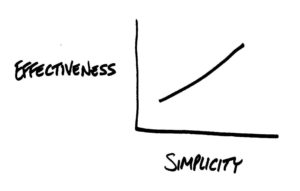
There is a direct relationship between simplicity and productivity, and an inverse relationship between complexity and productivity.
The most successful businesses have capitalized on this fact. This was one of Apple computer’s unique selling propositions – to focus on the simple and eliminate what wasn’t essential.
From its inception, the Apple Macintosh computer was designed with simplicity in mind. Other companies have focused on simplicity: McDonalds order via drive-through, Ikea with its simple design, and Amazon with one-click ordering.
Siegal-Gale is an international marketing firm that has studied simplicity in business and has been able to profile and rank businesses according to their simplicity. They call this the Global Brand Simplicity Index and have found that those companies that rank the highest, also outperform companies that rank as more complex. Their report states (2):
You want to simplify the experience your chiropractic (or other) patient has in your office. From the first phone call, first appointment, examination, report of findings, patient finances, and scheduling, discover ways to simplify your procedures.
Your intake forms may be redundant or complicated, there may be too many rote statements or “scripts” for your staff to say to patients, or there can be extra pathways that your patients have to travel, like so many rabbit trails, where they can get confused and the flow slows down. Staff, or doctors, may have too many decisions to make at each visit.
For example – what extra therapy should the patient receive? Not knowing, I have heard support staff simply ask the patient what therapy they wanted today, as if they were ordering a latte. And as we know, there are definitely too many codes and documentation rules to follow for the doctor. Going total cash is one solution, but intelligent software, dictation, and scribes are other solutions.
Many, if not a majority of the more profitable offices that I have worked with over the years practiced what could be called “straight” chiropractic. The straight practice (no additional modalities) works well, when it does, because its procedures and flow are simple. It is usually more profitable because extra overhead hides in the complicated.
Steve Jobs again: “People think focus means saying yes to the thing you’ve got to focus on. But that’s not what it means at all. It means saying no to the hundred other good ideas that there are. You have to pick carefully. I’m actually as proud of the things we haven’t done as the things I have done. Innovation is saying no to 1,000 things.”— Steve Jobs, WWDC 199(3)
I am not advocating no supplements, no exercise physiology, no electrical therapy. But to be honest, how much of this gets used in your office? I know offices — right now, and have known hundreds more, that have equipment lying around unused or bottles of vitamins collecting dust on overlooked shelves.
You have to embrace first only those unique outcomes that you can deliver. Work backwards and add only the most critical steps. “Begin with the end in mind”, as Stephen Covey observed in high producers.
For a chiropractor, this means adjust. (For other professions: what is your core function?) One of the first doctors I worked with when I moved to Wisconsin in 1988 worked closely with Clarence Gonstead. His license plate read: I ADJUST. He had a full practice, chuckled a lot, and seemed to make a nice living.
Start with this first, and then add additional services carefully – if you want.
Secondly, educate. Educate your patients, your team, and your community. But your education has to be simple. Your message has to be concise. One doctor we have worked with over the years has a waiting list practice, with nonstop patient, and even some MD, referrals. He doesn’t do a 4-day report of findings and he doesn’t do a 2-day report of findings on new or reactivated patients.
He just very intently adjusts and talks about the adjustment and what he is adjusting. From there, he then also gets into other health topics such as toxins (vaccinations), nutrition and weight, and exercise.
This is a good model: start with your core service and move out from there. For chiropractic education, you can use simple metaphors like “pinched nerve,” “garden hose,” “rusty gate hinge”, and how the body fighting toxins creates heat (inflammation), etc.
And keep educating your patients with care classes, lending library, table talk, movie nights, special speakers, case histories, and testimonials.
And do this first and continually with your support team. This is not done enough!
One method to discover what to simplify is to regularly practice your procedures. For example, do a rehearsal of what happens when a new patient comes into your office on their first day, 2nd day, 3rd day, etc. You will flush out confusions, redundancies, and extra motions that complicate the patient experience.
Outside of your office, the same applies. Educate your community on what you do. What is your simple selling proposition that people want?
For example, someone asks you “what do you do?”: “Well…
we help to improve your health, we relieve your pain,
and we increase your game – naturally!
No drugs, no surgery, and we guarantee you have fun in the bargain.”
How’s that? A simple and a desirable unique selling proposition (USP). (You can use this in all your marketing communications – no charge!)
Lastly, there is fun. You can and should have fun doing this. And so should your patients and support crew.
Patients will mostly remember how they feel after leaving your office. Was it a pleasant, enjoyable experience? Was it fun?
Practice life can often bring about a kind of serious hue over the office. Administrative errors, missed appointments, a dissatisfied patient, a staff member out for the day, too many bills – all of this can create an extra layer of anxiety or seriousness in the office.
Fight this by being grateful for all the wonderful outcomes of your patients. Work on having a “the gratitude attitude.”
And as you simplify your processes, you will find that everyone’s attention becomes freer to enjoy helping each other — to help the patients.
Simple is more fun and profitable.
So here is a question for you: Which comes first, the fun or the smile?
Well, you can kick things off right now… right now with a smile. Actually, smiling is simpler and requires less muscles than frowning.
Frowning is complex, so start right now by smiling.
Try it.
See? Already your business and life is simpler and better – and funner.
-Ed
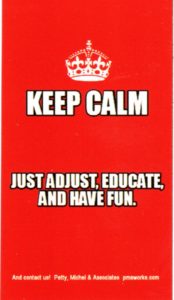
(To help you keep things simple, you can order two magnets of the above image for your office, courtesy of PM&A while quantities last. Click here to order. We will mail them to you at no charge.)
For a printable copy of this article click [The Power of Simplicity]
(Download a PDF of this article)
Most attention is usually put on marketing procedures. That is fine but when marketing fails, it is usually because the procedures just didn’t get done, or only half done. And this is because no one was put in charge of them and given the time to execute them. Pretty obvious, but easily overlooked. This was the essential theme of the Marketing Manager System I published in 2000. It is out of print now but much of the info is on our PM&A Member’s site.
And underneath it all is motivation. Who really wants to do the marketing? You may get excited from a seminar or about an event you have planned. But motivation can dissipate quickly and too often we are not active enough in keeping ourselves and our teams passionate and determined about providing more and better service.
So all three levels or echelons of marketing need to be in place. What follows is a brief list to help you set up effective marketing activities for the next 4 months.
QUALITY SERVICE AND CARE COMES FIRST
It goes without saying but it needs to be said – from an executive point of view, quality care and service comes first. Ultimately, an office that gives “WOW” service and produces extra-ordinary outcomes generates enough word of mouth to create a waiting list practice. Think of Clarence Gonstead.
MOTIVATION
Plan weekly motivational talks at your team meetings and major motivational activities each month. These can be discussing case successes, watching Doctored, or doing a free clinic for the underprivileged. Keep the saw sharpened. Keep reminded of WHY you all are doing what you are doing and your greater purposes. This is the fire that drives the engine of your practice.
MARKETING MANAGEMENT
Someone to Coordinate
Delegate someone to be the marketing coordinator. You could have someone for just internal and someone for external events. These roles are only a few hours per week as coordination jobs. The actual work is delegated as separate duties so that everyone on your team has a role in marketing. Your entire office is the marketing department but it helps to have duties assigned just like you do for the front desk or billing dept.
So Many Procedures, Which Should You Pick?
Select the marketing activities that have worked for you in the past and add a few at a time. Pilot each and see what works better for you. Marketing is all about testing. Find out what works and then put it in a system. Keep it simple. Get your marketing systematized and departmentalized and delegated.
Time to Plan
Part of marketing management is setting aside time to plan and coordinate upcoming events. At least monthly, schedule time aside to review past promotions and plan new marketing for the next few months.
Calendar
Make sure you have a large calendar to post all of your upcoming promotions.
MARKETING PROCEDURES
COMMUNICATION CHANNELS
All your marketing does no good unless it is communicated. Marketing IS communication, so keep the communication going – in and out of the office. Make sure each month you promote via team members, “table talk”, e-newsletters, posters, Facebook, etc.
Recurring Procedures
The most important marketing activities are your usual, recurring procedures that you do on a daily and weekly basis. Many of these are already embedded in your routine procedures. Because they are done routinely, the usual and everyday procedures can be overlooked or not given the importance needed. For example, just answering the phone can make a big difference. Don’t let the routine become the mundane. Practice new ways to have fun with your recurring procedures.
Community Services
This is what I call the free or discounted services you provide in your community. Health screenings, workshops, networking events, setting up alliances with dentists, for example, or just conspicuously showing up at the Lions Club breakfast. I would delegate this to one person and give them 4-6 hours per week to schedule events and to help coordinate who attends these events. There is a good deal of administration in this role. I have seen events scheduled a year in advance that generated new patients and referrals from alliances that come in years after they were initially set up because the relationship was well maintained.
Internal Workshops.
Internally, you can also schedule special classes over the next 4 months, including “Natural Approaches to Flu Prevention”, “New Healthy Ways to Lose Weight and Get Fit This Winter,” etc.
Google Reviews

If you get 4-5 star reviews on Google, you will get new patients. This is proven. It is true. Assign it to someone and do it. Now. It may take a few months, but if you do it, they will come.
Patient Education: Table Talk and the New Patient Care Class
In my opinion, educating your patients is more important than adjusting or treating them. Not all patients are easy to educate, but all can be gradually persuaded to understand the value of your services: what they do, how they work, and why they are important. Educated patients refer more. They stay with you longer. They are more enjoyable to care for. And, most importantly they are healthier. Table talk is an excellent practice with each patient. But your new patient care class is a proven winner. It just takes your intention to do it. Two times per month. Do with the fervor of a Sunday sermon or with the frankness of a fireside chat with old friends. It will boost your practice and you. And… how much does it cost? That’s right… nothing.
Care to Share
There are many ways to do this program but I like it because it encourages your patients to help you get the word out about their successes so that others do not have to suffer as long as they did. It gets them to help their community. It taps into their greater purposes and gives them an opportunity to help others. Set up a monthly drawing and give away a modest prize or two. Enter the drawing by submitting a Google review, by bringing someone into the office for a no charge consultation, or by getting a workshop set up in their place of employment. Run the program monthly or every other month.
Special Promotions
These are the big events that can be fun and energizing which you hold in your office every couple of months or so. I list some ideas below.
OCTOBER
October is National Chiropractic Health Month. (The International Chiropractic Association and the American Chiropractic Association once recognized October as Spinal Health Month, but now it is simply called Chiropractic Health Month.) This can give you a reason to do many different promotions. For example:
Child Health Day
Under a Joint Resolution of Congress, the President of the United States has proclaimed National Child Health Day every year since 1928. It was originally celebrated on May Day, May 1, each year until 1960, when the date was moved to the first Monday in October. Use this as a great opportunity to have a Kid’s Day. (Google it. Many differen sites offer suggestins.)
National School Lunch Week
National School Lunch Week takes place on the second Sunday in October (http://www.nea.org/tools/lessons/48412.htm ) You could have a workshop on fast and nutritious meals for kids targeting parents and moms.
Awareness Weeks
If workshops aren’t your thing, then set aside one week to focus on a particular condition, such as headaches and call it “Headache Awareness Week”, or “Pinched Nerve Awareness Week”, “Neuropathy Awareness Week”, etc. Schedule one a month where possible for the next 5 months as part of your Community Education Program. Detail procedure with posters in your Marketing Manager System Toolkit and on your PMA Members site under: “Community Education.” Offer free consultation, screening, and information regarding the condition.
Crazee Dayz
Select a day and make it special for your patients. Only one day a week is necessary otherwise it’s not special. It can be once per month or every week. Serve extra treats. You can have the staff dress out of uniform coordinated to the day. This can add some extra fun to the office and help with retention and long term referrals.
Chiropractic Opportunity Week (“The doctor is having a COW.”) (patient referrals and advertising new patients) Free consultation, exam, and x-ray if needed.
Hair Dresser/Beauty Salons/Spas
Kids and Halloween Party
With Casper as inspiration, a kid’s Halloween party with a friendly ghost theme has the right mix of tricks and treats. Invite the young ghouls to come dressed up, but you can also have them make ghastly masks as part of the fun. Other ideas include spooky decorations, scary snacks and a friendly ghost hunt.
NOVEMBER
Thanksgiving Turkey Drawing Poster
Thank a Veteran Day
Veterans Day – November 11. It is no secret that the physical and mental health support veterans receive is inadequate. This good time to set up a promotion honoring those who served. Special promotions including free or discounted services or donations to local Veterans organization. (More info: http://en.wikipedia.org/wiki/Veterans_Day )
Donation Drives (patient referrals, advertising new patients)
Holiday time always brings an increased demand for helping those less fortunate. Within your office set up a collection area for any of the following programs and promote it in your newsletter.
Deer Widows Week
During hunting season or first week of December offer complimentary massage for your patients who refer in a new patient
Girl’s Night Out
This is a shopping/gift exchange that can take place in your office. Have patients who have little businesses set up booths in your office and stipulate that they have to bring guests. Supply some refreshments and promote as great way to “Shop Local” for Christmas presents. Enlist the help of massage therapist, local spas and direct marketing consultants. You can provide free screenings.
DECEMBER
Holiday Coupons – Gifts Certificates (patient referrals)
Poinsettia Give Away
Give away free poinsettias, one per family. Include in the cards a gift certificate for family members or friends. (See Member’s site for gift card)
Saturday with Santa
Appreciation to External Referral Sources
Deliver a fruit basket or other present personally during December with a card of thanks and mention how you are looking forward to another year working together. This would go to any location where you had an external community services type of event, such as a screening or workshop. Include: “Looking forward to working with you next year.”
Health Never Takes a Holiday
Post a sign in your office in December that “Health Never Takes a Holiday” and review and re-schedule patients through December to January.
Giving Tree/Angel Tree
The Giving Tree/Angel Tree Project is a great way to bring community awareness to your office. It is a simple project that gets your patients be involved to help others where they might not otherwise have the opportunity to do so.
JANUARY AND FEBRUARY
Winter Workshops and Movie Nights – Internal
These, of course, can be done anytime of the year. Whether it is how to make organic soup for the week, or a talk on vaccinations with an MD, winter has been a good time for internal events. Weight loss, fitness, and food have seemed to be popular. These should be planned by December or even November. Ideally, plan your workshops with a guest speaker such as a holistic MD, biological dentist, midwife, etc.
We have a great deal of information on our PMA member’s site for those of you who are active clients, much of it compiled from the Marketing Manager System I published quite a few years ago. There you can find readymade posters and detailed information on how to do many of these projects.
Yes, I know some of the posters are old but we are not in the graphic arts business and neither are you. But they are on Word files and can be easily changed. A simple graphic and title is all you need with the specifics in bullet points. Depending on the level of your program, we can also put together simple posters to help promote your particular project.
If you are not active with PM&A, you can still find a great deal of info on our web site at www.pmaworks.com/observations.
With shared intentions to get more people healthier and smarter about their health!
Ed Petty
September, 2016

Welcome back to Wisconsin Phyllis!
We are excited to have Phyllis returning to Wisconsin to join us at the Chiropractic Society of Wisconsin Fall Summit.
The Fall Summit will be held October 21st through the 23rd at the Kalahari Resort in Wisconsin Dells.
Are you and your team registered? If not you will want to as Phyllis will be presenting to doctors and staff all day Friday. She will be covering the following topic:
“The Secrets of Referrals and Retention”
What’s the secret? The pixie dust? The magic potion to creating patients that stay pay and refer for a lifetime?
In this class you will walk away with what makes a patient pay and value their chiropractic care. This interactive class will help you create great customer service and learn easy, solid systems and procedures that will take your practice to the next level. Included is low stress, low cost marketing ideas that you can implement on Monday morning.
For more information on Phyllis visit: Our Experts
To register for the CSW Fall Summit visit: CSW Fall Summit 2016
REMINDER: Wisconsin License Renewal Credentialing Requirements
Doctors of Chiropractic (DCs):
Starting in October 2016 and prior to December 14th, renew online: DC Renew
Chiropractic Technicians (CTs):
Starting in October 2016 and prior to December 14th, renew online: CT Renew
Chiropractic Radiological Technicians (CRTs):
Starting in October 2016 and prior to December 14th, renew online at: CRT Renew
TIP: Keep your transcripts and file them safely, in the event of a continuing education audit.
All licenses (DC, CT, CRT) expire on December 14, 2016 at midnight.

Questions? Contact Lisa Barnett, PM&A Consultant, at 920-334-4561
~~~~
Links
DC Approved Courses: https://dsps.wi.gov/Default.aspx?Page=b74564c8-7d6c-4258-9809-cd118336a9f5
DC Renew: https://online.drl.wi.gov/UserLogin.aspx
CT Approved Course Listing:http://dsps.wi.gov/Default.aspx?Page=830a2718-a0f7-414c-8e97-2481f983bc78
CT Renew: https://online.drl.wi.gov/UserLogin.aspx
CRT Approved Course Listing: https://dsps.wi.gov/Default.aspx?Page=bcfb3543-eb0a-46bf-ba89-8f1fe6d84325
CRT Renew: https://online.drl.wi.gov/UserLogin.aspx
Printable Version of this quick checklist of requirements. [LINK]
Have you ever thought you could be both a great documenter and repeatedly educate your patients on their innate intelligence . . . if you only had the time? Keep reading on how to both bulletproof your documentation for a potential audit and maintain the energy of our profession’s principles.
Let’s help build your ammunition.
First . . . did you know that the US Health and Human Services advised Medicare to target chiropractors to curb questionable and inappropriate payments, projected at $280,000,000? Seriously! And clinics are, as I write this, being audited. How do I know? Because we’re receiving phone calls and emails asking, “What do I do? I received a letter from Medicare.” As a result, I’m traveling around to help chiropractic offices prepare.
To insure yourself and what you’ve worked hard for, make sure your documentation (that is, every single note in the patient’s file/your EHR software) is citing the following information:
Let me be clear: The above documentation requirements are not PM&A’s. They are Medicare’s.
Other Tips:
In closing, get out there, do what you do best to attract and help anyone with a spine, and follow the above documentation requirements to armor yourself in the event of an audit by Medicare and other payers. Need help staying relaxed and focused, and getting paid? Give us a call. That’s why we’re here.
Sincerely in Chiropractic,
Lisa
Lisa is now providing a no charge initial consultation regarding your Medicare documentation. You can contact at (920) 334-4561 or by email at Lisa (at) @ pmaworks.com
More information on Lisa[LINK]
Download a printable copy of this newsletter [June newsletter]
Download a customizable copy of the Checklist: [Medicare Documentation ChecklistDOC]
Print Checklist (PDF)[Medicare Documentation Checklist-PDF]
David Michel will be speaking on Friday, April 8th from 9:30 – 11:30 at Moraine Park Technical College in West Bend.
His topic “Overview of Medicare Billing for the Chiropractic Specialist” is open to the chiropractic public with limited seating for around 50 people. If you or your staff are interested in attending please let David know so he can inform Dr. McLean.
David can be reached at dave@pmaworks.com
I am standing on a beach by the partially ice-covered Lake Michigan, sometimes referred to as part of the “Third Coast.” It is a good day!
Once a year I send out a promotion for the wildest and most unique chiropractic seminar I have seen in 30 years.
“Out-of-the-box” is a cliché that doesn’t really do Cal Jam justice. Like extreme sports, Cal Jam pushes the boundaries of what is customary and conventional.
But isn’t that chiropractic? Isn’t that you?
Chiropractic is unique (and wild) because it has purpose and soul.
Purpose and Soul, plus plenty of… Rock and Roll.
At Cal Jam!
Hope to see you there!
Date: March 18-20, 2016
Link to site: California Jam: www.CaliforniaJam.com
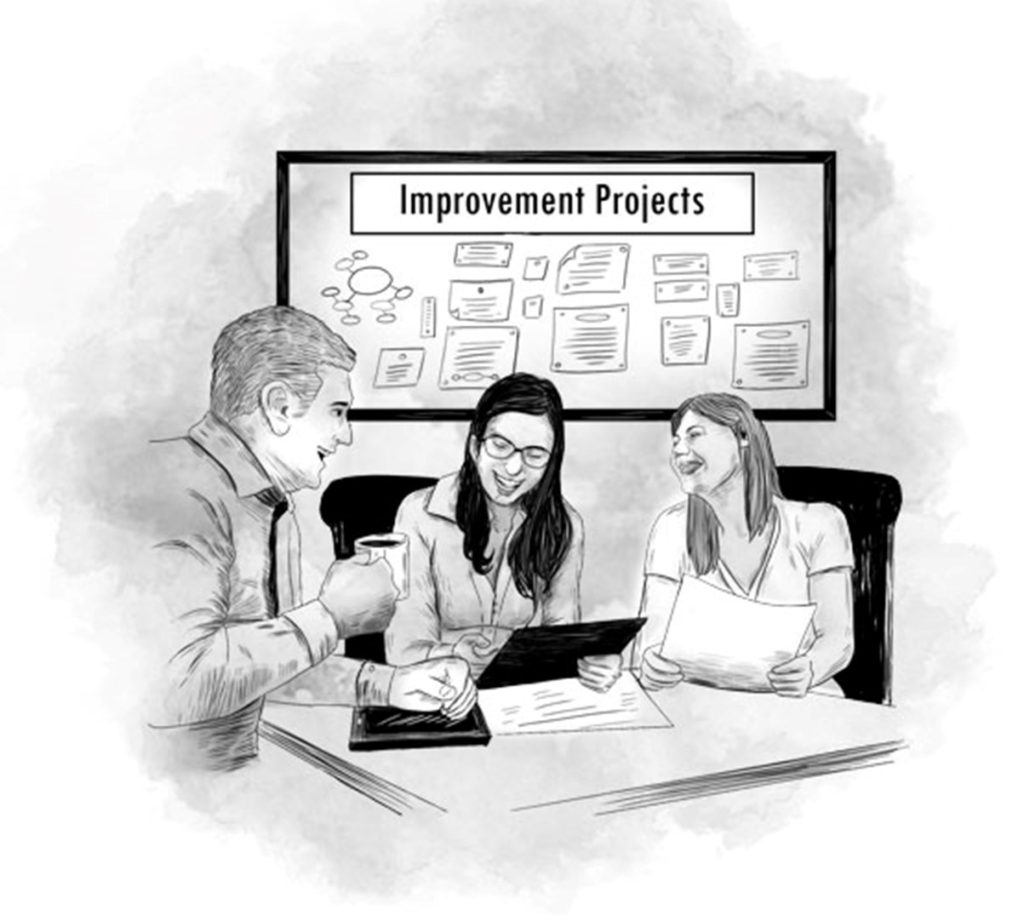
An Introduction to the Practice Development Process of Continuous Improvement
A key difference between a successful and profitable chiropractic business and a roller coaster type practice can be traced back to procedures and systems.
Many practice problems occur because procedures are not established, consistently followed, and regularly improved. This has been the secret to franchising. Starbucks may offer new products and services now and then, but for the most part, they follow their checklists and manuals of successful procedures. The local New Age coffee shop down on the corner with the unemployed guitar player usually lasts for about a year before the owner’s savings and inspiration dry up, along with the last cup of coffee.
Of all the categories of systems in your office, what would you say would be the most important?
☐Patient Accounts (Billing/Collections) Systems
☐Marketing Systems
☐Front Desk Systems
☐Therapy and Clinical Support Systems
☐ Doctor Systems
☐ Business Systems (Payroll, Financial Planning, Taxes,)
☐ Leadership
☐Office, Practice Management Systems
My guess is that you usually keep most billing procedures in place as… obviously, you need to be paid. And, you will usually keep most front desk procedures in place. These deal with patients and patients are obviously in the office, or not. And you, of course, follow your clinical procedures.
Your marketing procedures come and go, at least they do in most offices. They are just not consistent. This is why I put together the Marketing Manager System in 2000. The biggest error in most offices with their marketing is that it simply isn’t done consistently.
But the most important category of systems is not so obvious. These are the management procedures and systems. Why are these most important? Because they keep all the other procedures in place and are continually being improved upon.
Why do you think CEO’s are paid so much money? Because they are in charge of the management of a business and are able to increase its bottom line by the millions. They have procedures that they follow and insist that others do as well. These procedures all add up to systems.
Over the years, Petty Michel and Associates has been very successful at increasing the revenues of practices. One of the reasons is that we implement what we call the Practice Development Process. It is a monthly system of management that gradually works to objectively improve the business, repetitively over and over. It integrates into your current systems and does not take that much extra time. But in the end, it saves you a great deal of time, extra work, and lost revenue.
To learn more about the 3Goals Practice Development Process: 3Goals PDP
Four steps to continuously develop and improve your practice
The Practice Development Process is a simple, yet powerful practice building system that can help take you and your business to its full potential of a systematized, team driven and profitable business.
It transforms your practice. Month by month, it helps move your practice to a more profitable service oriented business that runs at near full capacity – with less ups and downs that demand your time and extra work.
It is based upon the idea of constant improvement.
The principle of constant improvement in management science has been a major factor in the success of large manufacturing corporations around the world. The success of the Japanese automobile manufacturing rests heavily on a process of constant improvement called Kaizen (kai = change, zen = good). Motorola developed its own program called “Six Sigma”, a process of continuous improvement.
We have adapted these processes to be applied in practice management and call it the 3Goals Practice Development Process (PDP).
The Practice Development Process has four steps:
Integrate This Process As Part Of Your Team Meetings. The first two steps, Assess and Plan, are usually done before or during the first staff meeting of the month. Supervision goes on during the month to ensure that the plan gets completed. At the end of the month, successful procedures are documented in a practice playbook for future training and assessments.
Your Consultant and Coach. This process is best done with your practice and business coach. Each month, the two of you should work through step 1 and 2. During the month, your coach may also be able to help with the implementation of the plan.
THE 4 STEPS OF THE PRACTICE DEVELOPMENT PROCESS:
1. Assess and Review. At the end of the month, look over the statistics and note what areas improved and what areas didn’t. Then check what was actually done, or not done in each area. Use your departmental checklists from your Practice Playbook if you have started this.
Many business owners still manage without looking at objective indicators. They manage by emotions, mistakes, fear, “bright ideas”and other flighty factors that ultimately hold a clinic back, or often just burn it out.
Effective clinic managers, like an athletic team coaches, base their actions first on actual outcomes and performance monitors. These are your daily, weekly, and monthly practice statistics. PM&A has developed a specialized form of review which is called Practice Analytics System which we display on our client’s personal Practice Dashboard’s.
This assessment also includes reviewing checklists of the key procedures and whether or not key duties were done.
2 Plan. Work out the key areas you want to work on in the next month. Pick just one or two areas that will make the biggest difference and make a list of a few action steps that will help improve the area in your office you have targeted. Get the actions assigned with a date on when they should be done.
3 Supervise. Regularly monitor the implementation of the action steps with yourself, your team, and your consultant. Provide help where needed to get them done.
4 Systematize. You do not want to keep inventing the wheel, so at the end of each month, document any procedure that worked well.
List all successful activities for each department and “lock them in” as standard operating procedures. Keep what works, throw out what doesn’t. Start with just a checklist of key procedures. Later, you can write or videotape a description of each procedure. It is from this that you will do your training and “coaching reviews.” Use your playbook often: refer to it and practice.
Gradually, you should have your own system of practice management and patient management and have it outlined simply in your Practice Playbook. For example, the “Smith Chiropractic System of Patient Management.”
IMPLEMENTATION SCHEDULE
Week 1. First Week of the Month: Do Steps 1 & 2 – Assess and Plan
Week 2. Supervise. Coordinate upcoming activities. Study and Train. (Optional: Separate Marketing Meeting)
Week 3. Supervise. Coordinate upcoming activities. Study and Train.
Week 4. Supervise. Coordinate on upcoming activities. Celebrate and party for a great month! Add to Practice Playbook.
REPETITION
Do The Practice Development Process Every Month.
The success of this process derives much of its power from a simple principle from Aristotle.
“We are what we repeatedly do.
Excellence, then, is not an act, but a habit.”
This often referenced quote is from a series of lectures he was to have given at the Greek Lyceum on ethics (300 B.C.). We could say, then, that continuing to do the Practice Development Assessment, and all of your procedures and systems, is ethical and leads to excellence. The contrary would also be true.
GOALS AND CONSTANT IMPROVEMENT
It is important to keep in mind WHY we are doing the PDP each month.
It is assumed we all want to improve, that improvement is possible, and that we have higher purposes and goals. Our patients do. That is why they see us and we help them improve and get closer to their goals at each visit.
By consistently working the 3 Goals Practice Development Process each month you, the practice, and each team member will also get closer to the higher goals each of you share.
MILWAUKEE, WI – November 27, 2015 – Petty, Michel and Associates (PM&A), a national chiropractic practice management company, is pleased to announce that David Michel, a partner with PM&A, was recently awarded the 2015 Presidential Award by the Chiropractic Society of Wisconsin (CSW). The award, presented during the Awards Ceremony at the CSW’s second annual 2015 Health & Wellness Summit, held at the Kalahari Resort in the Wisconsin Dells this past October 9th through the 11th, identifies:
Mr. Michel serves on the Board of Directors for the Chiropractic Society of Wisconsin (CSW). The CSW is a member driven and member controlled State organization that develops and maintains positive relations with consumers (patients), chiropractors, legislators, lobbyists, insurance companies and medical providers.
Dr. Jay LaGuardia, President of the CSW, when presenting the award to Michel, stated: “We would not have been able to achieve the success we have thus far without his valuable service.”
David Michel has been involved with the Chiropractic Society of Wisconsin since its inception in 2012.
Petty Michel & Associates (PM&A), a practice development company, was founded in 1988 as an alternative to conventional practice management seminar programs. For more information, go to: http://www.pmaworks.com
If you are like many chiropractors, other doctors and professionals, you are wasting potential revenue and don’t even realize it.
Before I tell you how this happens, let me give you a definition that I have been using for years that has helped many offices.
A practice is a network of relationships that is created and sustained through communication and service.
OK. Keep that definition in mind.
Now, here is how you can lose extra income and create extra work for yourself and your team: You start out spending a great deal of time and effort on generating new patients and then on processing them. You get to know the new patients and hear their stories. You empathize with them, ask them questions, and examine them. You explain what you have found about their condition and worked out what you see as their best option for treatment.
During their first few visits you are sensitive to how they are responding to your care and so continue to communicate with them. You put all this work into your new patient in order to help them follow your treatment plan and get better.
But as the patient improves and their frequency of visits decrease, your focus on them lessens. Your attention gravitates to the new patients.
When the patient has moved through your care plan, they often just drift back out into their community with an inadequate lifeline back to your office.
You have invested in, and created, a great relationship with your patient. Wouldn’t it be a good idea to stay in communication with them? They know you and like you and your team — shouldn’t you keep the connection alive and active? Just because their health condition has improved, don’t you still have approaches to help them become healthier and happier?
They have family and friends that can use your help now. They also belong to businesses and other groups that could use your help. Why let this relationship atrophy? Why not secure that lost income as well?
In some sense, the business is constantly starting and stopping. It is nomadic. This is the other “Paleo” practice: each day when the sun comes up across the plains, you are out hunting for and gathering new patients. This may be good for a diet, but not if you want a low stress practice. Wouldn’t it be better to create a business where existing long time patients would routinely stop by for care and refer their family and friends? This would save you a lot of effort, money, and stress, wouldn’t it?
A practice should be supported by business systems.
These systems are like an engine. An engine has starts and stops, but it also has a flywheel. The flywheel is a heavy wheel that, once it begins to spin, continues to do so with much less effort than it took to get it going.
A good practice is supported by a business flywheel, or a number of flywheels as there are different sub-engines in the business.
For internal marketing, the flywheel is the conversation that you first began. You want to keep it going and going. After you get it spinning in high gear, it takes little effort to keep it humming along.
You put in place a system of constant communication with your patients when they are NOT in the office through e-newsletters, hard copy newsletters, notes and cards, Facebook, and any other medium available. And of course, there is also personally seeing them at events in your community – county fair, grocery store, restaurant, salon or barber shop, etc. You want to keep the conversation going.
A very effective method is through electronic newsletters. Done right, and they usually aren’t, these newsletters can improve the numbers in your office.
We have tested this and found that the offices that do have personalized newsletters to their patients have more returning patients, more referrals, and more wellness visits as a result. Hence, more revenue and less stress about generating new patients.
See link below for a procedural article on what we have found that seems to work best for e-newsletters. Your customized e-newsletter can fuel your Facebook page, website, hard copy newsletter, and other mediums. We have worked out a relatively simple and very cost effective system that offices are using now to make this work.
Keep in mind that if your patients are not in listening to you, they will be listening to someone. For example, there are about 80 ads for drugs every hour on television (http://www.topmastersinhealthcare.com/drugged-america/) and this statistic is more than ten years old. It has been estimated that each of us are bombarded with about 2,000 advertising impressions per day. How many of these ads influence your patients toward unhealthful products or services?
Customized newsletters, and the cascading communications that they can feed, cost little but they help to keep the patient flywheel – and the communication – going. And in so doing, the patient wins, the community wins, and so does your business.
-Edward Petty
Publishing Your Newsletter – Does your mailing bottleneck when it comes to time to do the monthly newsletter Follow our easy steps to get your newsletter out “simple and fast”.
Newsletter Content – 9 suggested topics to include in your monthly newsletter to keep the conversation going.
Here in the good Ol’ USA, we are about to celebrate Independence Day, the date we commemorate the signing of the Declaration of Independence and declared our freedom from the yoke of the British Empire.
I think for those of us in health care this day bears special significance. In fact, I think of the chiropractic profession in particular.
Chiropractic has remained independent for 120 years. It has been fought by monopolist trade organizations, suppressed, and slandered, but it still stays outside of the clutches of Eli Lilly, Merck, or Monsanto.
To Chiropractors and those who work in the profession: You are brave, tough, and independent. You are living the American Way. You are a gritty bunch for sure and have maintained your integrity for putting care before profits.
The challenge you have is not only to remain free, but to help your patients and community also be free and independent.
Your patients are at the receiving end of billions and billions of dollars that are spent to manipulate them to purchase products that are known to be unhealthy. Through pervasive and clever marketing and massive efforts to influence government, Americans have become over fed, over medicated, and under nourished. Obesity rates have tripled (11% in 1960’s, 37% 2010)1, drug consumption has soared (average 7 per person in 1993 to 12.2 per person in 2014).2 Vaccination recommendations for our children from our government has increased from 64 in the 1950’s to over 1000 in 2013 (69 doses of 16 vaccines between day of birth and age 18).3
And the results? American’s health rates compared to other countries are abysmal. We are the worst or close to it in many categories. 4 Yet this is not what is advertised, so it would be shock for most Americans to hear that in the competition with other countries for the best health care, that they are losers.
The true American Way5 was and is to question authority, seek the truth and to stand up for justice.
But the truth can be obscured and the path of least resistance is easier, and it can seem more acceptable to simply follow convention and herd mentality. But the facts are there – provided by whistle blowers, mothers, and researchers, and we all need to look at the facts, do our research, and continue to educate ourselves and stay vigilant.
We can’t forget our patients… they too need to learn how their health choices have been manipulated, how they have been deceived, and what they should do to truly improve their health.
There is a price to pay for freedom. It takes work and is not always easy, but — it is the American thing to do. Stay brave, stay alert, and continue to help your patients achieve better health.
Happy Independence Day from Whitefish Bay, Wisconsin, USA
References.
The best chiropractic businesses excel at the basics. Too often we can take the fundamentals of practice excellence for granted and go off to chase the “shiny” things, forsaking the powerful potentials right in front of us.
So here is an organic reminder that you, and all of us, can immediately put to use to help us keep growing and groovin’.
Most of us enjoy spring…flowers blooming, birds singing. It is new. It is creative. It is a beginning.
Life goes in cycles – everything has a beginning, a progression, and an ending. Some cycles are longer – every twelve months the tulips come through the winter mud. Some are shorter – each day the sun comes up and we have a new cup of coffee. But nature endures through cycles.
Unfortunately, we don’t always follow nature in our offices.
If you are like most of us, you don’t really start your day. It sort of happens and you just go along. You walk into the office a see what the appointment book offers you. Based upon the urgencies of the morning, you make your way through to the afternoon until you can leave to go home in the evening. But do you really end your day or does it linger with you as you go home, or even stay with you till the next morning?
Most of us are stuck in the blur of stretched out cycles that are blended one moment to the next so that there is never any real beginning or never any real ending. One phone call in the middle of a busy afternoon is very similar to the one you had in the morning…everyday for the last three years. This adjustment to this patient is just too similar to the one you gave…3,000 times before. One moment blurs to the next.
Jim Parker, of Parker Seminars, used to talk about “PTC”, Present Time Consciousness, as a key element to practice success. A practice can suffer because, over time, our consciousness gets stuck in past moments, strung out so that we have less consciousness in the here and now. When you greet your patient, you are not as “here” or as conscious in the present as you might have been the first month you were in practice, or the first week you were on the job. And your patients know it, at least on a subliminal level. They can have a sense that you are disinterested in them and so end up leaving and looking for a doctor who is.
Each encounter with each patient should be new. It should be its own cycle. Each phone call, each adjustment should be unique, separate, as if it has never happened before.
The Japanese have a name for this: “Ichi-go Ichi-e.” Roughly, It means “one time, one meeting” — that this one time will never happen again. It is its own time. It is special.
What would happen to your practice if each day – today – was brand new? Like spring. If this week was the first week you were finally able to see patients after years of preparation?
First of all, you wouldn’t be bored. You wouldn’t be burned out, worried, or angry. Why? Because you are just starting and you have a chance to create the practice anyway you want.
So, what causes us to lose our “PTC” and fall into doldrums? How can we stay in the “now” and be creative each moment we are with our patients, each other, and our loved ones outside of practice?
First, watch out for the backlogs. They are energy dumps. Try to complete your work when you are doing it. Patient notes, insurance reports, filing…try to get it all done as soon as possible. You see, when you start to put your consciousness into a cycle you don’t really get all of it back until you complete that cycle. So, every pile of paperwork and partially completed job that is lying around the office will gradually draw your attention into the past.
Spend a weekend applying the 4 D’s: With each task: Get it DONE, or DELEGATE it, or DUMP it in the trash can. Not all jobs can be completed now, and so some can be DELAYED with a time noted to complete it.
Here are some other steps to make each moment new:
Some of this takes discipline and creating rituals to help ensure these actions take place
But you are part of nature and spring is already in your heart. You just have to let it out, like a song that is ready to be sung or a jig ready to be danced. You already have the creative spark of newness inside you.
So just breathe.. and let your spring happen today and each day. And help others to do the same.
Carpe Diem and Happy Spring!
–Ed
[If you think that you could make more money selling pharmaceuticals, injecting patients with vaccines and promoting flu shots in front of your office, these recommendations are not for you. For those matters, you might want to ask Palmer Chiropractic College or the Wisconsin Chiropractic Association for their opinions.]
What strategic moves should you be taking now to make sure that you have a better year in 2015 and in years to come?
After reviewing current literature and statistics, and based upon my observations and experience, I have put together a report which makes a number of recommendations that can be helpful to you. I have also included an extensive list of references for your further study.
The report contains a lot of information and so it is only for the serious practice executive. It will be a useful resource for you to refer to while you implement some of the suggestions I offer. Reading time is about 15 minutes. It offers new views on practice marketing, management, and leadership, with 25 specific recommendations. To go straight to the main course, go here:
Here is a shorter version:
1. Know Your Environment. The Medical-Pharmaceutical industries are spending more to dominate the market place. Their efforts are becoming more pervasive in reach and more covert in manipulation. At the same time, wellness statistics continue to grow. More people are turning to organic foods and are focused on wellness.
2. Marketing Positioning. My recommendation is to embrace the popular movement towards natural health and own it. Be its champion. You are the Healthy Life Doctors. This is your niche.
3. Unique Selling Proposition. Stay committed to your core services, but articulate your Unique Selling Proposition to your specific market niche(s). Not everyone is your patient. Select certain markets that are already reaching for your type of services: people fed up with drugs, baby boomers who want to stay healthy, mothers who want to avoid drugs for their children, athletes, employers who want healthy employees, etc.
4. Get More For Less. Watch your economics but don’t get stuck in a scarcity mindset. Central to economics is a return on investment -ROI. Invest in yourself and especially in making your support team expert professionals. Learn and apply the Pareto Principle (how 80 percent of your results come from just 20% of your efforts).
5. Insurance or Cash? Yes! Take insurance but don’t kowtow to the Insurance Cartel. There are millions of people who want help and can pay for it and are just looking for a solution. You have to let them know that you have their solution.
6. Shift from Personality Driven Practice to Team Driven Business. The successful offices of the future will be team driven and systematized. Each team member has to be an expert as a specialist, as a team member, and as a marketer. And each should try to achieve this as well. The doctor will delegate most marketing and administrative details to others.
7. Shift from Solo Practice to Group Practice. For those of you who are ready, you should join forces with other doctors in a group practice. This has not had a lot of success in the chiropractic profession as it has in other professions, but the time is right now to band together synergistically as brothers and sisters. There are many good reasons to do this now. However, it has to be set up — and maintained — correctly.
8. New Role: CEO and Leader. Why do CEO’s get paid so much? Because they can make such a positive difference in the business. Up to now in your career you have taken on administrative and marketing projects mostly from the role of doctor, or perhaps owner. The CEO role probably has not been emphasized. Shifting to the role of CEO changes everything. Growing a business becomes easier, you have more time available, and you make more money.
9. Seek Out and Integrate Your Greater Purposes with Your Business. The power for your office, and you, comes from those things that mean the most. This would include your family and your spiritual pursuits. But our world is smaller and we live in a networked economy and culture. Your office, in its own right, has to be a leader in your community and environment and contribute in some way beyond its walls. This also includes having a voice in your professional organization. Your greater purposes also include your personal hobbies. Since you are not working on an assembly line, many of these purposes should be integrated into your work.
10. Get an Executive Coach. Why does corporate America spend over a billion dollars on executive coaching? Because the return of investment proves to be at least 7 times, and in some cases, 10-49 times cost. Executive coaching doesn’t cost – it pays.
An executive coach is different from a clinical coach. An executive coach will help you be a better CEO – a better leader, marketer and manager who builds a team driven business which allows you to delegate most non clinical duties. He or she will help you sort out what tasks will produce the greatest positive effects for your business, and help you get those tasks done. He or she will be your partner, counselor, confident, coach, teacher, drill instructor, and friend.
The future has never looked brighter, but the challenges are not slight. This makes your success all the more important – and sweeter.
Ed Petty
I know you are busy now.
We all are.
We fly through our days, adjust and treat patients, make our calls, do our paper work, and then rush out to our personal lives.
But often we are like bus drivers, driving so fast that we drive past of our bus stops where our passengers are waiting for us.
So this is just a short note to remind each of us to stop, now and then, and say thanks. (And I know you know this, but a gentle reminder never hurts.) Over here in the U.S., we are celebrating Thanksgiving Day, so it is a customary holiday for us. But we really need to give thanks daily.
Gratitude is a powerful attitude and a feeling that we can use and regularly adopt to make our lives better. But its practical application derives from the fact that it is a basic recognition of a deep truth that we probably too often overlook.
The truth is that we are given so much — and that there is so much goodness in the world that deserves our appreciation.
And so this is a note to also let you know that all of us at PM&A are truly thankful for the work each of you do.
We know how hard you work and we know how much you help your patients and your community and we sincerely honor it. In fact, it is the reason we do what we do.
Unlike other management companies, we have seen you in your offices, talked to your staff, and know your numbers. We know that you don’t really get the appreciation that you deserve, but thankfully, you are not waiting around to receive “thank you” cards! Each of you are too busy helping others.
You really are the leaders in health care. You haven’t sold out. You are strong in your principles and motivated in your mission. And so are we. How each of us arrived in this line of work — who knows? Perhaps it is part of a plan, or a calling… but here we are.
I think it is safe to say that each one of you also appreciates the good work of each other across this planet in helping others get better naturally – even though you haven’t all been introduced. We are all connected by our basic efforts to help others get healthier.
And when you think about what we are all doing to help others, there certainly is a lot to be grateful for. It can almost give hope that the world can be, and will be, a better place.
With much gratitude and best wishes,
Happy Thanksgiving to one and all.
Phyllis Frase, consultant with Petty, Michel and Associates recently met up with Dr. Carol Ann Malizia in Texas. Dr. Malizia began sharing her story of her involvement in helping military personnel obtain chiropractic care and the Patriot Project.
Below is a recorded interview where Phyllis talks with Dr. Malizia as she shares her thoughts on the current climate of military health care today compared to years ago, how she became involved in the mission, and what the Patriot Project is all about and how you can get involved.
Patriot Project Interview (mp3-36 min)
Dr. Malizia mentioned a few books for followup reading:
If you’d like to contact Dr. Malizia she can be reached at camdc63@aol.com
If you’d like to learn more about the Patriot Project visit: Patriot Project
You may have heard about the Patriot Project.
The Patriot Project is a grass roots movement to provide chiropractic care to all active military, their families, wounded warriors & all gold star dependents.
Chiropractic care is included in veteran’s health benefits but has not been made readily available for all wounded warriors. Many of the ailments are currently being treated largely with pain medication and psychotropic drugs but can be relieved more conservatively with chiropractic care.
It is important to offer our active duty non-drug, non-surgical options for their painful conditions and Doctors of Chiropractic offer such care with attention to the optimum function and health of the whole person.
The Patriot Project aims to make chiropractic care readily available for ALL active duty personnel, military veterans & their families including all gold star dependents.
Thursday November 20th Ms. Phyllis Frase will be interviewing Dr. Carol Ann Malizia, D.C., who is on the Board of Directors of the Patriot Project. She recently heard Dr. Malizia speak at Parker Seminar in Texas and was very moved by her compassion for our veterans and what she has done to help them.
On our webinar you will learn how the Patriot Project can help you grow your practice, and in return, how you can help our veterans.
Register now for Patriot Project – an interview with Dr. Carol Ann Malizia moderated by Ms. Phyllis Frase on Nov 20, 2014 12:30 PM Central Time at:
https://attendee.gotowebinar.com/register/1716307227105199105
After registering, you will receive a confirmation email containing information about joining the webinar.
If you need assistance registering please contact Linda Skiles at linda@pmaworks.com or 262-749-0221.
For more information about the Patriot Project and Dr. Malizia:
Patriot Project
Ever see a one of those Swiss Army Knives?
I have one. It shows up now and then in one of my drawers. I always forget how many applications it has and I am always surprised when I keep pulling out more.
Well, there is a particular practice building tool that works like a Swiss Army Knife for your office.
It is inexpensive, almost free, yet this one tool serves many purposes more effectively than most anything else you can do in your office.
You could call it the Swiss Army Knife of Practice Development.
Once you, and your team, and especially your patients watch Bought, you will understand the power of the Swiss Army Knife of Practice Development.
This one tool can be your most effective marketing procedure. It can be your best therapeutic modality or ancillary service. It can also serve as your best tool to boost team productivity.
But like with my Swiss Army Knife, it can easily get taken for granted and NOT USED.
I can guarantee that IF you energetically use the Swiss Army Knife of Practice Development, your patients will stay with you longer, they will get healthier, your team will be more productive, you will generate more patients, and, yes, you’ll see your collections increase.
What is the Swiss Army Knife of Practice Development?
Education.
Education brings about an increase of awareness and results in a motivation to make a change. It does this for your patients in terms of improving their health, in motivating them to get others to use your services, and in helping to make your team even more purposeful.
You know chiropractic and what it does for people. Each day, miracles occur. It gets almost routine. You know how chiropractic works and you know why it works. Your patients do not. And most of your staff only have a general, and perhaps forgotten understanding.
By educating your patients you are fortifying them with knowledge that makes them aware of the power of your services and the importance of continuing care. It counteracts the propaganda they receive in the form of hundreds of ad impressions we all receive each day for drugs and bad food. It increases their awareness and will motivate them to not only continue with their care, but to benefit more from it.
This will, in turn, encourage them to bring in their family and friends to see you. They may even encourage you to speak to their work place or organizations.
Education can motivate your staff. I have seen numbers go up 25% quickly once the rest of the team was educated more on chiropractic and natural health care.
Lastly, education motivates you.
Education is your least expensive modality or ancillary service, it is the most cost effective marketing tool you have, and costs nothing to educate your staff.
Here are some sample actions to take to improve your educational activities.
There are many ways to educate yourself, your team, and your patients. Done right, education turns into enlightenment and this will produce a greater return than many other activities you do.
Like a Swiss Army knife, health education serves many purposes. But also like a Swiss Army knife, it has to be kept out, used, not hidden away in the back of a drawer or on a bookcase.