The Problem with Your Chiropractic and Health Care Marketing May Not Be What You Think

There could be a hidden barrier that jams your growth and holds you back.

MOST OFFICES WANT TO IMPROVE THEIR NEW PATIENT ACQUISITION. That is, attract more new patients.

At least, that is what many chiropractors and other doctors will say.

Oddly enough, that is not always exactly the truth.

Michel Killen, in his book Sell Futures, Not Features, says:

“Do you want more sales? The question should really be “do you really, really, REALLY want more sales?” This might sound insane and even obvious. Of course you want more sales, who doesn’t want more sales? However having taught and coached sales for a lot of people for a long time, this is often an underlying problem that has a tendency to sabotage our sales driving efforts. …I believe that people are creatures of goal pursuit, meaning they take actions which suit their goals. This means that if a business is struggling with sales, it’s usually because deep down a part of them doesn’t want more sales. This is extremely upsetting and even distressing to a lot of people, because of course they want more sales, everyone wants more sales!””

Well, I couldn’t agree more.

CONSCIOUSLY, you probably want more new patients as you know you can see more visits and, of course, you could use the increased revenue.

SUBCONSCIOUSLY, however, there is another story entirely. The devil’s advocate pipes up and says, “with more new patients, you will come home late, miss dinners with your family, your staff will make more errors, and your notes will start to backlog. You won’t have time to exercise, and your Worker’s Comp insurance will increase.”

But because you are a strong-willed entrepreneur and a bit of a rebel, you charge ahead and spend time and money on marketing. But after a while, you notice that your numbers don’t significantly increase.

Why?

There is a bottleneck somewhere in your office, a log jam, a Capacity Constraint.

The Theory of Constraints, originally discussed by Dr. Eliyahu Goldratt in his book, The Goal, has become a management science that implements a business improvement system. Simplified, it is a process that goes after the biggest constraint in any production process. Once that is fixed, management hunts for the next largest bottleneck, which continues as a never-ending process of improvement.

We adapted this, by the way, for practice management, in our Goal Driven System. The primary goal of the Theory of Constraints is profit. However, to achieve this, we need to look organizationally for the primary roadblock.

These constraints can be difficult to recognize sometimes. Partly because they are hidden and partly because of “damn-the-torpedoes” bias on the clinic director’s part.

For example, the front desk coordinator has been with the doctor for a few years and does a good job. The doctor returns from a new seminar, or someone new in the insurance department is hired, and things change. The doctor notices a moment when the front desk assistant is not busy and assigns them extra work. This happens a few times, and soon, the front desk has become a clerical department, filing insurance, ordering supplies, verifying insurance, and doesn’t have time to ensure all the patients are scheduled. When the phone rings, they kinda grimace and hope it’s not another new patient because they have more paperwork to do. Three months later, the doctor notices that the visits are down and spends more money on marketing.

But what is the real problem? The front desk is plugged up! Sure, some extra duties can be delegated to the front desk, but carefully, and ideally done at separate times when patients are not scheduled.

I have been able to increase patient volume and new patients by helping doctors locate the stuck points, the blockages in the office and open the flows. It could be a clinical assistant that is needed, a scribe, or replacing a staff member that really wants to work somewhere else. Maybe the staff needs better training, or intake forms massively simplified, or just a friendlier and less serious clinical director.

Constraints are like being stuck in a traffic jam. They wear your team down. And they affect your motivation and desire for growth.

Physical constraints result in mental constraints.

The real problem in marketing is not always with the marketing. It is often with the management. Being the entrepreneurial doctor you are, you know enough to make marketing work. You can make it work better once you fix the management of your practice and find the constraints and remove them.

Then, watch your volume pick up and your marketing really work.

Seize your future,

Ed

Want help removing all your constraints? Make an appointment for a quick all and I am sure I can help you uncover a probable bottleneck or two and give a you a couple simple solutions that could help.

Failure to Follow Through

It is the ‘follow through’ that makes the great difference between ultimate success and failure, because it is so easy to stop. — Charles Kettering

Failure to Follow Through

If it worked once it probably will work again

There is a management disease that many businesses, including chiropractic and other health practices, can suffer from. It is called “Failure to Follow Through.”

I noticed this at one of the first offices I worked with in Northern California – years ago. Their numbers were down. When I visited their office on a hot summer day, the reception room was empty, and few patients were scheduled. I noticed they had a thick binder of photos of patients and staff on the lower shelf of a dusty bookcase. The photos showed happy staff, doctors, and patients. There were also patient success testimonials, several years old.

We all met together for a staff meeting. I asked the doctor and staff if they could name a few specific actions they did back then. I said, “let’s start with marketing.”

Well, it turned out that they ran advertisements for a bi-yearly promotion. So I asked if they had done this in the last few years. “No” was their answer.

“What else were you doing at the time,” I asked. They said they always discussed financial and scheduling arrangements away from the front desk. Are you doing that now? “No.”

What else were you doing during that time? “We used to call the new patient after the first adjustment.” They also did progress exams. “Doing it now?” “No.”

The list went on and on.

Being the brilliant practice management scientist that I am, I encouraged them to re-implement what they had been doing. They did, and a few months later, the office was filling up again.

Practice Management

If it worked once, it probably will work again. Make minor improvements as needed, but why change the system if it is working?

Well, you can get bored, right? Or a staff member who knew the system left and their duties were not replicated by someone else. Or, everyone gets bored, so you feel the need to change things to bring excitement back into the office, and key procedures quietly start disappearing.

Discontinuing your successful procedures can create a roller coaster ride for your practice, with numbers going up and then down. And this can cost you thousands, even tens of thousands of dollars.

A checklist of successful procedures is essential, but that is not enough. They need to be reviewed regularly.

That, too, is not enough. We need to keep the practice environment fresh and lively while still maintaining those activities that are helping us grow and develop. We are not on an assembly line, and we are not robots!

I cover this in my book, The Goal Driven Business. (See Goal Driven Principle #17, Goals, Games, Groundhog Day). This is part of the Goal Driven System of practice development and includes checklists, reviews and coaching, and other components, such as gamification.

Gamification is a new term for an old principle: we like to play games! As video games became more prevalent, businesses saw that they could adapt elements of gamification to help engage employees and customers. Nothing new, really.

To make your office feel new again, you can think of a new promotion for this summer or new colors to paint the office. Spend a morning reviewing your goals, mission, and policies, and then go to a spa for a reward! One office creates a health theme each year and makes t-shirts promoting the theme for staff and patients.

Keep it fun — but stick to your winning ways.

Patient Management

ALSO… like practice management, patient management can also be affected by failure to follow through. Your patients need help to adhere to their treatment plan to achieve their health goals.

Stick-to-itiveness is simply being true to our goals.

Make improvements along the way and keep it fun. But help each other and your patients follow through.

Your goals are waiting for you!

Ed

Spring Marketing Calendar

spring marketing plan.

The Need for Marketing Never Goes Away

Daylight Savings Time starts in two weeks here in the U.S. And across the northern part of our Planet, Spring begins in 4 weeks (March 20th). Guess that would be autumn for you all in the southern hemisphere.

What a great time to plan your spring and summer marketing.

The Need for Marketing Never Goes Away

No matter how full your practice is, the need for marketing never goes away.

Marketing is business and business is marketing.

Putting something valuable in the marketplace that other people want and will pay for – that is marketing. And that is your business.

The type of marketing you do varies depending on the condition and circumstances of your business. If you are just beginning a practice, you must spend a large percentage of your time and budget on marketing, especially direct response marketing. If you have built up your business, the focus of your marketing can be more on retaining your patients, creating alliances, and world-class customer service and outcomes.

Marketing covers a broad spectrum of activities, but all are, or should be, designed to generate new patients and keep the ones you have.

Trends for the future indicate that, in the end, the best and surest marketing will be customer services and outcomes. The communication channels are so packed and manufactured that your messages will get lost unless you have millions to spend. And now we have AI marketing – ads that robots put together.

Therefore, the best marketing will always be personal – relationship based. You and your people — authentic and interested in your patients and the individuals in your community – delivering extraordinary service and outcomes.

Marketing Plan

Practically speaking, it helps to plan your marketing.

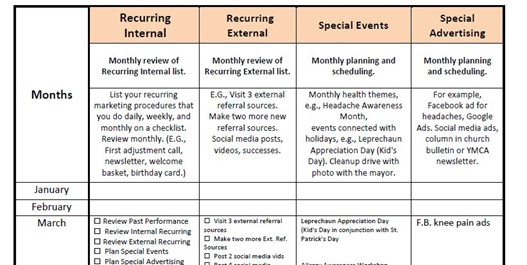
Plan your work and then work your plan, right? So, I have attached a sample marketing plan (link below at the end of the blog article) to help you outline what to do. It is a sample and gives structure to managing your marketing. We’ve used one like this for years, and it works. Make your own and customize it to fit your needs.

And stay tuned for a new service we will offer to help you with your marketing.

But for now, Happy Spring, and Plan your Future

Ed

Sample Marketing Calendar

Your Best Business Investment: Did you make First Adjustment Calls?

When was the last time you called your patient after their first adjustment?

We’ve advised this for years, and it is one of the many items on our Marketing Checklists. The procedure was simple: the staff handed the doctors a slip of paper with the names and numbers of patients who had their first adjustment that day. Then, on the way home, the doctor would give the patient a call to see how they were doing. I remember hearing from the staff that the patients loved getting a call from their doctor and felt it was an extra effort to ensure their well-being personally.

I was reminded of this when my wife, Barbara, took a phone call from the MD from whom she recently received a light skin surgery. She was impressed and delighted. (“Wow,” she said after the call. “I think I’ll call to schedule more surgeries this month!” She’s funny!)

But we live in a world where we are becoming more insulated from each other. We almost interact as much with Artificial Intelligence, electronics, and automation as with live people. Automation runs our shopping, our money, and our communication, even much of our medical care.

I just read a report this week that Google suspended an engineer from work who said that an AI program at Google was now sentient (conscious). He said that he had “startling talks” with a chatbot program.* And never mind the masking, social distancing, and lockdowns which I am sure we haven’t seen the last of.

It seems that honest, caring, and genuine interest from a live person, especially from someone who knows us, are vanishing human qualities.

And this is the niche where you and your team are uniquely qualified to own.
As entrepreneurs, we focus on business matters – we look at our scoreboard, analyze the numbers, and review our accounts receivable. We look at how we can grow our business and improve the bottom line. And all that is fine and part of our job.

But all the numbers, the paperwork, all the administration and marketing are for nothing if the personal connection you have with each patient is absent.

And this is what makes your service exceptional – the quality of connection you and your team have with each patient. The genuine interest in and authentic care for each patient, and the outcomes you deliver, are the heart and soul of your business.

Improving this is the best investment you can make for long-term success.

Carpe Posterum (Sieze the Future)

Ed

(Yahoo News)

Improve Patient Retention Through Gamification

winner running through the finish line

It all comes back to goals – helping patients achieve theirs.

Last week I discussed improving patient retention through excellent onboarding.

Onboarding is a 21st Century term meaning, in this case, those actions you take with a new patient to introduce and orient them to their new service. The analogy would be a new passenger coming “on board” a new boat. (The link to this article is below.)

The other activity I mentioned that can improve patient retention is also a 21st term: “Gamification.”

Merriam Webster says gamification is: “the process of adding games or gamelike elements to something (such as a task) so as to encourage participation.” The concept is not new, but it has become a science and is integrated into all video games. I cover this in detail in my book, The Goal Driven Business, which I recommend you purchase and use. (Link below.)

Games are native to our species. Even to puppies, as you see them rolling over each other. Kids love to play with their parents, and as they get older, with other kids, and then enjoy organized sports. The Olympic games began, according to one source, in 776 BCE. We love our games, and perhaps, we need them.

Awards

A game poses a challenge where you can overcome barriers and demonstrate your grit. If you win –hurray! Winning is the prize, but sometimes you also receive an award.

In ancient Greece, winners received an olive wreath as a crown. In modern Olympics, the winners receive bronze, silver, and gold medals. In some martial arts, as you advance in your skills, you are awarded different colored belts. When you graduate from college, you receive a nice certificate you can hang on your wall to impress your relatives! (sarcasm)

Your patient has accepted a challenge, along with you and the entire clinic team, to achieve certain health goals. So why not acknowledge or even reward the patient for completing specific benchmarks along the way?

Years ago, I recall some offices would have a special short ceremony for their patients once they completed their program of care. First, the staff would help the patient don a black robe used in graduation ceremonies and a graduation cap (mortarboard) and tassel. Then, they would take a polaroid snapshot (a brand of camera that produced instant hard copy photos) with the doctor and the patient in their graduation garb, give a copy to the patient and attach another to a bulletin board. I have even seen this in a hospital setting, just without the robe!

In Your Practice

Gamification can be applied in your office in many ways.

For example, after completing their 6th visit, the front desk could award patients a silver star sticker. After the 12th visit, they are awarded a gold star stuck to a coffee mug with the office name and logo. Finally, after completing their care program, the patient could receive a diamond star attached to an office t-shirt.

Gamification aims to keep everyone engaged in the “game” of achieving health goals.

One approach to bringing this about is to have a team meeting and go over this idea. Encourage unbridled creativity! Use the best ideas that make the most sense and run the program for three months on a trial basis. Set goals (and awards) for the team for percentages of patients completing their programs.

All these are examples of gamification. But even a “Glad you made it today Mrs. Jones. Good to see you and your daughter” is a kind of an award. Unfortunately, in life, we are rarely recognized for our accomplishments – and mostly for our errors.

So, compliment your patients for their courage to improve their health. It is a big deal and a major accomplishment that they even show up, let alone follow through with their care.

After all, games are fun. So, let the games begin!

Ed

Link to Onboarding Article

Link to The Goal Driven Business

Which is Better for You: Direct Marketing or Indirect Marketing?

Last week I sent an email with a link to Ode to Joy.

Ode to Joy is from Beethoven’s 4th movement of his 9th symphony, considered one of the top three symphonies ever created.

It was a short 5-minute rendition. It is beautiful and evocative – listen to it again. (Link below.) Plus, its performance was a masterpiece.

But it was actually an ad.

It was a brilliant advertisement for a Spanish Bank. It was promoting Sabadell Bank’s 130th year anniversary in 2012. According to one website, it has had 90 million views since 2012, while another posted in 2015 has received over 18 million views.

That is a lot of exposure. But does it generate new business?

This type of advertising is called brand marketing, or what I call indirect marketing. It is the opposite of direct marketing. Direct marketing, also called direct response marketing, tries to generate an immediate response. Knowing the differences will help you manage your marketing and make it more effective for your particular situation.

Direct Marketing

The goal of direct response marketing is to generate qualified prospects that respond to an offer. When you receive a card in the mail that promotes a free dinner about retirement funds, the company that sent you that mailer hopes you reply and attend the dinner and accompanying talk. At the dinner, a speaker gives a presentation with the hope of scheduling you for a private consultation later that week. When you see an ad on Facebook for a free manual, the advertisers intend that you respond and order their manual. The distinguishing characteristic of direct marketing is numbers – you can quantify the results of your marketing efforts.

Indirect Marketing

The goal for indirect, or brand marketing, is for the name of your business to be well known and well thought of. When you volunteer at the local food bank, co-sponsor a kid’s little league team, or simply provide excellent customer service, these are all examples of indirect marketing. The results of indirect marketing are difficult to identify immediately.

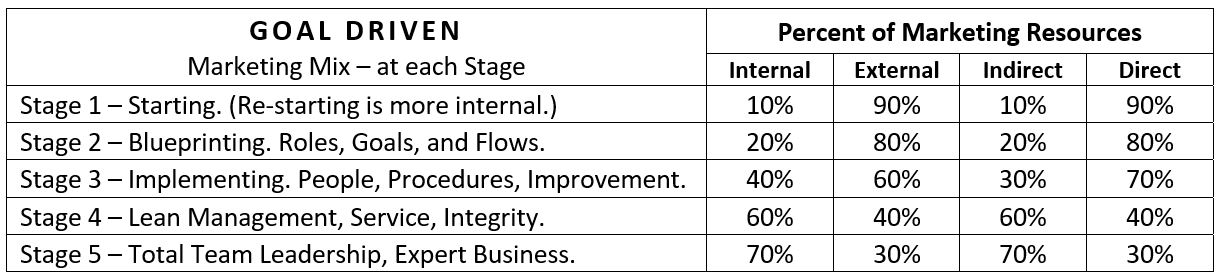
Until you are in Stage 4 in the growth of your business (about 75% or more full capacity), most of your marketing efforts should be direct marketing. Indirect marketing supports direct marketing, but even if your entire town knew about your business and thought highly of it, there is no guarantee that anyone would come to see you as a customer.

Handing out your business card to someone would be an example of indirect, personal brand building. However, handing out your business card with a handwritten note on the back that said something like “N/C screening in May for Joe M. Dr. EP” might be an example of a direct response marketing.

Marketing Mix – Direct, Indirect, and Internal, External

Another factor to consider in managing your marketing is how much should be directed externally – to non-patients and customers and how much should be directed internally to your existing and former patients and customers.

It has been my experience that too few practices are industrious enough with marketing to and communicating with their existing and former patients.

Below is a chart that gives approximate percentages of how to balance your direct and indirect marketing for your practice. I have divided the development of a business arbitrarily into 5 Stages. Figure each Stage to be about 20% your full capacity.

Telling your story and the successes of your services should never end, regardless of how successful you are. Change your marketing strategies depending at what Stage of development your business is in — but keep marketing.

Carpe Posterum (Seize the Future),

Ed
GoalDriven.com

Ode To Joy

The Mental Immune System

mental health, immune system, goaldriven.com

A healthy body has a well-functioning system to protect it or make it physically immune from disease. I am sure you have seen this occur with your patients as you adjust and treat them.

But there is no doubt that the mind also affects the body. In your practice, could you improve your patient’s mental immune system? Of course, and already do. I am sure you bolster your patient’s mental immune system even though you or your team may not have looked at it this way. Providing your patients with genuine positive feedback and showing them gratitude for their regular visits can go a long way in enhancing their mental well-being.

A mental immunity system would help individuals be protected, or immune, from negative influences or circumstances in the environment. This would be the ability to “roll with the punches” and keep one’s stress level low despite potentially stressful situations. You can’t be expected to help your patients achieve this in all areas of life, but you can help them with this regarding their health.

Your patients and clients are under a constant deluge of frightening and drug-related messages that can be demoralizing and lead them to less than optimum health choices. There is not much incentive for large corporations to promote exercise, eat organic food, take vitamins, and encourage people to be nice to their neighbors. Instead, there is more money in promoting drugs and fast food, and beer. It took a long time and great expense to stop cigarette advertising, but pharmaceutical advertising has now taken its place.

So, it is for this reason I recommend positive health advertising to your patients regularly. The more they know and understand how to maintain their physical health, the better prepared they will be to critically interpret the corporate advertising of products masquerading as “healthy.”

Here are some methods to improve your patient’s mental immune system regarding health:

  • Extraordinary customer service. Through empathic communication, get to know your patients so that they know you care about them and can trust you. You are in their corner and have their “back.”
  • Positive reinforcement. Genuinely recognize their good efforts to improve their health and any positive responses to your program of care.
  • Table Talk. Listen to their stories and provide quick positive educational tips about health related to their story.
  • Educational themes. Pick an educational them each week and have literature for patients.
  • Patient successes. You can include notable case successes with your education themes each week or each month. Spread the good news!
  • Lending Library. Stock your book shelves with books on subjects you would like your patients to read. Encourage your patients and staff to study. (See a sample list of books we selected a few years ago over at pmaworks.com.)
  • Workshops. These can be done virtually or in person.
  • Newsletters. These can be electronic as well as hard copies by snail mail. They help “keep the conversation going.”

You are the positive lighthouse of health in a storm of gloom and unhealthy corporate products. You can improve the physical immune system of your patients by also improving their mental immune system regarding health.

Ed

the goal driven business by edward petty

buy the goal driven business by edward petty

Image from: Kellogg, Yevgenia Nayberg

The Five Engines Driving Your Business Towards Your Goals

A service business needs 5 different engines to become a Goal Driven Business

Having goals is not enough.

Your business needs power, and lots of it, to propel it to its goals. There are five primary engines that you need to drive your business to its goals.

  1. Customer Service and Outcomes
  2. Marketing
  3. Leadership
  4. Management
  5. Personal Power

Most businesses have a few of these engines already firing. However, in most cases, full power has not been realized. This means that you may not have enough propulsion to make it to your goals.

Let’s take a brief look at each one, and as we do so, consider how each one rates in your office: half on, fully on and functioning, or barely functioning?

Customer Service and Outcomes. As a doctor and provider, your primary focus is on providing the best service and outcomes possible. This is both in terms of the subjective satisfaction of your patients as well as the objective criteria expected in your results. But to achieve this, you need support, and this support is provided by the organization you put together as the CEO.

Marketing. As the CEO of your business, your organization must first generate customers. As a businessperson, marketing will always be your number one and primary focus. A business is dependent upon the customer. In fact, it could be said that a business is the customer. If you are not providing a service to people that pay you for your care, you do not have a business.

Leadership. An essential quality of the CEO is leadership. Leadership helps define the goals of the business and keeps the team inspired to reach them. It also insists that they are achieved.

Management. In most offices, I have seen attention placed on service, marketing, and leadership. Management, however, is often not given enough attention. Management works out how we achieve our goals. This can be a laborious and difficult process that most business owners just don’t have the time for. Plus, you are paid for your services, not for “managing.”

Personal Life Management. Lastly, often brushed aside, is how well your personal life is managed. Are you happy, and is your relationship with your family and friends healthy? Is your personal life in good order? Too often, because of the stresses of work, our personal lives can drift off in directions we later regret.

THE MANAGEMENT ENGINE

Using the Goal Driven System as explained in my book, The Goal Driven Business, you can learn how to get each engine fully firing so that you have abundant power to make it to your goals.

It has been my experience working with offices across the country that the weakest engine is always management. This isn’t true when the office is just beginning or stays at 40-50% capacity. But once the volume picks up, there are more details that need to be addressed. In addition to providing outstanding service, there is… everything else.

Management deals with “everything else.” And when it doesn’t or can’t, all these untended-to “Everything Else’s” start gumming up the works. Paperwork gets backlogged, phone calls and emails stack up, staff becomes disengaged, patient communications get cut short, and marketing gets put on the back burner. Soon, there is just too much work to do. This clogs up and limits your capacity to provide more and better service and adds more stress to you and the team.

The default solution, which occurs naturally, is a reduction of the volume of services to a more comfortable level. This is the Practice Roller Coaster, the syndrome that causes continuous stress and unfulfilled potential. Service volume goes up, it can’t be sustained comfortably, so the volume comes down.

But good management solves this. It takes you off the Practice Roller Coaster and allows your service volume to continue to increase, unimpeded. And with more services, with good management, there will be more profit.

Of course, if this was a simple solution, more offices would be seeing many more patients and doing much better. The fact is, it is not a simple fix as there are unseen barriers, booby traps, and dead ends that thwart your best efforts to streamline your management and procedures.

I cover this in my book, The Goal Driven Business. I shine the light on the hidden barriers and show you a path that, regardless of your personal skills and personality, you can follow and make it to your goals. The book covers a system of business development I call the Goal Driven System.

Of course, essential to effective management is having a manager! Oddly enough, there are no in-depth training programs for this role, and as far as I can recall, there never has been one. I cover the reasons for this in my book. Yet the ROI on an effective manager is 3 to 4 times, or more, than what you pay them

According to Gallup:
“Based on our largest global study of the future of work, Gallup finds that the quality of managers and team leaders is the single biggest factor in your organization’s long-term success.” (It’s the Manager, Clifton and Harter)

In October, we will be launching our first training program on the Goal Driven System that will include in-depth training for practice managers – and their CEO’s.

If you are interested, contact me  for more information about the Goal Driven System Program and how you can turn your team into Goal Drivers!

Meanwhile,

Seize the Day!

Ed

Why What You Stand For is Important

Ed Petty, at Goal Driven, talks about masks for kids.Why What You Stand for Is so Important

I want to tell you about my experience on TV talking about masks for kids, but first, here is a related short story…

A few years back, an office asked me to meet with them for lunch. They wanted to discuss how their office was doing and if I could help them.

I liked the doctors and had known them for some time.  They had a group practice and had been in business for several years.  We met over sandwiches, and they said they had been working with a consultant who emphasized “evidenced-based” chiropractic.

My response could have been better as I look back on it now.

Barely concealing my disdain, I asked them whose approval they were seeking. Wasn’t there enough “evidence” from the results that they had with their patients over the years? Sure, double-blind studies are good for validation – but didn’t they already have enough evidence from their happy patients and their remarkable outcomes?

Had I been trying to “sell” them on our services, I would not have acted so irreverently to their seemingly serious question. But, instead, I tried to re-convince them that they did have enough proof, and the problem with their office (one of many problems) was that they were not promoting the successes they routinely achieved with their patients.

The doctors seemed equivocal about their services, so I asked them if they were committed to their profession and helping their patients reach their health goals. Unfortunately, I didn’t get a straight answer.

It seemed that they were seeking approval from some authority –  rather than from their neighbors who struggle daily with pain and poor health.

Now, years later, I recently had a friend see one of the chiropractors I met for lunch years ago. The doctor currently works as an employee for a local hospital and the office that he once co-owned no longer exists.

All this is a true story, and the lesson is that you have to have faith, confidence, and belief in your services, and mostly, in yourself.

You must stand up for what you know and use your voice to help others – find theirs.

You shouldn’t be too outrageous as this can completely alienate you from others, not unless you want to! But find your level of certainty, independence, and rebelliousness and help others to do the same.

Masks for Kids: I am on local television

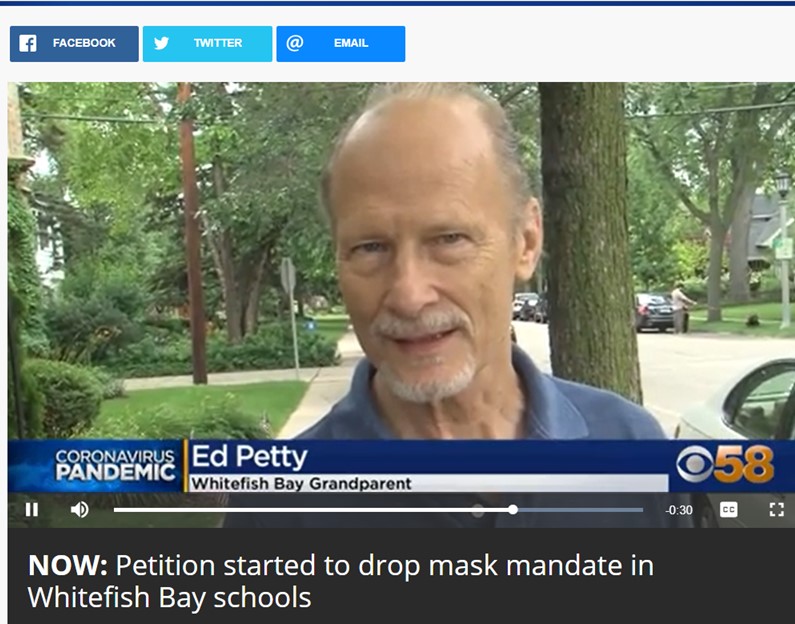
I was reminded of all this recently when a local TV station asked what I thought about masks for school children. I was on our main street, and a local reporter started asking me questions. You can watch my response and that of others here. Ed’s on T.V.!

Standing up for natural health care,

Ed

Buy my book, the Goal Driven Business. It is a distillation of my 35 years of in-the-field lessons about building a profitable practice and business. It will help you help more people. Go here to learn about the Goal Driven Business –A New Business Building Methodology for Professional Practices

GENERAL MARKETING STRATEGY — December 2020

marketing for prefessionals Time to prepare for the New Year’s marketing.

But before we leave 2020, here are a few tips to help you round out this crazy year and lay the groundwork for a fresh, New 2021.

For December, work “internally” with your existing network, including your active and inactive patients and your external referral sources. But prepare for external marketing for the New Year now.

INTERNAL

The Team – Your First Line of Marketing
Every member of your office is a marketer – everyone sells health. 2020 has been one heck of a year. Why not acknowledge your staff as Health Hero’s with a pin, a certificate, or plaque, perhaps with a bonus if there are any funds available? You all deserve many “thank you’s.”

Holiday Cards and Letters to your Patients
Send cards and letters to both active and inactive patients. Recognize their good efforts to improve their health during this peculiar year and tell them that you look forward to helping them and their family stay healthy in 2021.

Health Never Takes a Holiday
Post a sign in your office in December that “Health Never Takes a Holiday” and schedule patients through December to January. We have a customizable poster on our Member’s site, and sample posters here.

Keep the Conversation Going.
Send out regular emails to patients. Email is more effective than social media, according to many studies, but social media has its place too. Assign email and social media posting to someone. A simple four-paragraph informal health tip from the doctor shows that you care and help improve your patient’s health. It is better that your patients hear from you than from the local chain store pharmacist.

Poinsettia Giveaway
Some offices have done well by giving away free poinsettias, or another holiday plant, one per family. Include a gift certificate with the plant for family members or friends. (See Member’s site for gift card samples.) Make a special arrangement with your local florist for a discount.

Patient Education
Now, more than ever, provide health tips for your patients to combat the heavy advertising of COVID-related reports. Stress is amplified by a lack of knowledge. Good education can help lessen the fear and help keep your patients stay healthier and happier. Plus, educated patients remain with you longer and refer more. There are many approaches that work, including: table talk, newsletters, whiteboards with “Patient Education Prompters,” and short five-minute weekly video health tips. The more you teach, the more you reach.

Donation Drives
Holiday time always brings an increased demand for helping those less fortunate. Within your office set up a collection area for any of the following programs and promote it in your newsletter. There are also other times of the year where donations are welcomed and needed. These can be scheduled throughout the year. Here are some sample donations:

  • Coats for Kids
  • Food for Families
  • Toys for Tots
  • Blood Drive
  • School Supplies
  • Animal Shelter $25 in exchange for first day services.

Also, you can support drives at local churches or gyms. EG “Free first-day services for every donation a member of YMCA makes to the homeless fund.”

Giving Tree/Angel Tree
The Giving Tree/Angel Tree Project is a great way to bring community awareness to your office. It is a simple project that can assist your patients to help others where they might not otherwise have the opportunity to do so.

EXTERNAL

Show Appreciation to External Referral Sources
Send a Holiday Card to any business or individual outside of your office who referred a patient to you or helped you with your marketing. Make sure you include a card of thanks and perhaps a fruit basket or other small gift. Let them know that you are looking forward to another year working together for better health.

Internet
Review your website with your Internet company. Set up a consultation with someone to review how well it is drawing new visitors. Make plans for improving traffic and conversion for the first three months of 2021.

Sample Plan for Special Events
January. Video series about improving the immune system: 10 Proven Shortcuts to Improving Your Immune System: 15-minute video every Friday. Include guest providers. PROMOTE these.
February. Valentines. Have a Heart gift certificate. Donation Drives.
March. Saint Patrick’s Day – Leprechaun Appreciation Day – A special kid’s day.
April. Earth Day. Community Clean-up Drive. Include external alliances to help.

100’s More Marketing Ideas
For 100’s more marketing ideas that have worked, if you are active with PM&A, go to our Member’s site, www.pmamembers.com. If not, we still have many effective marketing procedures right here on this blog.

Meet with Your Consultant
All offices are different. Some need fast action direct marketing — others benefit most from long term development of their external network. Meet with your consultant to make plans for the first part of 2021.

MARKETING MANAGEMENT

In over thirty years of marketing practices, I have found the following two factors to be the most important:

Someone to Coordinate
It is essential that you delegate someone to coordinate your marketing as a project manager. Too often, marketing does not get done because, well, no one person is responsible. This is a major cause of the Practice Roller Coaster. While your entire office and everyone in it, staff and doctors, have marketing roles, one person aside from the doctor needs to ensure each project and procedure is implemented.

Goals and Attitude
Commitment to your goals and the right attitude undercuts everything. How strong is your desire to fulfill the mission of your office? Does the WHY? of your business enliven you each day, and are you happy about it? (Yahoo! Can’t wait to get to the office to see my next patient!!)

Of all the projects and procedures mentioned and the hundreds not mentioned, your drive to your goals and your attitude about achieving them is the most fundamental component to marketing success. Work and improve on this each day.

Ed Petty

Bonus Article: Health Tips from Mercola.com

Take the Middle Road and Educate.

“In other words, people may be dying for the need of Chiropractic, and yet they will refuse, unless they have been educated to its character and their need of it.”
B.J. Palmer (The Story of Selling Yourself)

I try to visit Facebook at least once a week. When I do, I sometimes see posts by others labeling the behavior of the public as “sheeple.” The term, I guess, refers to people acting obediently like sheep. The context usually includes those who believe that COVID-19 is a scam and view people who wear facemasks and observe CDC rules for quarantining as weak and stupid, and easily manipulated.

There certainly are indications, as well as precedents, that can support this view. The promotion of potential threats to generate fear has often been used to motivate people. Think of all the weapons of mass destruction that we were told Iraq had – which they didn’t have — that justified a 3 trillion-dollar war (estimated, Wikipedia) to the U.S. alone—not counting up to 400,000 killed. Someone made money off that scam.

There are over 100 cataloged types of biases, and we all have our own odd fears and weird ideas. Included with this is our basic “I-am-right” mechanism that makes others wrong and emboldens our ego.

Recently, I was talking to someone on their speakerphone while they drove in their car. They were wearing a mask and their voice was slightly muffled. I thought to myself that it was odd to talk to someone who was wearing a mask while in their car. Then, I was reminded that the person I was talking with has unselfishly devoted his entire life to taking care of his severely health-compromised daughter.

We all have our own stories and fight our own battles – with the best knowledge we have.

Another method to control people is to dissuade them from education and from learning to think critically and question authority.

So, I invite you to consider this as your #1 duty as a doctor – and as support staff — to educate your patients and community. Doctor, after all, means teacher.

People do not know what you know.

Perhaps they don’t want to know, are too tired, or seem too lazy to make an effort to learn. Maybe they have already made up their mind, and their view reinforces their own identity. But don’t give up on people — they are part of your family. They are your brothers and sisters.

Use newsletters, social media (even Facebook!), webinars, and especially Table Talk.

Educate because you care for people. Market your services from an attitude of compassion.

We are not sheep. We just don’t know. And regardless of what we say, privately, we look to you and your integrity — for your wisdom, your help, and your friendship.

Ed

The Story of Selling Yourself by B.J. Palmer

All about TELOS and Three Actions to Start the New Year

Goals: Telos
The Greeks believed that everything had its own innate goal – or Telos. Telos means ultimate aim or purpose of something. The Telos of an acorn is a tree – the purpose of a pencil is to write.

Steven Covey lists Beginning with the End in Mind as an essential habit in leadership and effectiveness.

Now is a good time to review the Telos of your office. What is its innate purpose? There may be a few of them.

Take it a step further – what are the values and standards in which the office must aspire to in order to achieve this mission? For example, “Deliver WOW through service?” (A core value of Zappos).

Reviewing these often and keeping them in mind will assist you and your team to manifest the tangible outcomes of these goals – more people helped and more income collected.

Your Patient’s Goals: Health Never Takes a Holiday
Your patients have made a goal for better health. Don’t’ let them down – help to keep them on their path to a pain free, functionally improved, and healthier life. Here is a desk poster for you to remind patients to keep their appointments over the Holidays. Link

Two Marketing Engines that Help You Reach Your Goals
One aspect of your clinic’s goals should be marketing. Marketing takes many forms, but ultimately it results in more people receiving benefits from your services.

Marketing gimmicks come and go. They work for a while, and then, soon enough, you find that that “hole” is “fished out.” Special promotions and direct marketing avenues need to be pursued. They work and are especially useful for new offices. But they need to be changed often – marketing channels get clogged quickly and the public tires of spam offers.

There are two forms of marketing, however, that will never wear out: extraordinary customer service and outcomes, and your network.

  • Extraordinary Service. Superior service will be THE distinguishing factor that differentiates your business from others. People want to go to the best provider – 5 Star reviews work – for now. But as Internet review systems get hacked – people will look for the best and rely more on word of mouth and endorsements. Simply – be the best at delivering the best.
  • Your Network. Those people who like you form relationships with you and others. Most offices have a network of supporters but are rarely nurtured. These supporters can and should be developed so that you create a network of alliances – people and business who all share your goals for better health are willing to send customers to each other because of their familiarity and trust.

Before the year is out, or just as the New Year begins, consider personally meeting with anyone in and out of your office who has sent you a patient, or supported you in any way. From patients to allied providers to the autobody repair shop down the street, send them a nice and unique gift, or a personal card, or make a phone call thanking them. Tell them you look forward to working with them and seeing them in the New Year. They are part of your network.

Lastly, on a personal note, we want you to know how much we appreciate all the great work you and your team do in helping people improve their lives. If you can, imagine all of us – you, and other offices like you, all of us working diligently as a positive force to make the world a better place.

This is a noble goal – and one we share with you in the New Year. We’ll see you then!

With admiration and respect,

Ed, David, and all of us, at Petty Michel & Associates

8 Successful Marketing Attitudes

“Marketing is an inside job,” one business owner told me years ago.

He meant it first starts with your attitude and your drive to reach your goals.

Your mental outlook will determine the effectiveness of all of your marketing activities. The good news is that your attitude is something which you do have control over. Even if you have difficult personal and environmental factors acting against you, you still have a choice on how you decide to act. The way you look at your world is entirely up to you.

Practice marketing is ultimately an “inside-out job,” and though marketing includes “outside-in” activities, such as advertising, its success is dependent upon what is happening on the “inside.” On a scale of 1-5, where “5” is strongest, and “1” is weakest, you should work daily to reach a “5” on each of these eight attitudes.

At a team meeting every few months, you can hand this article out to each team member and have each person grade (1-5) how the office has been operating regarding each attitude. You can also have a team member summarize one particular attitude and describe it to the rest of the team in their own words. These attitudes are your marketing muscles that can drive and maintain your growth. Keep working them and making them stronger.

I have observed these eight attitudes in common with successful providers and business owners. I encourage you to use them yourself.

1.  Friendliness and Cheerfulness. When you smile, the whole world smiles with you. And that is what you want: your whole community smiling with you. A positive and cheerful outlook opens the channels of communication between you and your community. It is an unspoken “open invitation” for people to interact with you. The happier you are, and the more positive your outlook is, the easier all other marketing efforts will be. “Laugh, and the world laughs with you; Weep, and you weep alone….” From a Poem by Ella Wheeler (1883)

2. Interested Attitude. Where I have been successful in selling and marketing services, this has always been my secret: be interested in the other person. Don’t fake it. Just start with whatever strikes your curiosity. You will find that having an honest interest in people is one of your best sales and marketing tools. People respond positively to sincere curiosity about them. “Betty, where did you find those blue shoes?” “So Frank, I have always wondered, why do you guys call yourselves the Kiwanis?” You don’t have to be interested in everyone. Be courteous and be professional, of course. But you’ll find that you can find something of interest in most people. Since your interest is genuine and not simulated, the other person can begin to trust you. You are not a phony operating off of a script. Even if your curiosity makes you seem a bit forward, at least you are honest. Behind your interest should be a desire to understand the other person, and this requires empathy. This kind of interest begets communication which lays the foundation for the other person knowing you, liking you, and trusting you.

3. “Get to Know Me” Attitude. You should want the community to know you. You should want them to know that you are an excellent provider and that your business gets results. Don’t assume people know what you do – or even care. Maybe they know you are a provider but think you are retired, or too busy and no longer taking new patients, or too important to talk to them. And let them get to know about you personally– that your dog’s name is Louie and you are not from Canada, even though you are very nice. Be willing to have the whole community know all about you, and believe that once they do, they’ll like you. Don’t hide. We all spend too much time in boxes – our houses, our offices, our cars, and other buildings. Get out of the boxes and be willing to be seen and heard. “It is better to be looked over than overlooked.” (Mae West)

4. “Gratitude Attitude.” This is a term often used by Zig Ziglar, meaning be grateful and appreciative. The “Gratitude Attitude” melts the ice between people. It shows respect and honors those around you, especially patients, prospective patients, your teammates, and of course, your family and friends. People hate to be ignored and too often we take for granted the amazing souls around us each day. Be thankful to be a provider and business owner and that you have an opportunity to help people. Show your gratitude to others. Let them know how you appreciate them. Count your blessings daily. “Gratitude is not only the greatest of virtues but the parent of all the others.” (Marcus Tullius Cicero. 106 BC -43 BC)

5. Service Attitude. Be a missionary on a mission to help. Be a giver. In the office, think ahead of what each patient needs each day and make sure they get it. Outside of the office, realize that people are in trouble, have problems, and want relief, so help them. Many are looking for answers. Offer information, community services, consultations, and be a “do-gooder.” Find out what people want and help them achieve it – through your services or another’s. It has been said that “The hole that you give through — is the hole through which you will receive.”

6. Big Capacity Attitude. “Whatever the mind can conceive and believe, it can achieve.” (Napoleon Hill.) Hold the concept that everyone in your community should receive your services. THINK BIG. Think abundance. Be willing to meet hundreds of new people each day and be open to scores of new patients. The mechanics of paperwork, finances, and procedure will all follow. Don’t let yourself become encumbered mentally by these things now. Get rid of the yellow light in your business and turn them all green. “Think little goals and expect little achievements. Think big goals and win big success.” (David J. Schwartz, The Magic of Thinking Big.)

7. Industriousness Attitude. Your outlook towards moving the business forward has to be a vigorous one. You must be ready to jump into the thick of things any time and get the work done. You will need a “can do, will do” attitude, one that enjoys being productive. It takes much more energy and effort to get and keep a business going than most people think. Marketing is simply physics. If you expend energy into your business and the community, there will be a reciprocal force — in terms of goodwill and new patients – coming back. Like planting seeds in the spring. You harvest what you sow. Don’t blame the politicians if the tomatoes didn’t come in at harvest time this year because you were too lazy to plant them. The more you sow, the more you can reap.

8. Have Faith, Confidence, and Belief. Be forthright and confident about the benefits of your profession, your skills as a provider, and the services your office can bring about. From this knowledge, you can be authoritative in telling your story and scheduling new patients. Know that you can help your patient. Believe and decide that they will win and you will succeed. If you are confident in what you are selling, then others will be too.

Edward Petty

Children’s Health Resources

Happy Health ChildThe following are some sources of information regarding the health crisis affecting our children.

===

The Children’s Health Defense is a powerful organization that is on the front lines in fighting corporate propaganda promoting harmful drugs for kids. They have many lawyers, including Robert F. Kennedy, Jr., working on exposing false information and corruption regarding children’s health.eBook Sign-Up—The Sickest Generation
Free eBook: The Sickest Generation: The Facts Behind the Children’s Health Crisis and Why It Needs to End Children are the key to a successful future and a prosperous nation, yet American children have never been sicker with a vast array of chronic illnesses. (Also available in Spanish.)

The Pharmaceutical Industry’s Front Men
By the Children’s Health Defense Team

The Medical Journals’ Sell-Out—Getting Paid to Play
By the Children’s Health Defense Team

Science Library
This database contains hundreds of peer-reviewed, published articles on environmental contaminants that are implicated in the rise of the childhood epidemics we are currently experiencing in the U.S. and other industrialized nations.

===

Pathways is a long-standing publication with health articles that is free to members of the International Chiropractic Pediatric Association. Its website has links to many articles, a few of which are below:

Pathways to Family Wellness

Are We Making Our Children Sick?
http://pathwaystofamilywellness.org/Nutrition/are-we-making-our-children-sick.html

Natural Immunity
http://pathwaystofamilywellness.org/Informed-Choice/natural-immunity.html

Ear Infections in Kids: Natural Remedies to Ease Ear Pain and Enhance Function
http://pathwaystofamilywellness.org/Holistic-Healthcare/ear-infections-in-kids-natural-remedies-to-ease-ear-pain-and-enhance-function.html

===

There are many books on children’s health, and it is fascinating to search to find them. Commit to buying at least one per month, reading it, reporting on it to a team meeting, and placing it in your Lending Library. Have your team members do the same! Here are three:

Books

A Compromised Generation: The Epidemic of Chronic Illness in America’s Children Paperback – September 16, 2010 by Beth Lambert

The Vaccine-Friendly Plan: Dr. Paul’s Safe and Effective Approach to Immunity and Health-from Pregnancy Through Your Child’s Teen Years Paperback – August 23, 2016 Paul Thomas M.D.

How to Raise a Healthy Child in Spite of Your Doctor: One of America’s Leading Pediatricians Puts Parents Back in Control of Their Children’s Health Mass Market Paperback – May 12, 1987
by Robert S. Mendelsohn MD

Facebook versus Email and “Conversational Commerce”

It’s a New Year!

And if you are just reading this in March or September, it’s a new month or a new week!

Whatever time of year it is, it is always time to get the “Word” out your servcies.

It’s time to tell everyone in and around your office and community — about your chiropractic and professional services and how they should get them now!

But what is the best way to do this?

Well, obviously, with each person you see when you are seeing them. You – and your health team – have a captive audience. Sometimes referred to as “Table Talk,” this is your way of educating your people at the time of service.

You can augment this with new patient workshops that motivate, educate, and entertain your people. It is a free class but is part of their treatment program because you have found that people “get better faster and stay healthier longer if they get a better understanding of the health process we are doing together.” Also…“It assists with your treatment program and you get a better return on the work you put in. It is just a good investment!”

Then…don’t forget your team. They need to hear about the successes and case stories of how their office really helps people.

But your patients aren’t always in your office. What then? Shouldn’t your conversation with them continue? Other vendors are certainly getting their “word” out. Pharmaceutical ads are pervasive.

What about people who have not discovered you yet – how do best tell them about how you can help them and why they should see you?

Many of you make posts on Facebook in hopes that this will help market your services.

Does it?

What about email? Some of you subscribe to template emails that go out to your patients. How is this working?

I have some strong feelings about this subject — but first I wanted to see what others have said and what the studies show. Here is the question:

Which is the better medium for marketing:
Facebook or Email?

Which works better?

According to most of the surveys that I have seen, email is the winner.

But comparing both mediums is like comparing apples to oranges — both work depending on how much time and expertise you put into it.

But it stands to reason that if you have someone’s email, they are a subscriber and have given you permission to address them personally.

From a sampling of various studies and surveys (references at the end of this article):

“Where is the first place you go online in a typical day?”

  • Email 58%
  • Search portal 20%
  • Facebook 11%
  • News site 5%
  • My company’s website intranet 3%
  • other 3%

“Where do you look when you want a deal from a company that you know?”

  • Email: 44%
  • Company website:43%
  • Search engine (e.g. for coupon codes): 6%
  • Facebook: 4%

Email reaches 79% of the people you send it to (this is the global average inbox placement rate). On the other hand, Facebook’s organic reach has declined to about 1 to 6%, depending on your total number of fans.

So the stats and studies seem to show that you are going to get a better ROI from email.

Over the years, I have observed that patient referrals, patient visit average, and reactivations improve with regular emails.

Facebook and social media can help create familiarity and trust. From this you can direct people to your website for upcoming events or information. You can also buy ads that target specific types of potential patients and set up workshops or make special offers. I have seen this work on occasion very well

But the algorithms, or computational rules, for Facebook and other mediums are always changing and what worked last month may not work this month. Currently, Facebook is becoming more of a “pay to play” medium – peppered with inspirational forwards and political rantings!

With email, you own your list and make your own rules. Plus, it is nearly free.

Email is a direct and personal letter from you to another person.

It is authentic and genuine. It is the reader – and you, personally. It is not manufactured “health news” which is just a mash-up of articles from 1998.

In this busy and more automated world, genuine communication is becoming scarcer… and more valuable.

The biggest challenge is simply getting the email out.

Actually, this is the big problem with all of your marketing – who is going to do it — and when?

We have found some simple procedures that work for getting this done which I offer below. But first, let’s look at the future.

The Future: Trending…

The future medium will continue to be more direct communication for selling. The trendy term is “conversational commerce.”

“Consumers are increasingly relying on messaging apps for all forms of communication, whether personal, business, or commerce. … Messaging apps are becoming the preferred means of communication.” (emarketer)

Messaging is personal, it is one to one.

According to a research commissioned by FacebookIQ and Nielson:

“53% of people are more likely to do business with a business they can message.”


This means, when people visit your Facebook page, if they can chat with you personally, half of them will be inclined to come in for a visit.

You can take a look at a couple of applications – Chatfuel and Manychat – for inexpensive chat programs that you can add on to your Facebook.

You can also ask your webmaster to install a chat system on your web site. An example is websitealive.com.

But the force of all this is personalized communication, something that emails and sales letters and video letters have always done and continue to do better than Facebook.

A few weeks ago I received an email newsletter from a yoga instructor I have followed off and on for a few years. I had question so I sent her an email thinking she might answer it. She did. What’s more, she included a short personal video – directly to me! I am now considering buying her DVD’s when I hadn’t even considered it before.

So how are you going to “Get the Word Out?”

I recommend personally. One-to-one. In a conversation in the office and out of the office through email and maybe… chat.

A Simple Procedure to Get Your Emails Out

  1. Someone in Charge. Assign someone to coordinate your email messages and newsletters. (They can also coordinate Facebook and Chat.)
  2. Time to do the Work. Give them at least 4 hours per month to get it done.
  3. Monthly/Weekly Reports. Have them give you a monthly written report and review it with them. (Advanced: Include email stats and Facebook stats this month and if they are up or down from the prior month. Analytics!)
  4. Email Content. The email should have a 3-4 paragraph (or more) candid letter from the doctor written as if she is talking to “Mildred” or “Jeff,” or just to one patient in particular. You can call it “Health Notes from Doctor Ed.”Or, publish it as a short newsletter, and include a recipe (My Grandma’s Buffalo Chili. I don’t like it but everyone I have ever met loves it. In fact, my uncle claimed it got him his wife, Mildred. Here is a picture of Milly (lucky guy!)” [show picture]
  5. Dictate it on your way to or from work and have someone edit.
  6. Email Service. Use Constant Contact, Mailchimp, or another service and send out your mail.
  7. Frequency. Do this 1-3 times per month. Keep it simple.
  8. Promotions. Attach a monthly promotion to it every now and then.
  9. Funky Office Fluff. Add recipes, success story, local news, or other interesting notes every now and then. (Think of over the back yard fence, neighbor to neighbor, chatting about local news.)
  10. Continue the Conversation. But most important is continuing your conversation with patients. The email is just you continuing your “Table Talk.”
  11. Messaging! Add a messaging application to Facebook and to your website.
  12. Don’t Get Addicted to Social Media. Don’t get sucked into Facebook drama!*

Remember that a practice is a network of relationships built and sustained in part by communication. Now and then attach a promotion to your email and this is one of the least expensive forms of marketing you will ever do.

Keep the conversation going…and going and going.

Till next time,
Ed

(*Facebook Drama. Social networking definitely has positive uses. But, according to one of its founding executives, it has negative effects. In an interview at Standard School of Business, Chamath Palihapitiya, (known as “C.P.”) who joined Facebook in 2007 and became its vice president for user growth, says that he feels tremendous guilt for the company that he helped make. Facebook, and others he says, have succeeded by “exploiting a vulnerability in human psychology.” “I think we have created tools that are ripping apart the social fabric of how society works,” he told an audience at Stanford Graduate School of Business. He hasn’t used it for years and won’t let his kids use it either!

“The short-term, dopamine-driven feedback loops we’ve created are destroying how society works,” he said, referring to online interactions driven by “hearts, likes, thumbs-up.”

It is a great interview that you can watch or listen – link at the end of the article.)

https://www.campaignlive.com/article/facebook-study-53-consumers-likely-shop-business-message/1404632

Email Marketing vs. Social Media: Is There a Clear Winner?


https://www.mailmunch.co/blog/email-marketing-vs-social-media/
http://image.exct.net/lib/fe641570776d02757515/m/1/SFF1-TheDigitalMorning.pdf
https://returnpath.com/wp-content/uploads/2015/10/2015-Deliverability-Benchmark-Report.pdf
https://support.getresponse.com/uploads/2016/01/The-State-of-Email-Marketing-by-Industry-January-2016.pdf
http://image.exct.net/lib/fe641570776d02757515/m/1/SFF14-The2012ChannelPreferenceSurvey.pdf

11 Reasons Why Your Email List Beats Social Media


https://manychat.com/
https://www.websitealive.com/alivechat/
https://www.emarketer.com/Article/Digital-Content-Advertising-Key-Revenue-Generators-Messaging-Apps/1013247#sthash.OEDM1ML5.dpuf
https://www.campaignlive.com/article/facebook-study-53-consumers-likely-shop-business-message/1404632
Talk on social consequences of Facebook. https://www.youtube.com/watch?v=PMotykw0SIk

Oklahaven “Have A Heart” – February 7-14th

Oklahaven, a non-profit children’s chiropractic center has been dedicated to making sick children well using natural, drug-free chiropractic care since 1962. To help fund their efforts the Annual Have A Heart Campaign is held in conjunction with Valentine’s Day each year.

It’s not too early to start planing your own “Have A Heart” Campaign for your office bringing a global awareness of the power of chiropractic for the children in your own community while helping out a greater cause!

If you’d like to participate, a complete marketing kit is available directly through Oklahaven simplifying the event preparation for your marketing coordinator.

Click here for a pamphlet with more details or visit the Oklahaven “Have A Heart” web-page.

Sign up for “Have-A-Heart” 2018 at http://www.chiropractic4kids.com/


November and December Marketing — and Your Higher Purpose

Petty Michel Associates Practice Promotions

November and December are special times for patient marketing, whether you are promoting to prospective patients, active, or inactive patients.

Usually, we have found that internal marketing is better during this time of year as you don’t need to compete with commercial businesses as they slug it out in an advertising frenzy. You can prepare now and schedule your external promotions and community services for January and February. Of course, if you see an excellent opportunity for external marketing now, take it. But the primary focus should be internal for these two months.

November and December are “cozy” months. In North America — we have Thanksgiving. This is a time we give thanks for all our blessings and gifts and family and friends. It is a time when people feel grateful. Christmas is also a time of good cheer and giving, as is Hanukkah and other holidays.

And, for some of you, it is also the season of the yearly hunt — when you bring home the ring tail pheasants, the turkeys, and “da ‘tirty point buck.” (Wisconsin-ese for “the 30-point buck.”)

Your promotions should align with the spirit of the season to be most effective. Donation drives are often held. There are many churches and associations in your town that need help as they prepare to assist the less fortunate.

“Toys for Tots”, “Food for Families”, or “Coats for Kids”, are many popular promotions by local media stations. I don’t doubt that they are helpful, but I do sometimes question their sincerity.

Of course, you want more customers, that is the nature of business. But you must lead with your mission statement first.

Any promotions should stem from your higher purposes.

The Higher Purpose Company
In The High Purpose Company, (Arena, 2007) Christina Arena reports on her team’s study of 75 companies’ efforts at Corporate Social Responsibility (CSR).

She shows how corporations, by doing good, by providing better conditions for employees, more sustainable sourcing of raw materials, and contributing to beneficial causes in their communities, generate more income.

“The central findings of my research can be distilled in the following way: superficiality fails whereas authenticity prevails. Companies that falsely approach corporate responsibility as a form of marketing, public relations, or even philanthropy don’t produce the most meaningful results. In fact, they often waste their money and create additional liabilities. Conversely, companies that truly approach the practice of corporate responsibility as a fully integrated business strategy, wisely investing in profitable solutions to meet unmet social and environmental needs and problems find their performance greatly enhanced.”

According to the Harvard Business Review, business spent more than $15 billion in 2016 on Corporate Social Responsibility (CSR) programs. (Davidson, July 7, 2016) And according to, Linda Novick O’Keefe, founder of Common Threads, “that number is rising as businesses see signs that investments in CSR improve company performance, talent recruitment and retention. (O’Keefe, 2016) “Giving in Numbers”, a study published by the CECP that analyzes giving and corporate societal engagement trends, revealed companies that increased giving by at least 10 percent between 2013 and 2015 actually experienced upticks in revenue and pre-tax profit, while all other companies saw a decrease in both.”

Your “WHY?”
Marketing must be honest, and it has to tell why you are doing the marketing. As Simon Sinek reminds us:

“Very few people or companies can clearly articulate WHY they do WHAT they do. By WHY I mean your purpose, cause or belief – WHY does your company exist? WHY do you get out of bed every morning? And WHY should anyone care?

People don’t buy WHAT you do, they buy WHY you do it.

All organizations start with WHY, but only the great ones keep their WHY clear year after year.” (Sinek, 2009)

I recommend finding charities or causes in your community that your patients care about. That you care about. Then, go talk to the head of the charity yourself – get involved – personally. Emotionally.

One office paid their staff for one hour for every two hours they went out of the office and worked on a community project.

And it doesn’t have to be charities. A Kid’s Day with “Saturday with Santa” can be a ball. One office holds a patient appreciation party with their patients each December with a Christmas Elvis impersonator singing Christmas carols. The one I attended was packed, and a little wild. But everyone talks about it for the rest of the year.

Your patients, and your neighbors, want what you want – a better and healthier community. Communicate that in all your promotions and you’ll get better results, and have more fun.

And, many thanks for you do from all of us at PM&A!

Ed

A list of sample promotions on our web site – see reference below.

References

Arena, C. (2007). The High Purpose Company. Harper Collins.

Davidson, R. H. (July 7, 2016). CEO Materialism and Corporate Social Responsibility.        Harvard Law School Forum on Corporate Governance and Financial Regulation. Retrieved from https://corpgov.law.harvard.edu/2016/07/07/ceo-materialism-and-corporate-social-responsibility/

O’Keefe, L. N. (2016, Decembr 15). CSR Grows in 2016 as Companies Embrace                Employees’ Values. Huffington Post – The Blog. Retrieved from https://www.huffingtonpost.com/linda-novick-okeefe/csr-grows-in-2016-as-comp_b_13657368.html

Sample Promotions. Chiropractic Practice Marketing Ideas For 2016. Retrieved from   www.pmaworks.com: http://pmaworks.com/observations/2016/09/20/chiropractic-practice-marketing-ideas-for-fall-2016/

Sinek, S. (2009, September). Simon Sinek How Great Leaders Inspire Action. Retrieved    from TED Ideas Worth Spreading:  https://www.ted.com/talks/simon_sinek_how_great_leaders_inspire_action

Using the Power of Simplicity to Develop Your Practice

“The way we’re running the company, the product design, the advertising– it all comes down to this: let’s make it simple, really simple.”     Steve Jobs  (Walter Isaacson) 1.

If you could simplify your business even more than it is, you would make more money and have less stress.

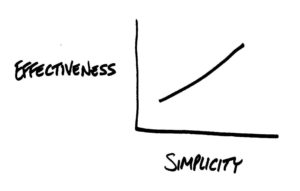
There is a direct relationship between simplicity and productivity, and an inverse relationship between complexity and productivity.

The most successful businesses have capitalized on this fact. This was one of Apple computer’s unique selling propositions – to focus on the simple and eliminate what wasn’t essential.

From its inception, the Apple Macintosh computer was designed with simplicity in mind.  Other companies have focused on simplicity: McDonalds order via drive-through, Ikea with its simple design, and Amazon with one-click ordering.

Simplicity Pays

Siegal-Gale is an international marketing firm that has studied simplicity in business and has been able to profile and rank businesses according to their simplicity. They call this the Global Brand Simplicity Index and have found that those companies that rank the highest, also outperform companies that rank as more complex. Their report states (2):

  • 214% – How much a portfolio of the world’s simplest brands has beaten the average global stock index since 2009
  • 69% – The percentage of consumers who are more likely to recommend a brand because it provides simpler experiences and communications
  • 63% – The percentage of consumers willing to pay more for simpler experiences

What Does This Mean for Your Practice?

You want to simplify the experience your chiropractic (or other) patient has in your office. From the first phone call, first appointment, examination, report of findings, patient finances, and scheduling, discover ways to simplify your procedures.

Your intake forms may be redundant or complicated, there may be too many rote statements or “scripts” for your staff to say to patients, or there can be extra pathways that your patients have to travel, like so many rabbit trails, where they can get confused and the flow slows down.  Staff, or doctors, may have too many decisions to make at each visit.

For example – what extra therapy should the patient receive? Not knowing, I have heard support staff simply ask the patient what therapy they wanted today, as if they were ordering a latte.  And as we know, there are definitely too many codes and documentation rules to follow for the doctor. Going total cash is one solution, but intelligent software, dictation, and scribes are other solutions.

Many, if not a majority of the more profitable offices that I have worked with over the years practiced what could be called “straight” chiropractic.  The straight practice (no additional modalities) works well, when it does, because its procedures and flow are simple. It is usually more profitable because extra overhead hides in the complicated.

Focus: Eliminate All but The Essential

Steve Jobs again: “People think focus means saying yes to the thing you’ve got to focus on. But that’s not what it means at all. It means saying no to the hundred other good ideas that there are. You have to pick carefully. I’m actually as proud of the things we haven’t done as the things I have done. Innovation is saying no to 1,000 things.”— Steve Jobs, WWDC 199(3)

I am not advocating no supplements, no exercise physiology, no electrical therapy. But to be honest, how much of this gets used in your office? I know offices — right now, and have known hundreds more, that have equipment lying around unused or bottles of vitamins collecting dust on overlooked shelves.

444378-simplicity

You have to embrace first only those unique outcomes that you can deliver. Work backwards and add only the most critical steps. “Begin with the end in mind”, as Stephen Covey observed in high producers.

For the Chiropractor – Adjust

For a chiropractor, this means adjust. (For other professions: what is your core function?) One of the first doctors I worked with when I moved to Wisconsin in 1988 worked closely with Clarence Gonstead. His license plate read: I ADJUST. He had a full practice, chuckled a lot, and seemed to make a nice living.

Start with this first, and then add additional services carefully – if you want.

Educate – In and Out Of The Office

Secondly, educate. Educate your patients, your team, and your community.  But your education has to be simple.  Your message has to be concise. One doctor we have worked with over the years has a waiting list practice, with nonstop patient, and even some MD, referrals.   He doesn’t do a 4-day report of findings and he doesn’t do a 2-day report of findings on new or reactivated patients.

He just very intently adjusts and talks about the adjustment and what he is adjusting.  From there, he then also gets into other health topics such as toxins (vaccinations), nutrition and weight, and exercise.

This is a good model: start with your core service and move out from there. For chiropractic education, you can use simple metaphors like “pinched nerve,” “garden hose,” “rusty gate hinge”, and how the body fighting toxins creates heat (inflammation), etc.

And keep educating your patients with care classes, lending library, table talk, movie nights, special speakers, case histories, and testimonials.

And do this first and continually with your support team.  This is not done enough!

One method to discover what to simplify is to regularly practice your procedures. For example, do a rehearsal of what happens when a new patient comes into your office on their first day, 2nd day, 3rd day, etc. You will flush out confusions, redundancies, and extra motions that complicate the patient experience.

Outside of your office, the same applies. Educate your community on what you do.  What is your simple selling proposition that people want?

For example, someone asks you “what do you do?”: “Well…

we help to improve your health, we relieve your pain,

and we increase your game – naturally!

No drugs, no surgery, and we guarantee you have fun in the bargain.”

How’s that? A simple and a desirable unique selling proposition (USP). (You can use this in all your marketing communications – no charge!)

Make it Fun – and Have Fun

Lastly, there is fun. You can and should have fun doing this. And so should your patients and support crew.

Patients will mostly remember how they feel after leaving your office.  Was it a pleasant, enjoyable experience? Was it fun?

Practice life can often bring about a kind of serious hue over the office. Administrative errors, missed appointments, a dissatisfied patient, a staff member out for the day, too many bills – all of this can create an extra layer of anxiety or seriousness in the office.

Fight this by being grateful for all the wonderful outcomes of your patients.  Work on having a “the gratitude attitude.”

And as you simplify your processes, you will find that everyone’s attention becomes freer to enjoy helping each other — to help the patients.

Simple is more fun and profitable.

So here is a question for you: Which comes first, the fun or the smile?

Well, you can kick things off right now… right now with a smile.  Actually, smiling is simpler and requires less muscles than frowning.

Frowning is complex, so start right now by smiling.

Try it.

See? Already your business and life is simpler and better – and funner.

-Ed

MAGNET003

(To help you keep things simple, you can order two magnets of the above image for your office, courtesy of PM&A while quantities last. Click here to order.  We will mail them to you at no charge.)

For a printable copy of this article click [The Power of Simplicity]

Chiropractic & Practice Marketing Ideas for Fall 2016

Autumn pumpkin background

(Download a PDF of this article)

3 Echelons of Practice Marketing: Motivation, Management, Procedures

Most attention is usually put on marketing procedures. That is fine but when marketing fails, it is usually because the procedures just didn’t get done, or only half done. And this is because no one was put in charge of them and given the time to execute them. Pretty obvious, but easily overlooked. This was the essential theme of the Marketing Manager System I published in 2000. It is out of print now but much of the info is on our PM&A Member’s site.

And underneath it all is motivation. Who really wants to do the marketing? You may get excited from a seminar or about an event you have planned. But motivation can dissipate quickly and too often we are not active enough in keeping ourselves and our teams passionate and determined about providing more and better service.

So all three levels or echelons of marketing need to be in place. What follows is a brief list to help you set up effective marketing activities for the next 4 months.


QUALITY SERVICE AND CARE COMES FIRST
It goes without saying but it needs to be said – from an executive point of view, quality care and service comes first. Ultimately, an office that gives “WOW” service and produces extra-ordinary outcomes generates enough word of mouth to create a waiting list practice. Think of Clarence Gonstead.

MOTIVATION
Plan weekly motivational talks at your team meetings and major motivational activities each month. These can be discussing case successes, watching Doctored, or doing a free clinic for the underprivileged. Keep the saw sharpened. Keep reminded of WHY you all are doing what you are doing and your greater purposes. This is the fire that drives the engine of your practice.

MARKETING MANAGEMENT
Someone to Coordinate
Delegate someone to be the marketing coordinator. You could have someone for just internal and someone for external events. These roles are only a few hours per week as coordination jobs. The actual work is delegated as separate duties so that everyone on your team has a role in marketing. Your entire office is the marketing department but it helps to have duties assigned just like you do for the front desk or billing dept.

So Many Procedures, Which Should You Pick?
Select the marketing activities that have worked for you in the past and add a few at a time. Pilot each and see what works better for you. Marketing is all about testing. Find out what works and then put it in a system. Keep it simple. Get your marketing systematized and departmentalized and delegated.

Time to Plan
Part of marketing management is setting aside time to plan and coordinate upcoming events. At least monthly, schedule time aside to review past promotions and plan new marketing for the next few months.

Calendar
Make sure you have a large calendar to post all of your upcoming promotions.

MARKETING PROCEDURES
COMMUNICATION CHANNELS
All your marketing does no good unless it is communicated. Marketing IS communication, so keep the communication going – in and out of the office. Make sure each month you promote via team members, “table talk”, e-newsletters, posters, Facebook, etc.

Recurring Procedures
The most important marketing activities are your usual, recurring procedures that you do on a daily and weekly basis. Many of these are already embedded in your routine procedures. Because they are done routinely, the usual and everyday procedures can be overlooked or not given the importance needed. For example, just answering the phone can make a big difference. Don’t let the routine become the mundane. Practice new ways to have fun with your recurring procedures.

Community Services
This is what I call the free or discounted services you provide in your community. Health screenings, workshops, networking events, setting up alliances with dentists, for example, or just conspicuously showing up at the Lions Club breakfast. I would delegate this to one person and give them 4-6 hours per week to schedule events and to help coordinate who attends these events. There is a good deal of administration in this role. I have seen events scheduled a year in advance that generated new patients and referrals from alliances that come in years after they were initially set up because the relationship was well maintained.

  • External Workshops and “Lunch and Learns.” Schedule external classes for January and February now. Business “Wellness Programs” or lunch and learns at the local YMCA or Senior center. Include massage to make it even more attractive.
  • Local Health Fairs. Contact all the locations you have held events in the past year and schedule events for the New Year.
  • Contact local businesses for health fairs in the New Year and get them scheduled.

Internal Workshops.
Internally, you can also schedule special classes over the next 4 months, including “Natural Approaches to Flu Prevention”, “New Healthy Ways to Lose Weight and Get Fit This Winter,” etc.

Google Reviewsgoogle-review

If you get 4-5 star reviews on Google, you will get new patients. This is proven. It is true. Assign it to someone and do it. Now. It may take a few months, but if you do it, they will come.

Patient Education: Table Talk and the New Patient Care Class
In my opinion, educating your patients is more important than adjusting or treating them. Not all patients are easy to educate, but all can be gradually persuaded to understand the value of your services: what they do, how they work, and why they are important. Educated patients refer more. They stay with you longer. They are more enjoyable to care for. And, most importantly they are healthier. Table talk is an excellent practice with each patient. But your new patient care class is a proven winner. It just takes your intention to do it. Two times per month. Do with the fervor of a Sunday sermon or with the frankness of a fireside chat with old friends. It will boost your practice and you. And… how much does it cost? That’s right… nothing.

Care to Share
There are many ways to do this program but I like it because it encourages your patients to help you get the word out about their successes so that others do not have to suffer as long as they did. It gets them to help their community. It taps into their greater purposes and gives them an opportunity to help others. Set up a monthly drawing and give away a modest prize or two. Enter the drawing by submitting a Google review, by bringing someone into the office for a no charge consultation, or by getting a workshop set up in their place of employment. Run the program monthly or every other month.

Special Promotions
These are the big events that can be fun and energizing which you hold in your office every couple of months or so. I list some ideas below.

OCTOBER
October is National Chiropractic Health Month. (The International Chiropractic Association and the American Chiropractic Association once recognized October as Spinal Health Month, but now it is simply called Chiropractic Health Month.) This can give you a reason to do many different promotions. For example:

  • A banner in your office for patients to bring in family members for a free “Check-up.”
  • Reactivation Month – send postcards to all inactive patients who have not been in for at least one year or more for free spinal checkup: “Chiropractic Check-up Time.” Use an image of an alarm clock.
  • The ACA has other suggestions on its site. (http://www.acatoday.org)

Child Health Day
Under a Joint Resolution of Congress, the President of the United States has proclaimed National Child Health Day every year since 1928. It was originally celebrated on May Day, May 1, each year until 1960, when the date was moved to the first Monday in October. Use this as a great opportunity to have a Kid’s Day. (Google it. Many differen sites offer suggestins.)

National School Lunch Week
National School Lunch Week takes place on the second Sunday in October (http://www.nea.org/tools/lessons/48412.htm ) You could have a workshop on fast and nutritious meals for kids targeting parents and moms.

Awareness Weeks
If workshops aren’t your thing, then set aside one week to focus on a particular condition, such as headaches and call it “Headache Awareness Week”, or “Pinched Nerve Awareness Week”, “Neuropathy Awareness Week”, etc. Schedule one a month where possible for the next 5 months as part of your Community Education Program. Detail procedure with posters in your Marketing Manager System Toolkit and on your PMA Members site under: “Community Education.” Offer free consultation, screening, and information regarding the condition.

Crazee Dayz
Select a day and make it special for your patients. Only one day a week is necessary otherwise it’s not special. It can be once per month or every week. Serve extra treats. You can have the staff dress out of uniform coordinated to the day. This can add some extra fun to the office and help with retention and long term referrals.

  • Muffin Mondays – Serve up a selection of health bran, blueberry, or gluten free muffins.
  • Two for Tuesday – Bring a friend for a complimentary spinal exam and offer the patient a free adjustment. “Two Fer Tuesday.”
  • Whacky Wednesdays – gag gifts for patients, “adjust-a-mints”, etc. (http://www.bannermints.com/)
  • Thirsty Thursdays — Organic apple juice served in plastic wine glasses with a sliced green apple on the rim. NA margaritas.
  • Fruity Fridays – Bowl of local fruit.

Chiropractic Opportunity Week (“The doctor is having a COW.”) (patient referrals and advertising new patients) Free consultation, exam, and x-ray if needed.

Hair Dresser/Beauty Salons/Spas

  • Offer a workshop on “How to Stay Fit While You Clip.”
  • Free massages (and screenings) for customers

Kids and Halloween Party
With Casper as inspiration, a kid’s Halloween party with a friendly ghost theme has the right mix of tricks and treats. Invite the young ghouls to come dressed up, but you can also have them make ghastly masks as part of the fun. Other ideas include spooky decorations, scary snacks and a friendly ghost hunt.

NOVEMBER
Thanksgiving Turkey Drawing Poster

  • Refer a friend and enter the drawing for a free turkey
  • Special for Organic Turkeys – announce in your newsletter
  • Make arrangements now with your local supplier

Thank a Veteran Day
Veterans Day – November 11. It is no secret that the physical and mental health support veterans receive is inadequate. This good time to set up a promotion honoring those who served. Special promotions including free or discounted services or donations to local Veterans organization. (More info: http://en.wikipedia.org/wiki/Veterans_Day )

Donation Drives (patient referrals, advertising new patients)
Holiday time always brings an increased demand for helping those less fortunate. Within your office set up a collection area for any of the following programs and promote it in your newsletter.

  • Coats for Kids
  • Food for Families
  • Toys for Tots
  • Blood Drive
  • $25 in exchange for first day services.
  • Also, you can support drives at local church or gyms. EG “Free first day services for every donation a member of YMCA makes to the homeless fund.”

Deer Widows Week
During hunting season or first week of December offer complimentary massage for your patients who refer in a new patient

Girl’s Night Out
This is a shopping/gift exchange that can take place in your office. Have patients who have little businesses set up booths in your office and stipulate that they have to bring guests. Supply some refreshments and promote as great way to “Shop Local” for Christmas presents. Enlist the help of massage therapist, local spas and direct marketing consultants. You can provide free screenings.

DECEMBER
Holiday Coupons – Gifts Certificates (patient referrals)

  • Good for Massage, consultation, exam, x-ray
  • Denominations: Free, $25, $25 or food donation to charity.

Poinsettia Give Away
Give away free poinsettias, one per family. Include in the cards a gift certificate for family members or friends. (See Member’s site for gift card)

Saturday with Santa

  • Set up Santa in your reception room corner
  • Treats for the kids
  • Pictures with Santa
  • Free spinal check with Doc

Appreciation to External Referral Sources
Deliver a fruit basket or other present personally during December with a card of thanks and mention how you are looking forward to another year working together. This would go to any location where you had an external community services type of event, such as a screening or workshop. Include: “Looking forward to working with you next year.”

Health Never Takes a Holiday
Post a sign in your office in December that “Health Never Takes a Holiday” and review and re-schedule patients through December to January.

Giving Tree/Angel Tree
The Giving Tree/Angel Tree Project is a great way to bring community awareness to your office. It is a simple project that gets your patients be involved to help others where they might not otherwise have the opportunity to do so.

JANUARY AND FEBRUARY
Winter Workshops and Movie Nights – Internal
These, of course, can be done anytime of the year. Whether it is how to make organic soup for the week, or a talk on vaccinations with an MD, winter has been a good time for internal events. Weight loss, fitness, and food have seemed to be popular. These should be planned by December or even November. Ideally, plan your workshops with a guest speaker such as a holistic MD, biological dentist, midwife, etc.

We have a great deal of information on our PMA member’s site for those of you who are active clients, much of it compiled from the Marketing Manager System I published quite a few years ago. There you can find readymade posters and detailed information on how to do many of these projects.

Yes, I know some of the posters are old but we are not in the graphic arts business and neither are you. But they are on Word files and can be easily changed. A simple graphic and title is all you need with the specifics in bullet points. Depending on the level of your program, we can also put together simple posters to help promote your particular project.

If you are not active with PM&A, you can still find a great deal of info on our web site at www.pmaworks.com/observations.

With shared intentions to get more people healthier and smarter about their health!

Ed Petty
September, 2016

Phyllis Frase to Speak at the Chiropractic Society of Wisconsin Fall Summit on Referrals and Retention

p-frase-hs2

Welcome back to Wisconsin Phyllis!

We are excited to have Phyllis returning to Wisconsin to join us at the Chiropractic Society of Wisconsin Fall Summit.

The Fall Summit will be held October 21st through the 23rd at the Kalahari Resort in Wisconsin Dells.

Are you and your team registered?  If not you will want to as Phyllis will be presenting to doctors and staff all day Friday.  She will be covering the following topic:  

“The Secrets of Referrals and Retention”

What’s the secret? The pixie dust? The magic potion to creating patients that stay pay and refer for a lifetime?

In this class you will walk away with what makes a patient pay and value their chiropractic care. This interactive class will help you create great customer service and learn easy, solid systems and procedures that will take your practice to the next level.  Included is low stress, low cost marketing ideas that you can implement on Monday morning.

For more information on Phyllis visit: Our Experts

To register for the CSW Fall Summit visit: CSW Fall Summit 2016