
Medicare in Your Chiropractic Office: Is Your Documentation In Order?

Lisa J. Barnett

Lisa J. Barnett

Have you ever thought you could be both a great documenter and repeatedly educate your patients on their innate intelligence . . . if you only had the time? Keep reading on how to both bulletproof your documentation for a potential audit and maintain the energy of our profession’s principles.

Let’s help build your ammunition.

First . . . did you know that the US Health and Human Services advised Medicare to target chiropractors to curb questionable and inappropriate payments, projected at $280,000,000? Seriously! And clinics are, as I write this, being audited. How do I know? Because we’re receiving phone calls and emails asking, “What do I do? I received a letter from Medicare.” As a result, I’m traveling around to help chiropractic offices prepare.

To insure yourself and what you’ve worked hard for, make sure your documentation (that is, every single note in the patient’s file/your EHR software) is citing the following information:

  • History Obtained at Initial Visit:
    • Symptom(s) causing patient to seek care
    • Family history if relevant
    • Past health history (general health, prior illness, injuries, hospitalizations, surgeries, current medications)
    • Mechanism of trauma
    • Quality and character of symptoms/problem
    • Onset, duration, intensity, frequency, location, radiation of symptoms
    • Aggravating or relieving factors
    • Prior interventions, treatments, medications, secondary complaints
  • Initial Visit or New Onset
    • History (as stated above)
    • Description of the present illness:
      • Mechanism of trauma (how did it happen?) For example, getting out of bed, twisting, gardening.
      • Quality and character of symptoms/problem
      • Onset, duration, intensity, frequency, location, radiation of symptoms
      • Aggravating or relieving factors,
      • Prior interventions, treatments, medications, secondary complaints
      • Symptoms causing patient to seek care. Symptom(s) must be related to the level of the subluxation documented.
    • Evaluation of spine/nervous system through physical examination.
      • PART: pain and tenderness, asymmetry/misalignment, range of motion abnormality, tissue, tone changes
    • Diagnosis: Primary diagnosis must be a subluxation, including the level or identified descriptive term of location, i.e., condition of the spinal joint involved, direction of position assumed by the named bone.
    • Treatment plan, to include the following:
      • Recommended level of care (duration and frequency of visits), specific goals, objective measures to evaluate treatment effectiveness, date of the initial treatment.
      • Though not a documentation requirement, this is where you will educate the patient face to face, as to their subluxation and what will happen if they don’t get it corrected, as well as educate them on their innate intelligence.
  • Subsequent Visits:
    • Review of chief complaint, changes since last visit, systems review if relevant
    • Physical Exam
      • Exam – area of spine involved in diagnosis
      • Assessment of change in patient condition since last visit
      • Evaluation of treatment effectiveness.
      • Though not a documentation requirement, this is a perfect time to re-educate the patient on chiropractic principles.
      • Documentation of the presence or absence of a subluxation
      • PART: pain and tenderness, asymmetry/misalignment, range of motion abnormality, tissue, tone changes
    • Documentation of treatment given on day of visit (technique(s) used and areas adjusted)
    • Progress or lack thereof, related to goals and treatment plan (is the patient meeting goals?)

Let me be clear: The above documentation requirements are not PM&A’s. They are Medicare’s.

Other Tips:

  • Your subjective findings in initial visits/new onsets should tell a story about what happened, how it happened, and when it happened.
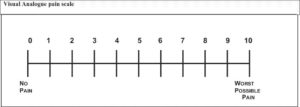
  • The Visual Analog Scale (VAS) is not sufficient documentation as your sole objective tool. Use additional tools to measure objectives findings.
  • See below for a typical VAS:

VAS-Lisa

  • You should self-audit your documentation on a regular basis.

In closing, get out there, do what you do best to attract and help anyone with a spine, and follow the above documentation requirements to armor yourself in the event of an audit by Medicare and other payers. Need help staying relaxed and focused, and getting paid? Give us a call. That’s why we’re here.

Sincerely in Chiropractic,
Lisa

Lisa is now providing a no charge initial consultation regarding your Medicare documentation. You can contact at (920) 334-4561 or by email at Lisa (at) @ pmaworks.com

More information on Lisa[LINK]

Download a printable copy of this newsletter [June newsletter]

Download a customizable copy of the Checklist: [Medicare Documentation ChecklistDOC]

Print Checklist (PDF)[Medicare Documentation Checklist-PDF]
 

Medicare Changes: National Government Services LCDs: Effective 12/1/2015

*This notice specifically pertains to those offices where the Provider of Medicare is NGS:  CT, IL, ME, MA, MN, NH, NY, RI, VT, and WI.


For those of you who have NGS as their Medicare provider (states listed above), we wanted to make sure you were aware of a new policy which has some big changes, mostly positive and where you could get more information about it.

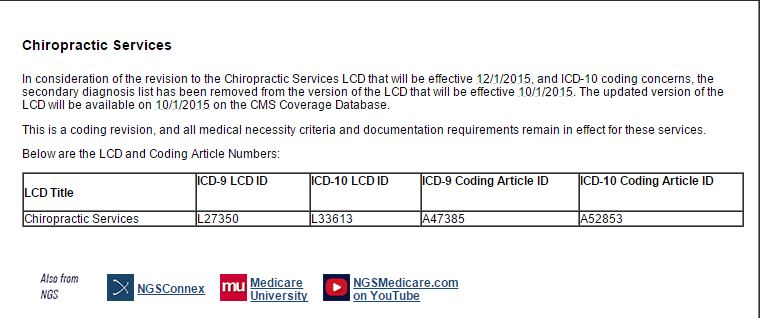
The NGS(National Government Services) recently published the new Chiropractic Medicare Policy which will go into effect on 12/1/2015

For more information on the chiropractic medicare policy visit:

L66315 Chiropractic Services Policy

Sincerely,
Dave

Preparation for the September 7 switch to NGS Medicare

This shouldn’t be too big a deal, but there are a couple steps I want to make sure you are on top of. Obviously it would be best if you can attend one of the Wisconsin CSW Medicare seminars (here), but these are the basics:

  1. Make sure you have talked to your billing software company and your clearing house and that you have made any changes needed so that your Medicare claims goes to the correct place as of Monday, September 9.
  2. Do your final billing to WPS Medicare on Friday, September 6. That is the last day you can bill to them. Starting with dates of service September 7 or later, send those to NGS Medicare.
  3. You and the doctors should review the diagnosis that NGS Medicare allows for chiropractic claims. I have heard that there are slight differences, so this all has to be reviewed prior to submitting claims after the switch. Medicare Allowed Diagnosis Codes
  4. The new chiropractic policy for Wisconsin, Minnesota and Illinois is L27350 (here:LCD for Chiropractic Services) and has all the diagnosis allowed. Double check these on your Medicare patients. Any Dx not on this list will be denied.
  5. Doctors need to review all onset dates for all current Medicare patients to make sure that they are under active care, that they have an updated onset, and that documentation is in order (see #4 above).
  6. In order to document your objective goals and functional impairment, I strongly suggest you start using an outcome assessment tool every 30 days with all Medicare patients. In speaking to several clients, they like the Functional Rating Index. It is quick, easy for a Medicare patient, and very fast for the staff to score.
  7. You can find the FRI form for free at http://www.chiroevidence.com/FRI.html. There is a two page version or a one page version.

As always, call me if you have any questions, but these are the minimum basics that we have to be ready to move on.

Best, Dave

Chiropractic Maintenance Care: Medicare Settlement Means No More “Improve or You’re Out”

In what could be a landmark decision for chiropractors that have long asserted that regular chiropractic care for seniors with chronic conditions actually saves Medicare money and keeps seniors active and independent, an agreement has been reached.

A Federal Judge has approved the proposed Settlement Agreement in the Medicare Improvement Standard case, Jimmo vs. Sebelius, [Link] clearing the way for thousands of Medicare beneficiaries to receive needed health services to maintain their current level of functioning. While not specifically aimed at chiropractic, the exciting implications remain.

The settlement, which represents a significant change in Medicare coverage rules, ends Medicare’s longstanding practice of requiring people to show a likelihood of improvement in order to receive coverage of skilled care and therapy services. It specifically pertains to “…those with disabilities or suffering from chronic illnesses such as Alzheimer’s disease, Parkinson’s disease, ALS, lung disease.” (ital added)

The Agreement, which is retroactive to the date of the suit was filed, January 18, 2011, includes skilled services covered by Medicare Part A and Part B, such as speech, occupational and physical therapy, nursing and home health services, even when the goal is maintaining the patient’s current condition rather than requiring that the patient improving.

The Medicare law has never supported the “”improvement standard.” Nevertheless, for decades beneficiaries have been denied needed services because they are not improving or have “reach a plateau”, sometimes with devastating results. The Center for Medicare Advocacy says providing maintenance services will save money in the long run, preventing decline, hospitalizations and need for more expensive services.

The official approval of the settlement means the Center for Medicare and Medicaid Services (CMS) must develop and implement an education campaign to ensure that Medicare providers are not denying coverage for vital maintenance services to those with any chronic illness who meet other qualifying Medicare requirements.

The “maintenance standard” is effective immediately. Importantly, this does NOT change anything at this time for you, your documentation, or your patients. Even though we have not seen the official documentation that Chiropractic Maintenance Care is included in this settlement, we are hopeful and following this closely.

More Info:
http://blog.aarp.org/2013/02/06/amy-goyer-medicare-pays-for-skilled-therapy-for-maintenance-with-chronic-illness/

Chiropractors – If You Get a Medicare Audit, Do You Know What to Do Next?

Are You Prepared?

If You Get a Medicare Audit,
Do You Know What to Do Next?

If you haven’t already heard, CMS Medicare has launched a massive audit project aimed at chiropractic offices around the country. Executive Order #13520 “Reducing Improper Payments and Eliminating Waste in Federal Programs” has unleashed a random attack of chiropractors aimed at recovering an estimated $174,100,000 in over payments.

Medicare has hired two companies to start auditing chiropractors. There is no way to know if you will get a request for an audit, but I can tell you this from being on the road: very, very few clinics will pass a Medicare audit based on the documentation that I have seen.

That’s not to say you aren’t providing proper, necessary care. Far from that. The Medicare documentation requirements for the physician’s signature alone are three pages long.

So What Should You Do?

PM&A is prepared to help you. We have had 25 years of experience with Medicare audits and appeals. If you get a request for an audit, DON’T freak out. Do this instead:

  • Do not ignore it! You have 30 days to respond.
  • Do not let your staff photocopy and send the records out blindly!
  • Call our office immediately and request our special MPDR Program: MEDICARE PRE-AUDIT DOCUMENTATION REVIEW

We will come to your office & go through any requested records with a fine-tooth comb to assist you in ensuring that you have complete documentation for all services rendered, that each date of service is properly documented, that all PART forms are complete, and that active care modifiers have been properly used.

We will go over each entry in the chart with the treating doctor to ensure that every requirement of Medicare documentation is met for the service you rendered. If addendums need to be made, we’ll ensure that the addendums meet or exceed Medicare requirements.

We will also draft a follow up and Medicare Compliance Plan for your office for any areas that need to be corrected so that you can avoid potentially devastating pre-payment future audits or fraud charges.

We have successful fought AND WON on numerous Medicare audits. No other chiropractic management company can say that. A bad Medicare audit can cost well over $100,000 and thousands of staff hours – and more importantly, hurts your patients and their right to chiropractic coverage.

====================

Medicare Audit Emergency Response Number:     920.459.8500


The MPDR is available to chiropractors in WI, MN, IL, IN, & ND only. This is an emergency response program and slots will be limited to PM&A clients first, then first come. Do NOT send records without calling us first.

The MPDR program covers up to two full days (20 hours) in your office, plus limited follow up. The cost is $4,800 prepaid. PM&A management clients can receive a 20% discount if they are active and current members.

Call for terms and conditions for this service. 920.459.8500