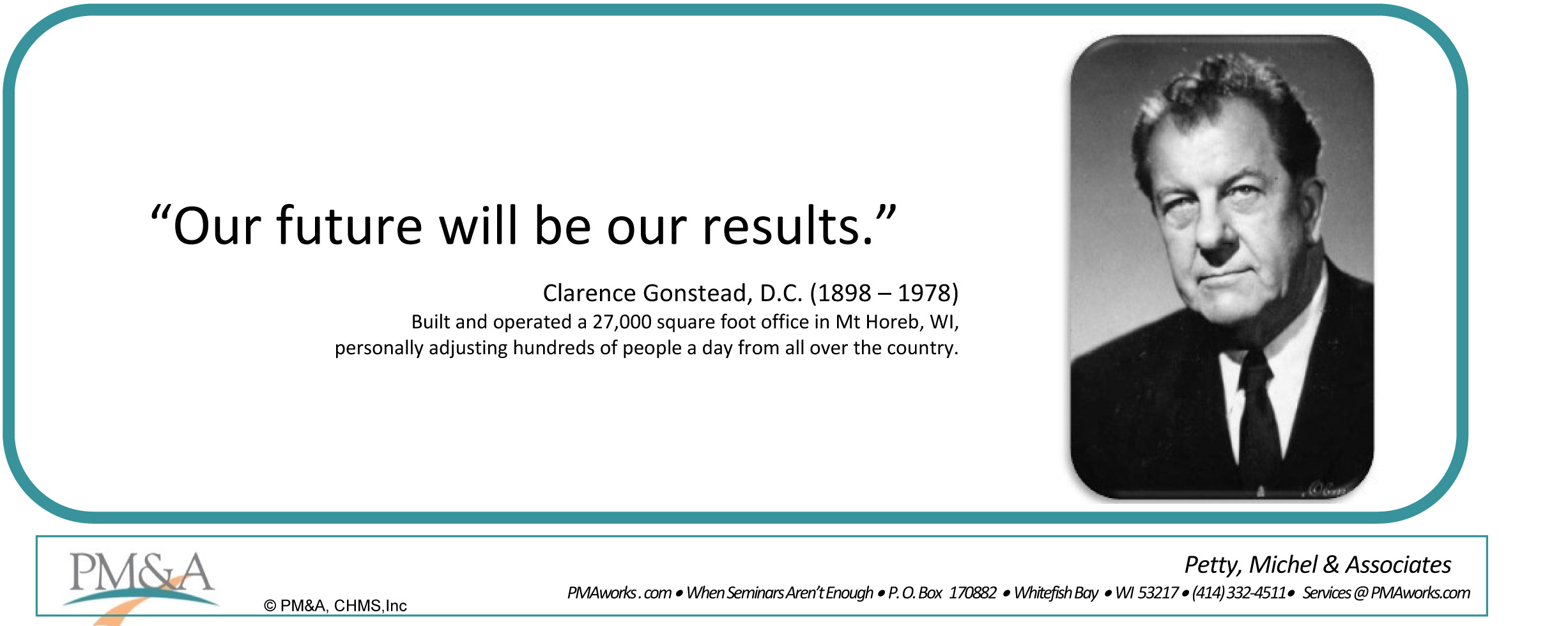
“Our future will be our results.”
Clarence Gonstead, D.C. (1898 – 1978)
For a printable version of this tent poster click Future Results – Gonstead

“Our future will be our results.”
Clarence Gonstead, D.C. (1898 – 1978)
For a printable version of this tent poster click Future Results – Gonstead
“Your customers are only satisfied because their expectations are so low and because no one else is doing better. Just having satisfied customers isn’t good enough anymore. If you really want a booming business, you have to create Raving Fans.” Ken Blanchard, Raving Fans
Customer Service is one of the 5 Power Drivers of your business.
It is the least expensive form of marketing you have and will be your surest guarantee to profits in the years to come.
But in my work in business development, and my experience as a consumer, most service is just adequate. It is “nice.” If it was any less, there wouldn’t be any service at all. Most service is just good enough to get by.
The most common examples of poor service I have witnessed were encounters by the provider that were so routine as to become rote and even superficial. Services were provided as part of a checklist, almost robotically. Even with all the smiles and friendly chatter, this customer was just like all the others before – nobody special. Added to this, the support staff were disengaged, bored, or even irritated at the customer for the interruption.
I have done enough customer interviews to know that most of those who give online reviews, for example, do so out of a sense of friendship and support, rather than from their exuberant advocacy. They are sincere, but just not that excited about the services they received.
For example, how would you compare your last visit with your attorney, dentist or accountant? They got the job done, right? But, it wasn’t “WOW… I just saw my dentist and it was awesome!”
You wouldn’t stand in line to see your accountant all night like people do to get a new iPhone or tickets to a favorite rock concert.
But this is the value customers will need to place on your services inorder for your business to thrive in the next ten years and more
There are dozens of books and studies that document why customer service is vital to the health of your business. Every year there are new studies that show the importance of excellent customer service. I am sure that you have seen them.
Some highlights:
On the down side:
As we move into the 2020’s, the quality of your service will be more important than ever before. It will be the distinguishing factor between your business and others that provide comparable services.
A recent report from a survey by Microsoft stated: “As customer expectations continue to climb, it becomes more challenging for brands to set themselves apart from the competition. Markets are increasingly crowded, and both price and product are being steadily overtaken by customer experience as the number one brand differentiator. (2018 state of global customer service report (Microsoft))
Research by Walker, Inc., predicted that by 2020 customer experience will overtake price and product as the main differentiator.
Your Replacement Is Being Shipped Now
Artificial Intelligence is coming for you.
By 2029, machines will be able to match human intelligence. This is a prediction by Ray Kurzweil (co-founder and chancellor of Singularity University and Google engineer and author of The Singularity is Near). Kurzweil, along with other futurists, predict that computers will be building computers faster and smarter than humans – and this would create a technological singularity – where the speed of technology development of increases infinity fast. According to Peter Rejcek – there is serious investment based upon these predictions. (Singualrityhub.com, March 31, 2017)
How will A.I. impact the professions? How will this impact you?
“Whatever terminology is preferred, we foresee that, in the end, the traditional professions will be dismantled, leaving most (but not all) professionals to be replaced by less expert people and high-performing systems. “(The Future of Professions, Susskind and Susskind, Page 303, 2015)
This is the writing on the wall and those smart enough, will heed it.
I truly hope that this is you.
If you are not the best in your niche, the time will come when you will be left behind – like an abandoned roadside fruit stand bypassed by a newer and faster road.
I want to give you some insight and actions steps so that you will be a winner and a profitable leader in your profession well into the 2020’s.
But beware — there are booby traps and thieves along the way that can rob you of your success. So, let’s look at these villains hang out so that you are prepared and able to create World Class service and dominate your niche.
How can a provider become a master at their craft and focus on creating great results while at the same time trying to run their growing business? There is just too much to do. All this work finally hobbles excellent service and outcomes.
There is just too much to do – too many roles to assume, too many hats to wear.
To achieve any success at all, you have had to persevere and breakthrough many challenges. You have many reasons, therefore, to feel that your way is a winning way because, obviously, it has worked. At least up to now.
But great service is not about you, it is not about your business or philosophy or religion or any of your bias’. It is solely about your customer. It is their goals, not yours and not those of the business, that must be achieved.
You must have humility to review the outcomes of your work and question how you can improve as a provider – and how the actions of your support team can also improve.
The business of providing service to your customers can begin to overshadow the benefits they receive. At some point, the people you care for become “cases,” and their individuality blurs with everyone else’s.
Sometimes the “negative few outweigh the positive many,” and we can’t see or appreciate all the good our services have done for our customers, their families, and even the community.
The joy of helping others and the victories of seeing your customers overcome their issues no longer make you smile or fill your chest with confidence and pride.
We live in a fast-paced world that does not seem to have time for understanding, empathy, or thorough results.
We are all in a hurry, and for the most part, don’t expect, or demand, much from our providers.
There also still lingers an assembly-line culture of receiving a manufactured template from our providers, or at least their support team. And, as providers and support professionals, we can fall into the assembly-line mode of just seeing “another case,” with all their problems, idiosyncrasies, and often confused rudeness.
We end up short-changing our customers on the benefits that they could be receiving.
You are selling and delivering a product that is invisible.
It is not like buying a refrigerator, a car or a kite.
But customers don’t always know what criteria they should use to judge their results. They don’t know the process that is undertaken to deliver the outcomes they want, or even what the potential outcomes are.
So accustom to the objective criteria of your services, you may not appreciate the customer’s lack of understanding about the nature of their situation. As a result, the customer doesn’t know if they had a minor service or a complete one.
Standards become foggy, outcomes become poorly defined. Customers leave unhappy or confused and the provider is dismayed.
There really is a difference between a rookie and a master.
The idea of mastery is a dominate value in sports, music, and in some of the professions. But we live in a commoditized world and we want our gratification fast.
Employees don’t see their roles as a journey to becoming experts, and neither do many providers of services. Everyone works hard and gets results. Isn’t that enough?
No. It isn’t.
Plain and ordinary service will not grow your business. If you and your support staff are not working hard on becoming masters in delivering World Class service, your customers and potential customers will be seeking businesses that are.
# # #
“If people like you, they’ll listen to you, but if they trust you, they’ll do business with you.”
— Zig Ziglar
For a printable version of this tent poster email us.
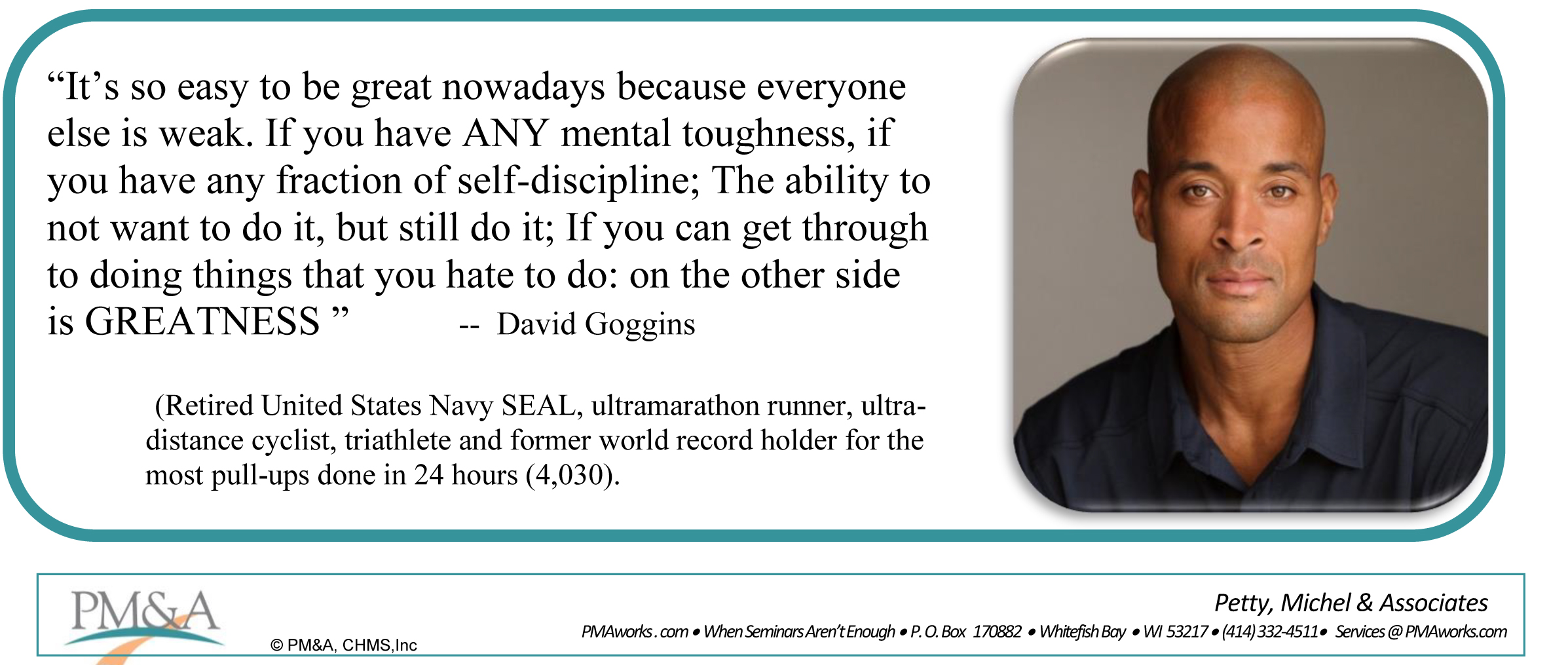
“It’s so easy to be great nowadays because everyone else is weak. If you have ANY mental toughness, if you have any fraction of self-discipline; The ability to not want to do it, but still do it; If you can get through to doing things that you hate to do: on the other side is GREATNESS ”
— David Goggins
For a printable version of this tent poster visit: Mental Toughness:Goggins
Hi and Summer Greetings!
A vital component in our 3 Goals System is the importance of becoming an expert.
I’ll cut right to the most immediate reason:
Research shows that experts in any field or role make more money.
In high complexity jobs like professionals, the top 10% produce 80% more than average and 700% more than the bottom 10%[i].
But this is also true in less complex jobs, where it was found that the top 10% of workers produce 25% more than the average, and 75% more than the bottom 10%.
Aside from high school interns that help file and run errands, all the roles in your office are high complexity.
So, how do you become an expert?
From the book, the Talent Code[ii]:
Plus, I believe that through advertising we have been encultured to think in terms of instant gratification – I can get a “meal” through the drive-in at McDonald’s and replace that broken appliance through Amazon Prime.
And providers… you too are often so distracted by organizational issues that, well, good enough is good enough. You get fine results, right?
But I will remind you of Clarence Gonstead.
He continually worked at developing his skills and methodology. Everything else followed, including thousands of patients, so many in fact that he had to build a hotel next to his clinic for those coming from out of town.
And the key is deliberate. Take some aspect of your job and work – deliberately. You might be surprised on how you might have taken some procedure for granted as working but when you examine it, you discover that there is a lot of room for improvement.
Research shows that doctors who have been in practice for twenty or more years do worse on certain objective measures of performance than those who are just two or three years out of medical school.
The reason for this is that doctors working day-in and day-out can begin to go on automatic because their work no longer pushes them out of their comfort zones[iii].
I know… I talk about this all the time …and will continue to do so as it is one of the least expensive methods to improve your business and increase income. And I know you also know this! So, this is just a friendly reminder to train and encourage your team to become experts.
I suggest your goal is to create a team of experts, and… and Expert Team!
[i] Hunter, J. E., Schmidt, F. L., Judiesch, M. K., (1990) “Individual Differences in Output Variability as a Function of Job Complexity”, Journal of Applied Psychology
http://psycnet.apa.org/index.cfm?fa=fulltext.journal&jcode=apl&vol=75&issue=1&page=28&format=HTML
https://80000hours.org/2012/09/how-good-are-the-best/
[ii] The Talent Code: Greatness Isn’t Born. It’s Grown. Here’s How. by Daniel Coyle
[iii] Peak: Secrets from the New Science of Expertise by Anders Ericsson
Ed’s Training Maxims
I am working on some sayings, or aphorisms on training and study. I have come up with a few.
Don’t cringe…!
Can you add any?
Not mine, but good ones:

I’m facing the “BIG 60” in just a couple of days. With that, back in April, I decided to take on the Great Cycle Challenge, which is a bicycle challenge during the month of June for Children’s Cancer Research. My goal was to ride 60 miles during the month of June with 60 friends sponsoring me at $10.00 each to raise $600.00.
This challenge has been more eye opening than I had anticipated.
I haven’t really done much bike riding in probably 35 years. The peaceful rides through the countryside along the White River Trail in Lyons have given me time to reflect on much more than raising money for Children’s Cancer and/or the fact that I’m turning 60.
Each day, while riding, a thought would pop into my head of someone I knew that has had to face cancer. When my (ars) began to pain me…. I would think of those going through treatment and the challenge they face each day of their cancer treatment journey. I would think of the challenges each family faces as their loved one struggles through the pain and how it really affects the whole family when one is afflicted. I would think of those that have lost the battle to this horrible disease. This was motivation enough for me to continue the ride returning to the comfort of my home.
Usually allowing a day in between rides to rest and rejuvenate today was different… I rode 8 miles yesterday and set out for 8 today. Passing the half way mark the ride again became uncomfortable to say the least. Again, I tried to focus on something other than the pain.
Immediately, “DRIVEN” came to mind. My mind pondered that word for a moment…thoughts racing to my head.
When I have a birthday I often reflect on the past, where I’ve been and where I’m headed.
Ed has been an instrumental piece in my life providing me the motivation, knowledge and guidance to become a better person both personally and professionally. He has helped me develop good communication skills, encourages a healthier lifestyle, and is there to listen when faced with a personal challenge. Ed was one of the first people I was able to reach when my husband was killed at work just over 7 years ago. I’m sure my call came to him as a shock as much as the call I received did however during that brief call he calmly presented me with two options. “You can choose to wallow in your loss and look for sympathy from those around you or you can face the challenge and move forward.” Again, that “driven” attitude to move outside our comfort zone at the forefront.
Happy Father’s Day to all those that Drive you to Excellence!
* https://pmaworks.com/observations/goggins/
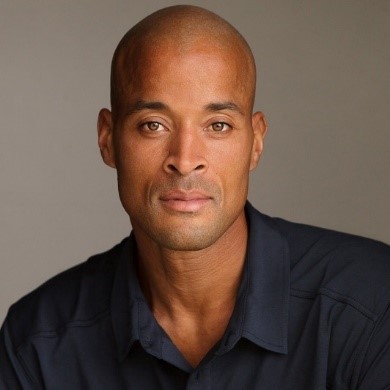
David Goggins
Now and then I see a motivational talk that I find inspiring.
It doesn’t happen too often.
Below you will find links to an interview with David Goggins. I can’t say much about it other than I found it inspiring and relevant. He reminded me that by pushing through, and not dodging from, discomfort when working toward important goals can lead to success and fulfillment. An important lesson for us all.
David talks about how he achieved his goals. He is an American ultramarathon runner, ultra-distance cyclist, triathlete and former world record holder for the most pull-ups done in 24 hours. He is a retired United States Navy SEAL who took part in the War in Afghanistan and the Iraq War.
Please watch it. If it resonates with you, you may want to watch it with your team and discuss afterwards.
Sincerely,
Ed
Photo from Wikipedia
Thanks to Dr. Maxwell for the reference.
Links to interview:
NOTICE: Some use of profanity #@!*#!
On April 16th, 2018, Governor Walker of Wisconsin signed into law legislation that removed the arbitrary, higher National Board of Chiropractic Examiners scores and in the process completed the six-year project by the members of the Chiropractic Society of Wisconsin to end the efforts to block young chiropractors from entering Wisconsin.
The higher exam scores were enacted in 2012 in Wisconsin. The National Board of Chiropractic Examiners’ passing scores were 375 on both parts in 2012. But applicants in Wisconsin now had to get a score of 438 on the third part and 475 on the fourth part. Maryland required 438 on the third part, and North Carolina and West Virginia require 475 on the fourth part, but no other state requires both, said Horace Elliott, executive vice president of the national board, according to Dave Walburg of the State Journal in Madison (See link below) .
Under the guise of raising standards, the higher scores were initiated by the Wisconsin Chiropractic Association. The result was to discourage new chiropractors from practicing in the state. With no real marketing to bring more chiropractors into Wisconsin by the WCA, it is obvious that the intention of the WCA was to limit chiropractic utilization. And it worked. New chiropractors being licensed in the state decreased.
Quoting from their press release, Steven Conway, D.C., the Executive Director of the C.S.W. said: “I personally believe the most important moment of this six-year project for the entire chiropractic profession in Wisconsin can be summed up with one of the key and deciding moments related to the first efforts by the CSW to remove the Wisconsin exam.
“I vividly remember a meeting with our legislative champion. The WCA had put on a very successful, full court press using all of their resources to stop the CSW’s efforts. I was told that the game was essentially over as the WCA had convinced the legislative leadership to keep the flawed Wisconsin exam and that the CSW should stand down. However, I knew that as an organization we could not quit on these young doctors or quite frankly our profession, so I let him know that the chiropractors associated with the CSW never quit on what we believe in and instead of folding we did just the opposite and increased our efforts. At the time, we didn’t know how we were going to win; we just knew that losing was not an option we could accept. That underlying purpose to fight against all odds resulted in a victory for the chiropractic profession and the hundreds of young chiropractors who had to suffer through the failed Wisconsin exam.” (Link below.)
All members of the CSW should be congratulated for their dedication and hard work in achieving this win for chiropractic. In this time of increased opioid use, non-drug solutions are more important than ever before. Chiropractic has always been a popular and effective choice for the residents here in Wisconsin and the CSW has done them a great service helping to bring more chiropractors to the state.
Of special note is own Mr. David Michel for his generous work in personally working with the CSW as a member of its Board of Directors. I know he has unselfishly put in long hours over the years to help and all of us at Petty Michel and Associates commend him… with pride! Yea Dave!
Below are some links to more information about the history of this fight.
Report from State Journal in Madison, 2013

“I tend to approach things from a physics framework. And physics teaches you to reason from first principles rather than by analogy.”
— Elon Musk
Below is a link to a poster you and your team can refer to that lists the principles which form the basis of chiropractic.
Principles are basic: if you understand them then everything else makes more sense. If you really understand principles, you can develop your own effective procedures in administration, marketing, and patient care.
These 33 principles were published in 1927 by Dr. Stephenson. However, according to Rob Sinnott, D.C.:
“…these 33 principles were the result of decades of effort and consideration. It is also now clear that they were not first written by Dr. Stephenson. As a matter of fact, most of these principles are contained in other language in D.D. Palmer’s 1906 and 1910 texts long before Dr. Stephenson’s well-known effort.”
You may already have these 33 principles hanging in your team breakroom and refer to at your team meetings.
If so… great! Let this then just be an encouragement to continue.
However, if you are not, then please do so.
The chiropractic profession operates in a different model of health than the medical model. In fact, it could be said that the chiropractic system operates outside of the conventual commercial matrix that persuades people to seek symptomatic gratification through pharmaceuticals, bad food, and often, bad culture.
But grassroots trends are on our side. Organic food sales have been booming and people want natural, sustainable solutions. New yoga studios are sprouting up even faster than essential oil representatives, both of which emphasize natural health and “P.T.C.” – “present time consciousness” (an old Dr. Jimmy Parker acronym). And our professional athletes and their teams standardly utilize chiropractic services.
The world is catching up to chiropractic. It wants what you have and have had for over 100 years – natural health and health freedom.
Even though these principles may seem like “old news” in chiropractic and not high-tech, they are, in fact, just catching on. But you must own these principles and this niche in the market-place — and teach them to your team members – and your entire practice family. Do so to improve everyone’s understanding of health and to increase their motivation to improve it. But teaching it also benefits your work in practice management.
You want to get everyone on your team playing in the same ballpark, working in the same model of health and business. Going over these principles will help create a positive team culture that will improve practice performance.
Ed Petty
References:
http://www.elonmusk.info
Interview by Chris Anderson (@chr1sa) is editor in chief of Wired 10/21/12
Textbook of Chiropractic Philosophy, Vol.1, Rob Sinnott, D.C., DPhSC
Download the Poster now: The Thirty Three Principles of Chiropractic-2018

It’s a New Year!
And if you are just reading this in March or September, it’s a new month or a new week!
Whatever time of year it is, it is always time to get the “Word” out your servcies.
It’s time to tell everyone in and around your office and community — about your chiropractic and professional services and how they should get them now!
But what is the best way to do this?
Well, obviously, with each person you see when you are seeing them. You – and your health team – have a captive audience. Sometimes referred to as “Table Talk,” this is your way of educating your people at the time of service.
You can augment this with new patient workshops that motivate, educate, and entertain your people. It is a free class but is part of their treatment program because you have found that people “get better faster and stay healthier longer if they get a better understanding of the health process we are doing together.” Also…“It assists with your treatment program and you get a better return on the work you put in. It is just a good investment!”
Then…don’t forget your team. They need to hear about the successes and case stories of how their office really helps people.
But your patients aren’t always in your office. What then? Shouldn’t your conversation with them continue? Other vendors are certainly getting their “word” out. Pharmaceutical ads are pervasive.
What about people who have not discovered you yet – how do best tell them about how you can help them and why they should see you?
Many of you make posts on Facebook in hopes that this will help market your services.
Does it?
What about email? Some of you subscribe to template emails that go out to your patients. How is this working?
I have some strong feelings about this subject — but first I wanted to see what others have said and what the studies show. Here is the question:
Which works better?
According to most of the surveys that I have seen, email is the winner.
But comparing both mediums is like comparing apples to oranges — both work depending on how much time and expertise you put into it.
But it stands to reason that if you have someone’s email, they are a subscriber and have given you permission to address them personally.
From a sampling of various studies and surveys (references at the end of this article):
“Where is the first place you go online in a typical day?”
“Where do you look when you want a deal from a company that you know?”
Email reaches 79% of the people you send it to (this is the global average inbox placement rate). On the other hand, Facebook’s organic reach has declined to about 1 to 6%, depending on your total number of fans.
So the stats and studies seem to show that you are going to get a better ROI from email.
Over the years, I have observed that patient referrals, patient visit average, and reactivations improve with regular emails.
Facebook and social media can help create familiarity and trust. From this you can direct people to your website for upcoming events or information. You can also buy ads that target specific types of potential patients and set up workshops or make special offers. I have seen this work on occasion very well
But the algorithms, or computational rules, for Facebook and other mediums are always changing and what worked last month may not work this month. Currently, Facebook is becoming more of a “pay to play” medium – peppered with inspirational forwards and political rantings!
With email, you own your list and make your own rules. Plus, it is nearly free.
Email is a direct and personal letter from you to another person.
It is authentic and genuine. It is the reader – and you, personally. It is not manufactured “health news” which is just a mash-up of articles from 1998.
In this busy and more automated world, genuine communication is becoming scarcer… and more valuable.
The biggest challenge is simply getting the email out.
Actually, this is the big problem with all of your marketing – who is going to do it — and when?
We have found some simple procedures that work for getting this done which I offer below. But first, let’s look at the future.
The future medium will continue to be more direct communication for selling. The trendy term is “conversational commerce.”
“Consumers are increasingly relying on messaging apps for all forms of communication, whether personal, business, or commerce. … Messaging apps are becoming the preferred means of communication.” (emarketer)
Messaging is personal, it is one to one.
According to a research commissioned by FacebookIQ and Nielson:
This means, when people visit your Facebook page, if they can chat with you personally, half of them will be inclined to come in for a visit.
You can take a look at a couple of applications – Chatfuel and Manychat – for inexpensive chat programs that you can add on to your Facebook.
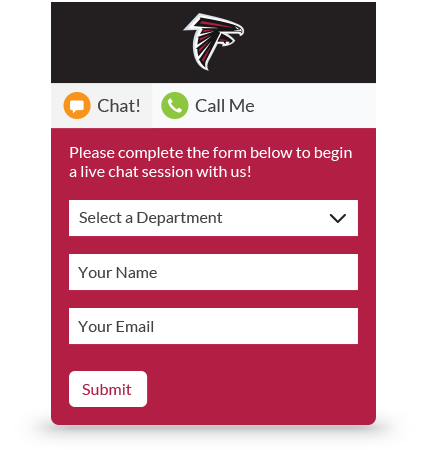
You can also ask your webmaster to install a chat system on your web site. An example is websitealive.com.
But the force of all this is personalized communication, something that emails and sales letters and video letters have always done and continue to do better than Facebook.
A few weeks ago I received an email newsletter from a yoga instructor I have followed off and on for a few years. I had question so I sent her an email thinking she might answer it. She did. What’s more, she included a short personal video – directly to me! I am now considering buying her DVD’s when I hadn’t even considered it before.
So how are you going to “Get the Word Out?”
I recommend personally. One-to-one. In a conversation in the office and out of the office through email and maybe… chat.
Remember that a practice is a network of relationships built and sustained in part by communication. Now and then attach a promotion to your email and this is one of the least expensive forms of marketing you will ever do.
Keep the conversation going…and going and going.
Till next time,
Ed
(*Facebook Drama. Social networking definitely has positive uses. But, according to one of its founding executives, it has negative effects. In an interview at Standard School of Business, Chamath Palihapitiya, (known as “C.P.”) who joined Facebook in 2007 and became its vice president for user growth, says that he feels tremendous guilt for the company that he helped make. Facebook, and others he says, have succeeded by “exploiting a vulnerability in human psychology.” “I think we have created tools that are ripping apart the social fabric of how society works,” he told an audience at Stanford Graduate School of Business. He hasn’t used it for years and won’t let his kids use it either!
“The short-term, dopamine-driven feedback loops we’ve created are destroying how society works,” he said, referring to online interactions driven by “hearts, likes, thumbs-up.”
It is a great interview that you can watch or listen – link at the end of the article.)
https://www.campaignlive.com/article/facebook-study-53-consumers-likely-shop-business-message/1404632
https://www.mailmunch.co/blog/email-marketing-vs-social-media/
http://image.exct.net/lib/fe641570776d02757515/m/1/SFF1-TheDigitalMorning.pdf
https://returnpath.com/wp-content/uploads/2015/10/2015-Deliverability-Benchmark-Report.pdf
https://support.getresponse.com/uploads/2016/01/The-State-of-Email-Marketing-by-Industry-January-2016.pdf
http://image.exct.net/lib/fe641570776d02757515/m/1/SFF14-The2012ChannelPreferenceSurvey.pdf
https://manychat.com/
https://www.websitealive.com/alivechat/
https://www.emarketer.com/Article/Digital-Content-Advertising-Key-Revenue-Generators-Messaging-Apps/1013247#sthash.OEDM1ML5.dpuf
https://www.campaignlive.com/article/facebook-study-53-consumers-likely-shop-business-message/1404632
Talk on social consequences of Facebook. https://www.youtube.com/watch?v=PMotykw0SIk
“Strive for excellence in few things, rather than good performance in many.”
~Richard Koch, the 80/20 Principle
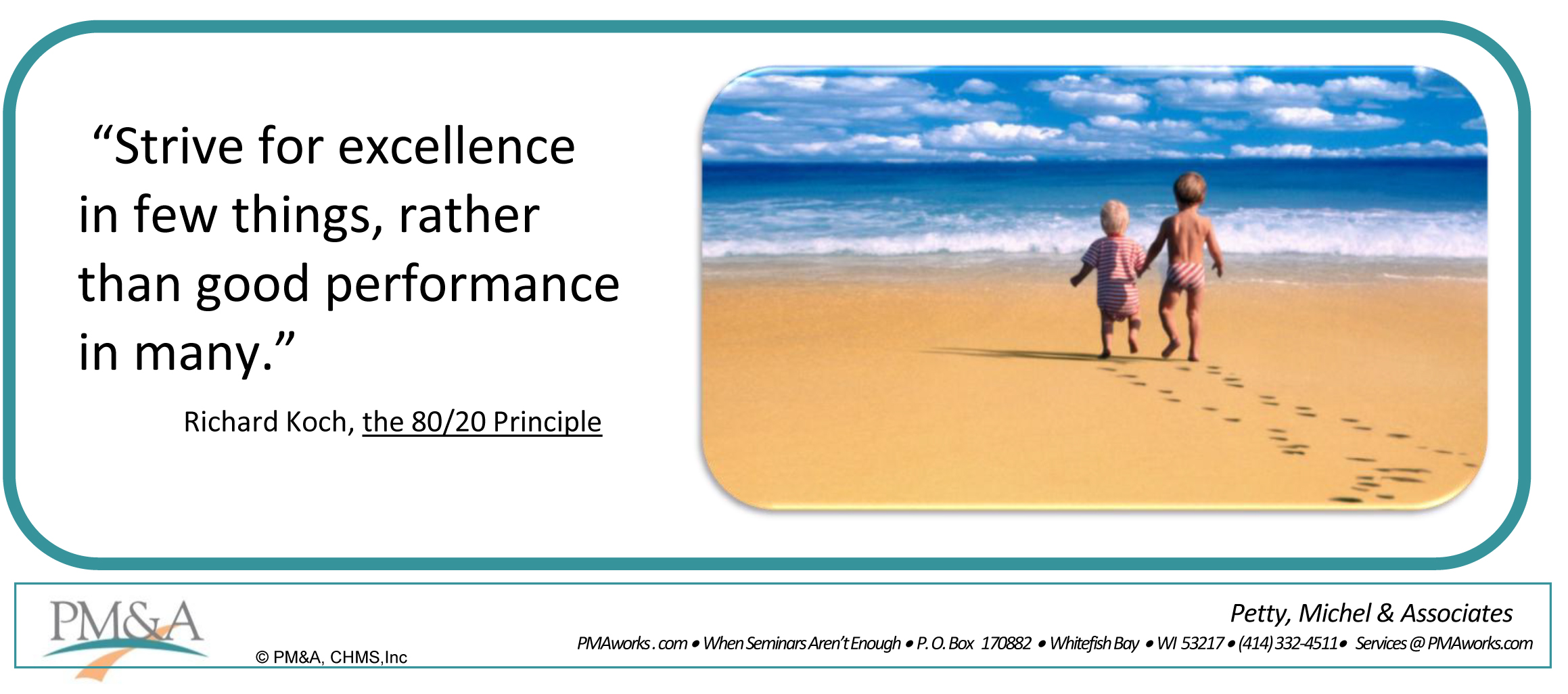
For a printable copy of this tent poster click: Strive for excellence.
“It’s kind of silly and fun, but I think that silly and fun things are important.”
~Elon Musk
For a printable copy of this tent poster email us.
“Wisdom frees us from doubt, virtue frees us from suffering, resolution frees us from fear.”
~Confucius
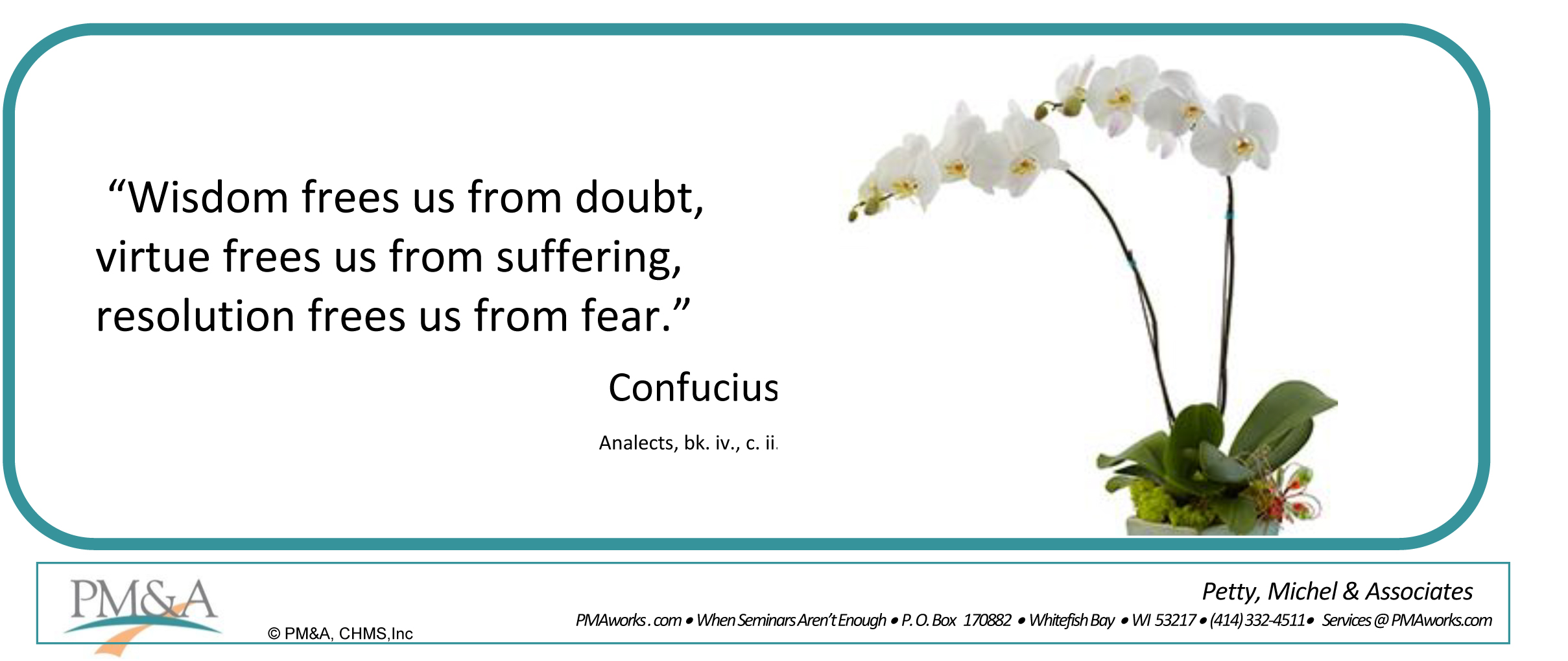
For a printable copy of this tent poster click: Confucius Virtue

Progress in practice is made by steady persistence and passion.
In Angela Duckworth’s new book, she calls this “Grit.”
Think of evolution, think of growing crops… think of growing children! Whether it is child development or practice development, growth is achieved through steady and unrelenting nurturing and adjusting according to circumstances.
I recommend you take some time to do some planning before the New Year gets in high gear. January and February are good months to do this. Do it by yourself – and do it with your team. But…
Don’t reinvent the wheel… Just make it go faster with less effort.
A few of our actions are always more productive than most of the other actions that we do. Unfortunately, we can get distracted and spend far too much time on activities that, in retrospect, just don’t give us that much of a return.
The “vital few” actions that have helped you the most will be camouflaged, even countered, by the “trivial (but useful) many.” This is a term used by Nathan Juran, famous for his approach to business and quality improvement and the Pareto Principle.
And, I would like you to consider this: In many respects, your business has succeeded in ways that – perhaps – you have not yet recognized. Therefore, I don’t recommend abandoning all you did last year and start chasing the newest “shiniest” procedures that seem appealing.
The key is to dust off all your actions from 2017 – review everything you did — and see the great things that worked and the victories you and your team achieved.
Then, just find better approaches to do more of this!
The idea of having diamonds in our backyard, a story made famous by Russell Conwell (1843 – 1925) of the 1800s, applies. There are many variations, but it goes something like this: there once was a man who wanted more wealth, so he sold his house and left in search of diamonds. Years later, penniless, he happened back to his village where he roomed at a shelter for the poor. The shelter was supported by a grant from a local resident. In inquiring who the resident was, the diamond searcher discovered that it was the person to whom he had sold his house.
One day he paid a visit to his old house, now renovated into a beautiful estate. He talked to the new owner who told him that he had become rich. He said that when he bought the house, he needed to do some digging in the backyard where he discovered thousands of diamonds.
The moral of the story is obvious: you already are rich – you already have the diamonds. You just need to polish them.
Many of the components of your future success are already in your office. But we overlook them, or use them once and then forget about them, like teenagers looking for the next new article of clothing to make a fashion statement.
As entrepreneurs, creatively – we are all looking for that next dopamine high… and seek the next new “shiny” thing.
You have a show on the road. Just make it better. Make it fresh. Set a new standard, and make a new game to “level up!” Add a few new things here and there, but keep doing what is working.
Review what has been working for you. Reaffirm it and keep at it. Look at what hasn’t worked that well and fix it so that it does, or drop it like barbell that you have been holding over your head for too long.
By yourself, and later, with your team, here are some areas to look into:
____1. Review Your Mission Statement. Does it apply? How? Does it need to be customized? Beyond your mission, what is your WHY? Does the mission satisfy this?
____2. What Are Your Outcomes? For example: “People relieved of pain, healthier, educated so that they can and will continue to improve their health… and refer others?” You can also define Minimal Viable (Valuable) Outcomes, e.g., “A patient who accepts care.” Etc.
____3. How Is the Office Vibe? This is determined by your values and how everyone is living up to them. Are these values posted for all to see and check how they are “measuring up?” Are they defined? Do we need to add more, change some, delete some? Should we better define each value? Should we add:
• Trust. Are we worthy of trust with our patients and ourselves?
• Mission Oriented. Do we help each other cheerfully achieve our mission – each day?
• How well are we living up to these?
• How can we live up to these better?
____4. How Were the Numbers? Up, or down?
• When the numbers went up, what did, or didn’t we do? How can we improve upon this?
• When the numbers went down, what did, or didn’t we do? Should we improve or discontinue those actions?
____5. Individual. What can each one of us do professionally this next year to improve our ability to contribute to our team and its mission?
Some of this should be on simple, brief checklists and memo’s. Add it to your Practice Playbook. Document it so that it can be referred to for training and coaching in the future.
Imagine that your practice is a merry-go-round, the kind you find at children’s playgrounds.
It takes a lot of energy to push it and get it going. But… once it is moving, it takes less effort to gradually get it going faster. And faster! And faster…
Take some time to review how you are pushing your merry-go-round. What procedures worked better for pushing it faster? Focus on these… Makes these better.
Go faster… and push less.
And as you do, watch those, including yourself, hold on tighter and smile bigger.
With admiration,
–Ed
A few years back, a long-time client of ours gave me a call and said that he had hired two new doctors. He asked if I would visit his office and see if I could help them grow their caseloads.
I told him that I was happy to pay him a visit. A month later, I was touring his office and interviewing his team. I then went out to lunch with the two new associate doctors.
I got to know them and asked them questions. They were not shy about their goals. They told me that they wanted a “high volume” practice. They boasted that they felt that it would not be difficult to see as many visits per month as the senior doctor by the end of the year.
They went on about philosophy, BJ Palmer’s “Green” Books, clean food and wellness. Both were young and looked fit and seemed eager.
They said that they wanted marketing help. They talked about how they had been working on social media, but felt that the owner doctor wasn’t supporting them enough by buying advertising. It wasn’t blatant, but they seemed to be blaming him. I acknowledged this and said that was something we could look into.
I knew that their practice statistics were very low. I told them that marketing comes down to caring about people – caring enough to talk to them, and caring enough to be honest about how you can help them.
They nodded like zealots. “Absolutely!”
I then said:
“OK, look around this restaurant and describe a possible health issue with some of the customers. Just pick one and do a very preliminary screening based upon the way they are sitting or walking.”
This didn’t go as well as I had thought it would. Both doctors, I discovered, didn’t look at the fellow customers in the restaurant. So, I prodded and finally got one of them to mumble a possible health issue with someone who was walking out.
I then asked each for their business card. Neither had one on them. I paused to give them a look: “What?”
I had taken a couple of their cards each before lunch and placed two of them in front of each doctor.
Then I said:
“I liked what you both said about wanting a large practice and wanting to help more people. I would like to help you. So, to start, I would like you to get up from this table and find someone in the restaurant, introduce yourself, and hand out your card. If possible, make an appointment for them to come see you.”
They both looked at me as if they saw a ghost. Gripped by fear, they both slumped down in their chairs. Neither would do it.
Seeing this, I suggested they talk to the cashier or waitress, or the manager. Now the fear turned to a dismissive attitude, as if this exercise was beneath their dignity.
We ended lunch and went back to the office. We met with the owner doctor and discussed the situation. Over the following weeks the two doctors agreed that the relationship wasn’t working out and decided to leave on good terms to start their own office.
— — —
You don’t have to be a hyper-extroverted charming salesperson to be an effective marketer. In fact, this may act against you. The largest office I have ever worked with was seeing over 2,000 visits per week. And the owner was serious and gruff, and talked like an angry fishing boat captain.
Marketing starts with a burning desire. It begins with an almost obsessive drive and purpose to help others by getting them into your office. Marketing then depends on your belief and confidence in your skills and service. And it hinges entirely on how much you really care and empathize with each patient or prospective patient. And then, there is the effort you put in. You gotta do the work, and this means sometimes long hours, long weeks, and long months.
And as the C.E.O of your business, it also means getting the rest of your team to feel the same.
Again:
There are thousands of different methods to market your services. These may include “social media,” big goals, and “philosophy.” They may include newsletters, workshops, or back to school promotions. But in the end, marketing is communication, whether done electronically, through print, in groups, or one on one. It is always and especially – one on one. In time, you will find what works best for you.
But no number of manuals, books, or coaching will do a damn thing for you if you don’t have the desire, the belief, the empathy or put in the work.
“Nothing great is created suddenly, any more than a bunch of grapes or a fig.
If you tell me that you desire a fig, I answer you that there must be time. Let it first blossom, then bear fruit, then ripen.”
~Epictetus
For a printable copy of this tent poster email us.
“If the path before you is clear, you’re probably on someone else’s.”
~Joseph Campbell

For a printable copy of this tent poster click the link: Campbell – Your Path
“We have healing power inside us. But we block it because we feel we need to take pills and become dependent upon outside forces…
We have an inner doctor.”
~Wim Hoff
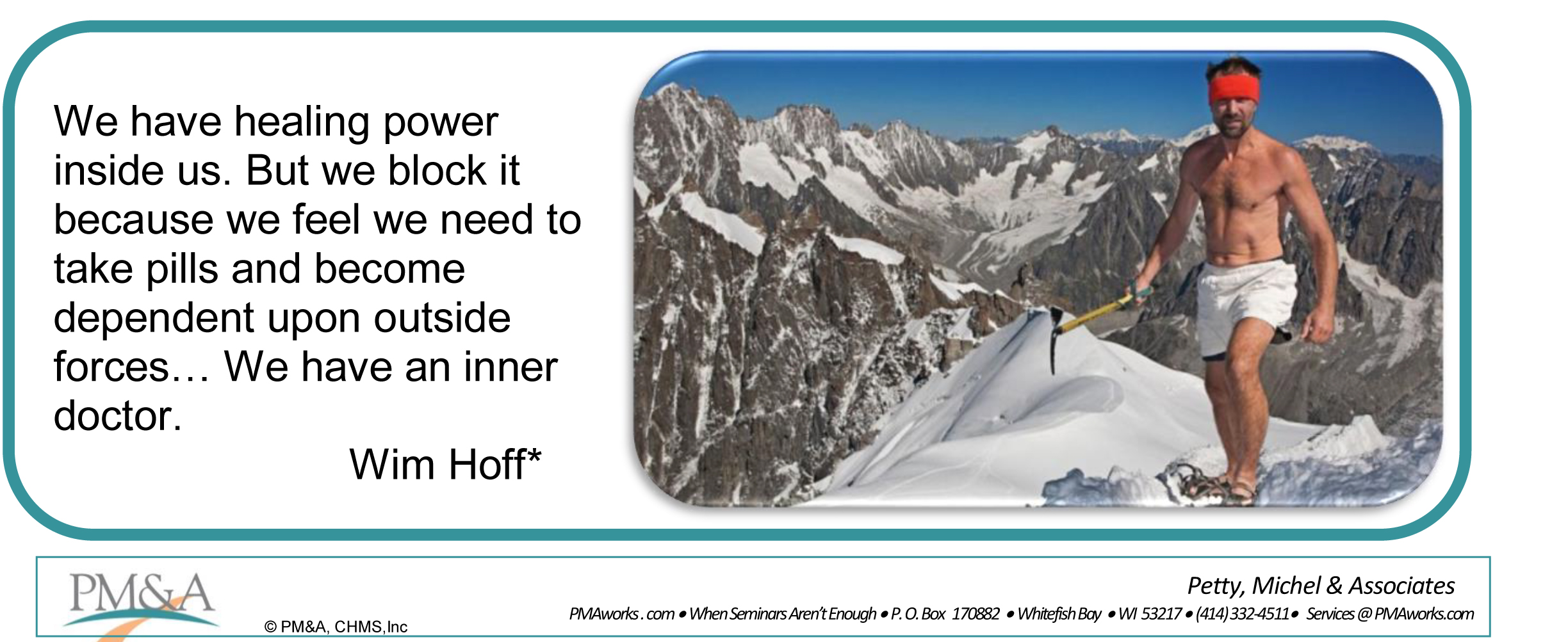
For a printable copy of this tent poster click link: Wim Hoff
Patient education is definitely a clinical function. But… it is also good marketing.
And note that your entire office IS the marketing department and each team member has a marketing role.
To help everyone on your team better participate in patient education, use this simple and fun method:
Get a whiteboard and place it where patients can see it. Assign someone to write something on it each day so that your patients, or you, can comment on it.
For example, you could write:
“Pain is the last to show
… and the first to go.”
This will be a cue for the doctor or a team member to talk to your patients – and can also provoke your patients to talk to you.
Here are some other examples:
At your morning team meetings, or weekly meetings, go over each subject so everyone has a better idea on how to educate patients on the topic.
For active PM&A members, go here for a more complete list: PMAmembers.com
Ms. Lisa Barnett with Petty, Michel and Associates specializes in preventing Medicare Audits. She has helped those who have already been targeted find a fast and safe way out of trouble.
You are not alone…. Things do Happen…..
You are busy and possibly you have overlooked a certain requirement. Your computer has gone through updates and you have not kept up. Or possibly your documentation is simply inadequate in the eyes of medicare or the government.
Whether you are faced with a prepay audit or a post payment audit. I can help !
With 10 years of experience in the chiropractic industry and with documentation; and a chiropractic advocate for 30 years I care and I want to help.
Call today for your complimentary phone consultation and record review. 920-334-4561