
WHAT RECESSION?

You know by now that the American economy is just a little bit shaky. On Tuesday, January 22, the stock market dropped 465 points, only to recover to a loss of 128 points due to a fast save by the Fed to cut interest rates a 3/4 of a point. Reports from oversees indicate that foreign exchanges are bracing for a recession in Europe and Asia, caused in part by America’s financial markets and our threatening recession.

But it doesn’t take an economist to add up the facts. The lending market, the housing market, the falling value of the U.S. dollar, the international trade imbalance, and, of course, the huge expense of the Iraq war all add up to big challenges. And, I don’t have to tell you about the condition of “health” insurance.

The reports and financial stats are out there for you to draw your own logical conclusions.

Most of us have seen recessions before, though factors appear to be stacking up to make this recession an especially big one. But who knows for certain? It may be forestalled till after the election, or other factors may come forth and send the economy in a different direction altogether.

It is good to pay attention to current events, but you don’t want to get distracted by the fact that prosperity starts at home – in your office. The best guarantee to surviving a recession, or worse, is to ensure that your practice and business are as strong as possible. In a down economy, there may good investments to be made, but the best investment is in yourself and your business.

The demand for health care, wellness care, has never been stronger. Chiropractors are continually becoming more accepted as the leader in the wellness movement. Your big challenge is simply not to participate in any recession but to move into the leadership role you have as a health doctor, a Doctor of Chiropractic.

There is no recession in the demand for health care and wellness care, nor will there be. Making yourself well known and popular, being accessible, and providing consistently excellent service with quality outcomes will insure your future prosperity.

If you work to continually improve all functions of your businesses, you will always be able to ask: “What Recession?”

Best regards,

Ed

P.S. By the way, our old friend, Dr. Jim Sigafoose wrote about this same concept, with the same title, back in 1991. Here is his article on another web site: LINK

PSS Also, here is what Siggy says about us: LINK

Billing Audits and “Red Flags”

Angie’s Angles
From a Chiropractic Billing Consultant

For your protection, you should be aware of the Top 10 Red Flags for a billing audit in a chiropractic office. Here they are.

Since this is the beginning of a new year, I will start with the Top 10 Red Flags for a billing audit (in no particular order):

1.  “Phantom Billing”—Billing for services not rendered.

2. “Double Billing”—charging more than once for the same service, e.g., using an individual code again as part of an automated or bundled set of tests.

3. “Clustering”—Using only a few codes on the theory that it will average out.

4. “Upcoding”—Using a higher reimbursement code than the code reflecting the service rendered; e.g., billing for complex services when only simple services were performed, billing for brand named drugs when generic drugs were provided, listing treatment as having been for a more complicated diagnosis than was actually the case.

5. “Unbundling”—Using two or more billing codes instead of one inclusive code where
regulations require “bundling” of such claims. Submitting multiple bills in order to obtain a higher reimbursement for tests and services that were performed within a specified time period and which should have been submitted as a single bill.

6. “Code Jamming”—Inserting or “jamming” fake diagnosis codes to get insurance coverage.

7. Billing for non-covered services

8. Billing for services that are not reasonable and necessary.

9. Inappropriate balance billing—billing Medicare beneficiaries for the difference between the total provider charges and the Medicare Part B allowable amount.

10. Routine waiver of co-payments and billing third-party insurance only.

The complexity of managing a practice is not a walk in the park. As a Billing Consultant with PM&A, my job is to free doctors from the worries that can accompany running the financial end of a medical practice.  I can review and streamline your billing department, train staff, and credential doctors with insurance companies, among other services.

Questions on how any of these might apply to your office? Contact me and I will let you know.
Next month – look for tips on nailing your Financial Consultations!!

Goals For Patients and Chiropractors

Goals Give Us Tools to Put Dreams Into Action

Phyllis A Frase

If each of us is on a lifelong journey to find our hat, to know who we are, then by implication we are all on a journey to somewhere. It is our passion for that destination that makes us engaged and purposeful about our work and lives. Without a dream, without goals, we have no direction. As the old expression says, “If you don’t know where you are going, any path will get you there.”

William James, the visionary turn-of-the-century psychologist, might be considered one of the fathers of self-actualization. He understood the power of our thoughts to affect our lives. His advice then is as true today as ever: “Seek out that particular mental attitude which makes you feel most deeply and vitally alive, along with which comes the inner voice which says, ‘this is the real me,’ and when you have found that attitude follow it.”

Many, many people are afraid to follow their dreams. They are afraid of goals or at least resist them. They think goals take the fluidity and spontaneity out of life.  And they worry about how they will feel if they don’t reach them.

But we need to remember that goals are not a blueprint; they simply provide a vision.

Think about it in terms of a fishing line. A big goal, like a big fish, puts some tension on the line. You’ve got to have tension to succeed. You can’t catch a fish without it. If you line goes slack, you know you’ve lost a big one. If you yank too hard, you risk losing the fish and the lure as well.

We teach our patients our chiropractic truth and values. We offer gentle but continuous pressure to gradually pull and lure them into referring, committed lifetime oriented chiropractic patients. But if you lose patience and jerk the line too often, you can lose the patient by not having systems and procedures that guide that patient. Constant dialogues, clarity, trust and soft tension on the line—those are the qualities that lead to the results and relationship we look to have with our patients.

In your life you’ve got to go after your goals and dreams. Of course, for the passion and the persistence to be there, and to take ACTION and not think about it, they need to be aligned with who you are and not what everyone else thinks you are. They also need to be about what you what to accomplish. And yes, you will surely lose some.  But you can’t catch a dream without tension on the line.

So be purposeful. Don’t be satisfied just dawdling along. We need to save people chiropractically…..If you don’t do it and take action, who will?

How Gratitude Can Improve Chiropractic Clinic Performance

“Gratitude is not only the greatest of virtues, but the parent of all others.”
Cicero (106-43 B.C.)

Those Greeks were pretty smart, and Cicero’s statement is just one example.

According to an article in Psychology Today, gratitude is a sentiment we’d all do well to cultivate.  “Feeling thankful and expressing that thanks makes you happier and heartier–not hokier.”

But more than that, when gratitude is expressed to others, many benefits occur.  A simple “thank you” goes a long way in improving the morale and ultimate performance of others. Of course, it has to be genuine. Counterfeit praise is easily seen through and can do more harm than good.

According to Tom Rath, co-author of How Full Is Your Bucket, “Gallup polling has revealed that 99 out of 100 people say they want a more positive environment at work, and 9 out of 10 say they’re more productive when they’re around positive people.”

He points to research that shows when a work team has more than three positive interactions with managers for every one negative interaction, it is significantly more likely to be productive.  The point is not to keep managers from correcting or reprimanding, but just to express more praise.

To improve your gratitude attitude, consider the following actions:

1. In your personal life, you can list the kindnesses of someone you’ve never fully thanked.  According to Lauren Aaronson in Psychology Today, if you read this letter aloud to the person you’re thanking, you’ll see measurable improvements in your mood. She refers to studies show that for a month after a “gratitude visit” (in which a person makes an appointment to read the letter to the recipient), happiness levels tend to go up. In fact, according to her references, the gratitude visit is more effective than any other exercise in positive psychology.

2. In your practice life, list the positive contributions of each team member.  Once each day, take just a moment to recognize your team member’s action and express it to them. Your communication does not have to be lavish, just a short 3 second notice of something good followed by a “thanks for the report, Dr. Smith” is all it takes.

One chiropractor I worked with years ago seemed to always be in a bad mood. He was quiet and basically ignored his staff. His opinion was that he paid them to work, they should work hard, and that was it.  But, his office wasn’t doing well so he called me in.  I made several visits to his office, each time simply improving the communications between he and his team. I coached him on listening to each staff member and to simply acknowledge them for their contributions.

A few month’s later, we saw his practice grow.  I remember this because he was always complaining to me that I was not doing anything for his office! (Sheesh!) His constant complaining and lack of appreciation was the real problem yet he just didn’t see it.

This concept is not new, of course, but it is worth remembering now and then. More studies that validate the practical aspects of this as a management tool are covered in the above referenced book.  But beyond management, like Cicero says, it is just an all round good virtue to cultivate.

For a motivational tent poster with the above quote, click here.

And … thank you for taking the time to read this!

Note: If you feel you need some instant appreciation yourself, try this. (Will need speakers or earphones.)

The Four-Handed Chiropractic Office

We once knew of a dentist that was able to see hundreds of patients each week. Just himself.

How?

He had four hands. Actually, he had about 40 hands.

Four-handed dentistry became popular in the 1960’s and is a procedure that utilizes a dental assistant at the chair side of the patient with the dentist.

The two extra hands of the assistant allows the doctor to do the essential work on more patients. It is actually more than just adding two more hands. It includes all aspects of cooperation and coordination, allowing for maximum production through improved efficiency.

But his success was due to not just having extra “chairsides.” He had everything delegated, had separate departments in his office systematized, and had manuals for each department from which he constantly trained his staff. And, he had a fast and efficient management system to keep it all going. This permitted him to work with patients and develop the personal rapport that helped to keep them coming back to complete their treatment programs and refer their family and friends.

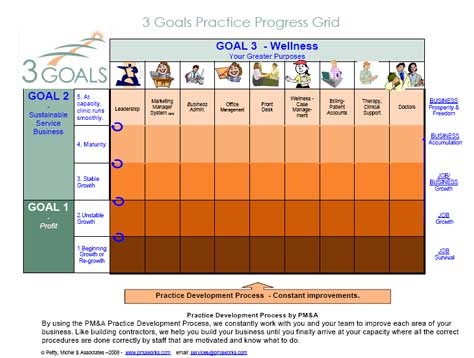
All of this leads to a key concept: capacity. Capacity is the ability and “room” to produce. Four-handed dentistry increases the capacity for the dentist to serve more people.

The reason why many offices stop growing is that, simply, they run out of room. It could be that there is not enough physical space or not enough effective staff. It could be poor patient, staff, and paperwork systems that clog up the flow so badly that even a can of Drano or a visit by the Rotor-router man couldn’t fix.

And, sometimes, even our mental capacity can get “filled-up.”

A well-organized office allows you to leverage your abilities and create more production. It also opens up the room to produce.

Imagine trying to play a football game on a 10 yard by 10 yard field. This is what many of us are trying to do, yet we just don’t know it. If you are having a hard time growing your office, you may have unseen capacity constraints holding you back.

A four-handed chiropractic office would be an office where there were many “hands” efficiently doing all the work, allowing the doctor(s) to focus only on those key actions necessary to treat patients and run the office.

Give this some thought and we will SOON show you some specific examples and what to do about capacity restraints in your office. Stay tuned…

P.S. If you know any doctors or marketers who would enjoy this article, just send them an email with this link: http://www.pmaworks.com/main/Four-Handed_Chiropractic_Office.shtml
P.P.S. E-mail addresses are never shared.

You are free to use the material from these articles in whole or in part on your web site or eZine (email newsletter) as long as you include the attribution below and also let me know where the article will appear.

“This article is by Ed Petty of Petty, Michel & Associates. Petty, Michel & Associates web site is a comprehensive resource on practice development for chiropractors. For free marketing resources and valuable development tools visit http://www.pmaworks.com”

Randy Pausch

Randy Pausch
Last Lecture

Carnegie Mellon Professor Randy Pausch, who is dying from pancreatic cancer, gave his last lecture at the university Sept. 18, 2007, before … a packed McConomy Auditorium. In his moving talk, “Really Achieving Your Childhood Dreams,” Pausch talked about his lessons learned and gave advice to students on how to achieve their own career and personal goals.

Summary of lecture from the Wall Street Journal.   Viewing time  4 minutes 39 seconds.

Link, or watch below:

Full Lecture 1 hour 39 minutes

Fall Chiropractic Marketing

Here are some quick ideas for you to consider for your fall marketing of your chiropractic services.

There are different approaches to these themes and projects. Please give us a call anytime for advice on how to implement them. You can also find them on your MMS computer program. For those of you on the MMS Coaching program, you can also find information on your Member’s site, which is updated often.

Internal/External

  • September – Kid’s Day
    i.    Spinal Care Class (New patients and their guests friends.)
    ii.   Care To Share Program (Referral drawing)
  • October – “Pinched Nerve Awareness Week” (October is national Spinal Health Month.)
    i.    Reactivation Program
  • November – “Headache Awareness Week”
  • December – Donation Drive
  • January – Weight loss and Fitness Programs

Community Services
Now is an excellent time to work on setting up your external community events. Schedule workshops and screenings in business, clubs, and organizations over the next 5 months – through January.

An important key to setting up these events is knowing what it is you are going to provide. For example: a workshop on headaches, or fitness, or a screening, or something else entirely.

We have found that there is a direct ratio between having a clear idea of what service you are going to provide and the success in scheduling the event. Here are some ideas, but again, there are many more on your MMS computer program and please call if you have any questions.

  1. “8 Healthy Home Remedies for Relieving Headaches”
  2. “How to Stay Fit When You Sit”
  3.   Company Health Fair
  4.   Employee Appreciation Luncheon

Lastly, and as always, keep yourself inspired.  One way to do this is to keep learning and working on improving your procedures.   Fall is not just a time when children get to learn. We always have the opportunity to improve if we just study.  We can analyze our new patient intake procedures, our patient education programs, our clinical protocols for different cases, etc.

If you are feeling like your practice is getting boring, just study it. Learn how it could be improved.  A professional is constantly improving.

Till next time,

Ed

Chiropractic Motivation – Two Wolves

An elder Cherokee Native American was teaching his grandchildren about life. He said to them…

“A fight is going on inside me… it is a terrible fight and it is between two wolves. One wolf represents fear, anger, envy, sorrow, regret, greed, arrogance, self pity, guilt, resentment, inferiority, lies, false pride, superiority and ego.

The other stands for joy, peace, love, hope, sharing, serenity, humility, kindness, benevolence, friendship, empathy, generosity, truth, compassion and faith.

This same fight is going on inside you and every other person, too.”

They thought about this for a minute, and then one child asked his grandfather… “Which wolf will win?”

The old Cherokee simply replied… “The one you feed.”

Chiropractor: Are You a D.C. or a D. S.?

Whether you are a D.C. or a D.S. makes a big difference in your patient retention and patient referrals.

Many years ago we were working with a chiropractor who, while he had a great practice, couldn’t manage it worth a damn.  Even so, because his patient retention and patient referrals were exceptional, he had a high volume practice.

As we worked with him to improve and expand his business structure, his volume continued to increase. This was a while back; when note taking was very simple, but I think he got up to seeing around 500 visits a week, with peak weeks over 600. We helped with marketing and associate doctors, and he continued to grow. He had all kinds of marketing programs, plenty of associates, and made a great name for chiropractic.  But at the heart of his growth was a special secret he often related.

What was his secret?

Well, one of them was the way he started each case.  On his initial consultation with each patient he would say:

“Before I tell you what chiropractic does, let me tell you what it doesn’t do. As doctors of chiropractic, we do not prescribe drugs.  (Pause.) We also do not perform surgery. (Pause.) Lastly, we do not treat symptoms.” (Long pause.)

He would let that sink in for a few moments. He would then briefly explain what chiropractors were really after.  Namely, subluxations. And while there may be other terms for this condition, from a marketing point of view, this has worked. It fixes in the mind of the patient that there is an underlying cause or a basic contributing factor that resulted in, or at least affected their current complaint(s).

Over the years of consulting, we routinely see doctors “going shallow”, treating only the superficial symptoms that patients come in with. “Hey doc., I must got a crick in my back. Can you just give me a crack here (points) and fix it?”  Horror of horrors!

It is easy to focus only on the symptoms.  First, it is the reason why the majority of your patients come to see you.  They have pain, stiffness, or discomfort and want it fixed.  Second, it is what your insurance company requires in your documentation.  Third, it is the path of least resistance. Give the patient some relief and then move on.  Fourth, chiropractic is usually SO effective with symptoms relatively quickly, that we often are just happy with that.

I am certainly not advocating any particularly type of treatment guideline.  I am just pointing out that many successful chiropractors look for earlier traumas in their consultation and history and maybe spend just a bit more time on the general diagnostic process, if only a minute more.

This is from a marketing point of view, not from a clinical perspective. In these times of higher deductibles, you have to put the value into your service.  If a patient comes to you for a pain in the “keister”, and you only address that, not only is the patient being the doctor, but also you are relegated to “therapist.”

Another doctor David and I worked with had a practice “melt down” one winter day. (By the way, we see these “melt-downs” every now and then! Too much insurance B.S., mid-life burnout, staff problems, etc. Please call us if you feel one coming on!)  He was mostly a “straight” doctor, but had purchased a very inexpensive, used EMS (muscle stim.) unit for patients.  One day, one of his patients came for his adjustment. He told the doctor that he didn’t want adjustments anymore, just wanted some of that electronic muscle stimulation.   Our doctor blew a fuse. “Fine”, he said. “Here, take the dang machine and go home. You can have it.” And he actually gave it to him.

A bit extreme, but it was probably good to get it out of his system. The doctor was feeling that he had become only a band-aid therapist for his patients because of the therapy unit. It took a while, but we got him to see that it was not the patient’s fault. The patient simply did not understand the purpose of the doctor’s treatment program.

D.C. could be called Doctor of “Chronicity.” I was reminded of this recently by one of our clients.  D.S. could be “Doctor of Symptoms.”

We suggest the following:

1.    Be a D.C. Doctors who emphasize the chronic nature of the patient’s symptoms seem to have busier practices.  We suggest that you should do both:  definitely help patients get what they want – pain relief.  But, as appropriate, work with them to get what they really need.

As a side note, some doctors can become so philosophical that they loose touch with the fact that “the Customer is King.” (In Japan, I have read they say that the “Customer is God.”) Philosophy, principles, and emphasizing the chronic nature, as indicated, is fine.  So is “Wellness.” Just remember that you have to also give the patients what they want and keep them happy.

2.    Integrity. Needless to say, in all things you have to call it like you see it and maintain your integrity. If there are no chronic conditions, then so be it. But at least, take the time to look.  Be curious, investigate, and don’t let the insurance company or the patient’s desire for fast results compromise your clinical integrity.

3.    Interest. Traumas may have occurred many years earlier, or accumulated over the years.  Be genuinely interested and focused on their case. Even intense about what you discover in their exam and x-ray and how you explain it. “Would you look at this, Mrs. Jones”, pointing to a spot on the x-ray as if this was the first x-ray you had seen of this kind before. (And it is.)  This will increase the patient’s confidence in you and acceptance of your treatment plan.

4.    Time, Repetition, Effort. It may take time to correct the condition. It may take repetitive visits (like an orthodontist), and it will take effort on the patient’s part as well as yours.

Go over the factors of time, repetition, and effort with the patient. You can also ask the patient how long do they think it will take to correct the condition.   If you have educated them on the true nature of the condition, you might be surprised to hear that they often offer a longer period of time than you were ready to present to them in your treatment program. (A very successful doctor recently reminded me of this.)

5.    You Are, And Have Been, A Leader. And finally, don’t sell yourself short. As a chiropractor, you are an active member in a profession that, no doubt, has led the way in real health care over the last 100 years.  Certainly, it will continue to do so in the future, provided that you stick to your guns, while always adapting to the ever-changing market.

By looking for and working to correct the long term causes of spinal related symptoms, you will inspire trust and confidence in your patients as their doctor of chiropractic, coach, and friend. As such, your patients will be loyal and refer their friends because of your care. And, as such, you will be a D.C.

Ed Petty