

Ask Lisa: Front Desk and Insurance Departments Hook Up for Start of New Year!

balance scale between aesthetics and your bottom line in the chiropractic profession

Balance Between Aesthetics and Your Bottom Line

Greetings!

I’m condominium and cat sitting from December into January and am looking out of a window of natural beauty. If you are familiar with the Kettle Moraine areas of Wisconsin, affectionately referred to as “The Kettles”, you’ll deeply appreciate the beauty balanced with serene livability. The Condo complexes are built on a solid but interesting foundation of intertwining drumlins and kames of deposit sediment from glacial melts, making it challenging to keep your footing if you hike these.

Which brings me to you, and the balance between the sometimes hilly, lose-your-footing areas of your office and the beauty of it when you help a patient return to their own footing. And such is the time for your Front Desk and Insurance Department roles to intertwine at the start of the New Year!

Here is a simple New Year Checklist for your front office and your insurance departments to maintain balance of beauty and your bottom line:

1)  Obtain all patient’s insurance cards and make a copy for scanning into your practice management software. This is also the time to verify patient’s current address, cell phone number, and email address. Both areas of your office – front desk and insurance, need this information, and need it to be current. Maintain a pleasant, aesthetic reception area that is welcoming for patients and creates an amicable environment for patients, who will now be more likely to be kinder in providing you their personal insurance information. I know the difficulty this request can pose.

2)  Team up to discuss and decide who will be holding patient financial consultations post-insurance verifications on new patients or change of insurances. Remember these need to be done at the very minimum, in a semi-private, to fully-private area. Will it be the front desk? Will it be an insurance staff? CT? Will it be you, the doctor, conducting these in the treatment area? We’ve seen it done all four ways and sometimes combined. Whatever works best, with the framework of respecting and staying compliant with the patient’s privacy and finances.  What have you done regarding communicating benefits to patients up until now? Has it worked? If so, keep doing it. If not, how can you tweak this process to make it better for you and the patient? See last month’s article* on process improvement while not necessarily focusing on efficiency improvement.

3)  Working and following up on Patient Receivables. As with financial consultations, it needs to be done. Your prep work is to decide who will do the patient receivables follow-up: front desk, insurance, a combination? Consider updating your office policies to almost always collect at time of service to prevent the need for future follow-up on aged receivables.  Insurance follow-ups are best done by your insurance department. Consider sourcing out your insurance billing to someone who will do the insurance follow ups for you if you do not have internal insurance staff.  And…

4)  Make it a great, serene start to 2026!

And I have more great news for you! Our newly updated Welcome to Wellness* program is ready for purchase. As a special bonus this version includes:

  • 15 minute telephone consultation with the author, Dave Michel, on how to implement this class in your office. This includes sample versions of the most recent classes.
  • 90 Day Subscription to thePMA Members Library of over 500, helpful, customizable documents and articles.  You can read more about it here. [LINK]
  • Additional add on services for the Welcome to Wellness are also available.

We are currently in the process of updating our Patient Financial Consultation Kit for early Spring delivery.

Just Ask…

Lisa
920-334-4561
lisa@pmaworks.com

Pain is the Last to Show and the First to Go in Chiropractic Healthcare

Previously published on The Goal Driven Business

pain level of a subluxation

An Important Chiropractic Patient Education Tip

I recently visited a highly successful practice that had its usual issues and wanted to expand to the “next level.”

What did they need? More marketing, more staff training, more associates!

Sure.

But they also needed to tend to the basics, and here is one that is simple but easily overlooked:

Chiropractic Patient Understanding of Symptoms

I learned this early on: subluxations and other dysfunctions of the spine and joints can be present long before pain or other symptoms show up.

Finally, the individual drags themselves in to see you, and you begin care. After a few visits, the pain subsides. Yahoo!

Are they fixed? Probably not.

They have moved from acute care to corrective care. (You may call it something different, but the idea is the same.)

Your patient may not be familiar with this distinction. Hence, the report of findings and the importance of future patient education.

“How are You Feeling?”

So it was with some dismay that, visiting this office with excellent doctors, I kept overhearing them greet the patients with “how are you feeling?”

What!! What did you say?

Nooo!

Patient thinks, “Hey, I’m feeling pretty good. No need to come in anymore. Bye!”

Two months later, they hobble back in: “Doc, I have the same problem.”

So, what should you say? You want to be nice and show interest. You do care, and would like an update, right? So what do you say?

Just be genuinely interested and ask them how they are doin’? Or better, try these:

  • “How are you moving this week?
  • “What improvements have you noticed?”

I am not a doctor and would not presume to suggest care procedures. But this is a matter of patient education, marketing, and business development.

You want to improve their function, structure, and health. Maybe their mindset as well.

And of course, you want them pain-free.

Just remember that pain shows up last, and usually leaves before your work is done.

Get this on your chiropractic and healthcare patient care checklist and for a reminder, review it often. I bet you’ll see an improvement in outcomes and retention. Even a 10% increase in patient retention can significantly impact your practice outcomes and bottom line.

If your goal for your patients includes pain relief AND better function, this can help.

Stay Goal Driven,

Ed

Ask Lisa: It All Goes Back to the Goal!

theory of constraints the goal by Eliyahu M. Goldratt for the chiropractic office

I recently took a book off my bookshelf to re-read …

The Goal by Eliyahu M. Goldratt is one of my favorite business books. I love that Eli drives home being human, while at the same time having great capacity to improve systems and procedures in the workplace. As a business owner this relates directly to you.

Keep reading to learn how.

A few key takeaways from the book and how this ongoing process can help YOU improve your collections and income include:

Keeping in mind that the true goal of any for-profit company is to make money now and in the future. Two features of this are:

All operational decisions are evaluated based on whether they help achieve this goal.
Performance measurement is framed around three metrics:

  1. Throughput, or productivity (Service productivity is reflected in your NP, PV, charges, and collections stats)
  2. Inventory (making purchases intended to sell, such as supplements, pillows, exercise rehab supplies; and
  3. Operational Expense, which is money you spend to turn your inventory into productivity. This can include your practice management program and billing program’s monthly payments, maintaining and enhancing the office space, and maintaining functional chiropractic equipment such as your adjusting tables.

So, what specific actions can help you achieve the true goal for your business?

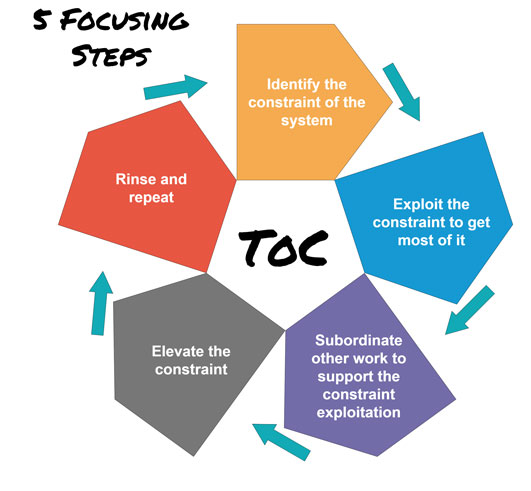
1. Identify constraints or bottlenecks in the office.

a. Look at time studies of the doctor(s) and staff. Can scheduling be done differently to open up blocks of time for more patients and/or paperwork.

b. Look for a breakdown in policies and procedures. How can it be done more effectively with better results?

2. Second, maximize and support the constraint,

a. decrease interruptions;

b. delegate tasks that are not directly clinical;

c. work on office flow for greater capacity.

3. Take note of variables. When a variable is presented such as doctor or staff
vacation and holidays , make adjustments to accommodate and still maintain your
goals.

4. Repeat steps 1 through 3, and you’ll find another constraint/bottleneck to work
through.

It may not feel good at first, but each time you cycle through the steps, according to the theory of constraints, you actually are improving the quality of your practice and its value!

Want to learn more about specific action steps for identifying bottlenecks and improving your collections and income? Give us a call. We’ve got your back. Just Ask . . .

Lisa
lisa@pmaworks.com

PS: Another great book that directly relates to this topic is “The Goal Driven Business” by Ed Petty.

Ask Lisa: Actions you can implement now to reach your Goals in 2026 and Beyond!

It All Goes Back to the Goal!

Greetings!

I recently took a book off my bookshelf to re-read …

The Goal by Eliyahu M. Goldratt is one of my favorite business books. I love that Eli drives home being human, while at the same time having great capacity to improve systems and procedures in the workplace. As a business owner this relates directly to you.

Keep reading to learn how.

A few key takeaways from the book and how this ongoing process can help YOU improve your collections and income include:

Keeping in mind that the true goal of any for-profit company is to make money now and in the future.  Two features of this are:

  1. All operational decisions are evaluated based on whether they help achieve this goal.
  2. Performance measurement is framed around three metrics:

1)  Throughput, or productivity (Service productivity is reflected in your NP, PV, charges, and collections stats)

2)  Inventory (making purchases intended to sell, such as supplements, pillows, exercise rehab supplies; and

3)  Operational Expense, which is money you spend to turn your inventory into productivity.  This can include your practice management program and billing program’s monthly payments, maintaining and enhancing the office space, and maintaining functional chiropractic equipment such as your adjusting tables.

So, what specific actions can help you achieve the true goal for your business?

  1. Identify constraints or bottlenecks in the office.

a.  Look at time studies of the doctor(s) and staff.  Can scheduling be done differently to open up blocks of time for more patients and/or paperwork.

b.  Look for a breakdown in policies and procedures. How can it be done more effectively with better results?

2.  Second, maximize and support the constraint,

a.  decrease interruptions;
b.  delegate tasks that are not directly clinical;
c.  work on office flow for greater capacity.

3.  Take note of variables. When a variable is presented such as doctor or staff vacation and holidays , make adjustments to accommodate and still maintain your goals.

4.  Repeat steps 1 through 3, and you’ll find another constraint/

bottleneck to work through.

It may not feel good at first, but each time you cycle through the steps, according to the theory of constraints, you actually are improving the quality of your practice and its value!

Want to learn more about specific action steps for identifying bottlenecks and improving your collections and income? Give us a call. We’ve got your back.  Just Ask . . .

Lisa

lisa@pmaworks.com

PS: Another great book that directly relates to this topic is “The Goal Driven Business” by Ed Petty.

Keep Hope Alive in Chiropractic and Healthcare Offices

Previously published at GoalDriven.com

two young teens visiting an older gentleman with thanksgiving dinner.

A Message from the “Head Office” ?

Early Thursday morning, I drove to a suburban high school with two of my grandkids. We were participating with others involved with a service organization called Community Projects for Seniors here in Milwaukee.

When we pulled into the expansive parking lot, we saw hundreds of cars and people driving through designated stations, receiving boxes of hot Thanksgiving dinners to deliver to seniors across Southeast Wisconsin.

The loading was well organized and ran smoothly, despite everyone being volunteers. Everyone looked to be having a good time, smiling and high-fiving in the early morning, freezing temperatures!

The two grandkids and I delivered 51 meals to residences in a low-income section of Milwaukee. It was a good experience for them, knocking on apartment doors, wishing seniors a happy Thanksgiving, and sometimes offering short expressions of care and interest or best wishes for the Packers (professional football team) later in the day.

As we were getting to the end of our route, a senior gentleman, must have been 6′ 4″ or more, after accepting the meal, looked dead at my grandkids and said, “Keep Hope Alive.”

Keep Hope Alive

“Keep Hope Alive” was a phrase Rev. Jesse Jackson often used when he ran for president in 1988. Jackson participated in the Selma marches in 1965 and became a close aide to Dr. Martin Luther King Jr.

The Selma marches included Bloody Sunday, when 600 unarmed peaceful civil rights protesters were violently attacked and beaten, some unconscious, by state troopers in March of 1965 in Selma. The Voting Rights Act of 1965 was signed into law by President Johnson, guaranteeing the right to vote for African-Americans, especially in the South.

But here we are in 2025. What did this resident mean when he said “Keep Hope Alive” as he accepted the Thanksgiving dinner? Why did he say it to two suburban kids this Thanksgiving?

Unlike most of the other people we handed dinners to, he was the most cheerful. Perhaps, for him, an elder and certainly not well-off, he had hopes for a better future.

A better future for himself — and maybe for others.

Keep Goals for Your Chiropractic and Healthcare Practice Alive

The word “hope” is defined as the feeling of trust that something wished for can or will happen. The derivation of the word “hope” traces back to Old English “hopian,” meaning to expect, or look forward with confidence in a positive outcome.

Hope is more than just wishing… it is expecting what you want will happen.

Kinda sounds like a goal, doesn’t it?

You know, you can receive messages that are meant for you – from others.

Someone I know calls these “Memo’s from the Head Office!”

I think that, for me, the “message” from the senior gentleman was that any hope, or goal, for a better future must be actively kept alive.

That means, your dreams and goals for the New Year, including your chiropractic and healthcare practice, can’t be made and then parked.

They need to be kept alive.

Maybe his message was meant — for you too!

😊

Keep Hope — and Your Goals — Alive.

Ed

Preparing for a Powerful New Year in Your Chiropractic Healthcare Business

Previously posted on (Goal Driven.com)

petty michel and associates end of year business preparation checklist

42 more days until a New Year is here.

Before we know it, it will be at our morning doorstep. Like a happy eager dog ready to be taken for its morning walk, tail a wagin’.

But before we look at all what is coming, we have the next few weeks to wrap up 2025. This includes the Holidays, both in business and in our personal lives. We also have all the year-end admin details to complete.

NOW is the time to nail everything down — to plan the events and complete the admin tasks.

And while doing this, filling the end of the year with Christmas cheer, ready for 2026 — your best year yet!!

We’ll prepare for the New Year in a few weeks, but let’s finish off this year with a flourish. Consider these 4 actions:

  • Relationships. Focus on re-bonding with all your patients and supporters from this last year.
  • End of year care. Encourage them to come in and get care.
  • Referrals. Bring in their family and friends for an end of year check-up.
  • Year end admin checklist. Review and complete all year end admin duties that need to be done.

Most important is your connection with current and past patients and supporters.

Remember:

a practice is a network of relationships that is created and sustained through communication and service.

Be ready to take a little extra time to chat, to communicate, and to listen — and an extra “a cup of kindness, yet.”

Marketing. I gave a list of some marketing activities you can do for November and December in a recent newsletter. You can review them here. Get those planned and going.

End of Year Administrative Checklist for Chiropractic and Healthcare Businesses

In addition, we have put together a short list of administrative items that should be reviewed and completed by year end for your chiropractic and healthcare office. It is by no means complete, but the idea is you want to get them taken care of as soon as possible, or at least scheduled, so you can focus your creative energies on launching your 2026.

Block 2-3 hours in early December to work through this list. Delegate sections to your manager, billing staff, and bookkeeper.

You can also contact Lisa who is an expert in these subjects. You can contact her anytime.

Just Ask Lisa! (Lisa@pmaworks.com)

The checklist covers these categories:

2025 ADMIN WRAP UP CHECKLIST

  • FINANCIAL & TAX
  • CREDENTIALING & LICENSING
  • EMPLOYEE ADMINISTRATION
  • INSURANCE & PATIENT ACCOUNTS
  • COMPLIANCE & OPERATIONS
  • BUSINESS ENTITY & LEGAL

Download the ADMIN LIST below and tend to the admin.

Meanwhile, have a great time with your patients over the next 6 weeks.

And let’s prepare for your best year ever – in practice, in business, and in life!

And stay…Goal Driven,

Ed

Download the Checklists HERE

Ask Lisa – Compliance 201: Your Shield Against Bad Risk

compliance in the health care field for chiropractorsAs a follow-up to our previous compliance articles, I thought what I’d do this month is put together a FAQ list for my dear readers and call it Compliance 201. Keep reading to learn about upcoming new requirements in the compliance/cybersecurity world to keep you at least safe-guarded when you are hit with a cybersecurity incident. Special thanks and credit goes out to ChiroArmour and Dr. Scott Muensterman for his research and presenting at the Chiropractic Society of Wisconsin Fall Experience last month on some of the content in my FAQ.

Q: What is HIPAA and HITECH?
A: HIPAA is the acronym for Health Insurance Portability and Accountability Act of 1996, in which uniform standards and requirements for the electronic transmission of certain health information were put into place and made into law. HITECH is the acronym for Health Information Technology for Economic and Clinical Health Act of 2009, a countrywide adoption and standardization of information technology to securely support the sharing of clinical data.

Q: What is Cybersecurity?
A: Cybersecurity is the practice of protecting digital systems, networks, and data from malicious attacks, damage, and unauthorized access.

Q: Is there a checklist available to ensure we are in compliance?
A: Yes. Current and Active PM&A clients have access to our HIPAA/HITECH compliance checklist, on the PMA Members Site, and compliance services are included upon request from the client.  If you are currently inactive or not a client, we can provide you with the checklist for a nominal fee. Please keep in mind your staff are already very busy, so ask yourself who is going to take on ensuring compliance at your office and going through the checklist? We can help.

Q: Isn’t it a matter of IF a cyberattack at my office occurs, not WHEN as you stated above?
A: On average there are 11 to 12 cyberattacks happening per minute in the US. So in today’s world yes, it is a matter of when, not if. And after research, it has been found that small businesses are more of a target for an attack than large organizations mainly because large organizations can put more dollars into security measures.

Q: What does Windows 10 and Windows 11 have to do with compliance?
A: Windows 10 no longer supports the security patches it used to support, effective 10/25/2025, so all of your computers must be operating on Windows 11 at minimum by this time. You CAN extend your Windows 10 protection for 1, 2, or 3 years at a significant price, but your software vendor may not honor the upgrade.

Q: I heard that there is something called an OIG Exclusions report – what is this and does it affect me and my practice?
A: The OIG Exclusions database is a reporting site listing every individual who is prohibited from seeing Medicare/Medicaid patients due to prosecution of a criminal activity, which can include being found guilty of fraud against Medicare/Medicaid, non-compliance of court-ordered child support payments, and illegal drug convictions. It is and will be a requirement to run a report MONTHLY on every person in your office including owners, subcontractors, and upon a new hire.

Here’s the link to check names: https://exclusions.oig.hhs.gov/
If you don’t see your name, that’s a good thing. Some of you are already running and checking this report due to insurance contract requirements. Save or print and file the results page.

Q: How can I confirm if my practice management program is fully compliant?
A: The website for verifying compliant healthcare software programs is down as of this writing, so for peace of mind if you are not 100% certain, call your software company or IT person.

Q: When do changes/new requirements occur?
A: As of now, no date has been set by HHS, but if you are doing the above steps and have written policies in place, you should not worry, but watch for future communications. You can subscribe to HHS email notifications here: https://cloud.connect.hhs.gov/subscriptioncenter

Q: What does Medicare documentation have to do with cybersecurity?
A: To avoid a documentation audit and subsequent potential visit from the OIG to further audits on compliance with HIPAA and your cybersecurity policies, keep your documentation and billing practices solid per Medicare chiropractic documentation standards, and make sure to securely send your notes to Medicare upon audit (and any other payer group who requests) to ensure you are staying HIPAA compliant.

Q: Can my staff be our Security officer?
A: By law, yes, but you as the doctor owner are always ultimately responsible for any attack or breaches, and payments to the government, so it is strongly recommended that the doctor owner be the compliance security officer for the business.

That concludes our FAQ for now. I know you’ll have additional questions. Feel free to reach out with those we’ll respond within three calendar days!

Stay Secure,

Lisa

References: ChiroArmour


cards

Powered by paypal

Fun and Effective Promotions for November and December

food drive grocery cart for chiropractic and healthcare facilities

Spark Some Magic in Your Chiropractic Practice This Season!

Special Promotions for November and December 2025! These are loud and lively events that engage the entire team!

Why do them?

  • Increase new patients with great offers.
  • Energize less active patients and get them back.
  • Build greater team spirit for a shared purpose.
  • A reason to promote your office and let patients and your community know how active you are!
  • Increase your presence as the Health Hero’s in your community.

Even without an offer, just the fun of giving back will boost your visits and instill greater loyalty.

Read the full Goal Driver Newsletter at Goal Driven.com and checkout the fun, festive promotions that will spark magic in your office this holiday season!

Why Clear Roles Build a Stronger Chiropractic & Healthcare Practice

team players wearing staff hats front desk billing promotion marketing

Better teamwork, smoother operations, and improved patient care all start with clarity.

Years ago, I visited a chiropractic office where the doctor was frustrated: patients weren’t keeping appointments, and he blamed his front desk staff, “Sue.” The problem wasn’t effort—Sue was polite and friendly—but she had no clear job description, no checklist, and no real understanding of her responsibilities.

Once we clarified her role, outlined simple procedures, and scheduled regular reviews, the practice quickly improved. Patients kept their appointments, and both the doctor and Sue felt more confident and motivated.

This is a common issue: when roles are vague, results suffer. But when roles are clear, teams thrive.

The Three Elements of Every Role

According to the Goal Driven System, each role should include:

  1. Purpose – Why the role exists.
  2. Outcome – The measurable result it should achieve.
  3. Procedures – The specific actions to reach the outcome.

Example – Front Desk Role:

  • Purpose: Help patients achieve health goals by ensuring they stay on schedule.
  • Outcome: Patients consistently keeping appointments.
  • Procedures:
    • Greet every patient with a smile.
    • Answer the phone warmly.
    • Confirm each patient leaves with their next appointment scheduled.

 Action Steps for Your Practice

  1. Have every team member list their roles.
  2. Define the purpose, outcome, and 5–10 key procedures for each.
  3. Add measurable indicators (e.g., % kept appointments, total visits).
  4. Review and rehearse roles regularly, just like a winning sports team practices.

Clear roles create accountability, boost morale, and drive better patient care. Keep it simple, keep it consistent, and keep it fun.

Stay Goal Driven,

Ed

Want More New Patients in Your Chiropractic or Healthcare Practice? Start Here.

chiropractic team going over stats to improve care and service

Most doctors think the first step to getting more new patients is marketing. But that’s not always true.

Years ago, a large chiropractic office asked for help because their new patient numbers were slipping. After analyzing their situation, it was clear their promotions were weak—but the real problem went deeper.

The senior doctor, in practice for 20+ years, had become bored. Patient visits felt routine. Long-time staff were stuck in old habits. Meanwhile, the two younger doctors had enthusiasm but lacked confidence and experience.

We started by focusing on quality of care, not ads. The senior doctor began coaching the new doctors on cases and patient communication. Staff refreshed their service procedures and rehearsed ways to create a stronger patient experience.

The result? Without launching a single new promotion, new patients and visits went up. Only after that did we create a marketing calendar—because now they had something truly worth promoting.

The Lesson

Before you spend time and money on external promotions, make sure your practice delivers the kind of care that inspires patients to return and refer. Quality care and continuous improvement are the foundation of real growth.

As Stephen Covey said, “Sharpen the Saw”—renewal and improvement keep the drive alive.

Stay Goal Driven

Ed

Read the full article here: Goal Driven Blog

Don’t Get Left Behind

3 children playing football. Their goal is to play, win and have fun

Football Season, Chiropractic, and Winning Strategies

Football season is here—and it’s a perfect time to highlight chiropractic. Every professional football team has a chiropractor, proving that even million-dollar athletes rely on it to perform at their best.

Top athletes agree

  • Aaron Rodgers credits chiropractic (and his chiropractor father) for helping him stay at peak performance.
  • Tom Brady says adjustments make him feel taller and better aligned.
  • Joe Montana calls chiropractic a key part of his game.

If chiropractic works for them, imagine what it can do for local athletes and weekend warriors.

How to Market Your Services with a Sports Theme

Position your office as the place for athletes of all ages to boost performance, recover faster, and prevent injuries.

Ideas to promote chiropractic through sports:

  • Workshops:
    • The Injury-Proof Playbook: 8 Moves That Keep Athletes in the Game
    • Weekend Warrior Survival Guide: 8 Strategies for Active Families
  • Business Talks: Offer lunch-and-learns, screenings, or mini-chair massages.
  • Athlete Recovery Days: Host Monday Morning Quarterback Recovery sessions for post-game soreness.
  • Community Partnerships: Team up with schools, youth leagues, and local teams for education, sideline care, or screenings.

Promotion Tips:
Use your newsletter, office fliers, social media, and table talk. Assign a part-time Marketing Coordinator (3–5 hrs/week) and hold monthly planning meetings so every staff member contributes.

Build Your Own Winning Team

Think of your practice like a football team:

  • Have a game plan.
  • Play 4 quarters each month.
  • Work as a team.
  • Keep score (track progress).
  • And most importantly—keep it fun.

Chiropractic helps athletes win on the field. With the right marketing and team mindset, it can also help your practice win in the community.

Ask Lisa: When Your Patients Need Extra Help

payment terms for chiropractic care plan

When Your Patients Need Extra Help

Tips and Sample Policies for Financial Consideration Cases

It does happen from time to time… patients will need care but are not in a position to be able to afford care. To maintain your goals of:

  1. getting sick people well and maintaining health through chiropractic, and
  2. remaining profitable, you do have a duty to provide care to those that cannot afford care.

The two goals do not conflict.  And you do not want a patient to discontinue care because they have financial problems. Your clinic should have policies in place to enable a patient to get care – regardless of their financial ability. For active clients sample policies can be downloaded from the PMA Members Site. For all others sample policies are included in our Patient Financial Consultation Tool Kit.

Immediately following the Report of Findings, the CA should meet with the patient (the Post Report) to work out any financial arrangements, and to answer any questions that the patient may have concerning the policies of the clinic.

If the patient expresses concern over their ability to pay for the services that will be performed, go over the different fee policies that you have and see if one of these programs will handle their financial problem.

First discuss payment at time of service and prepayment options.

Here is a sample Introductory Script you can utilize:

[Patient Name], it sounds like you know how important our care is for your condition, and we want to be able to treat you. We understand that money can be a problem and know that you have to eat, pay rent, etc. I would like to set you up on our individual “Financial Consideration” program. It will provide you with the care that the doctor has outlined, at a price that you can afford.”

If the patient pushes back, inquire, empathetically, if the problem is truly a financial problem, or if they have a problem with the treatment program prescribed.

OTHER TIPS

  • Avoid writing: “(“Clinic Name) agrees to waive $100 of patient’s $200 deductible.”
  • We suggeest this be worded: “(Clinic Name) agrees to accept $100.00 from patient towards their deductible and waive any remaining deductible.”
  • When writing up the agreement, please remember to use a “per visit” amount only, rather than per week or month.
  • Please note that in talking to patients, they are not a “hardship” case, but a Financial Consideration case.

For active clients sample policies can be downloaded from the PMA Members Site. For all others sample policies are included in our Patient Financial Consultation Tool Kit.

Contact us if you need help accessing the scripts or if you have any questions!

Lisa

920-334-4561

lisa@pmaworks.com
Please share this newsletter with your colleagues so they may benefit from these services too!

Scripts are Secondary in Your Chiropractic and Healthcare Practice

female chiropractor discussing care plan with patient

Why Scripting Can Fail—and How to Make It Work

A script is a prepared set of phrases, questions, or responses designed to guide staff or doctors in patient interactions. Whether word-for-word or just an outline, scripts help keep communication consistent, especially for new team members. But even the best script can flop if it’s missing one thing—authentic human connection.

Connection Comes Before Words

Think of connection like a radio signal. A carrier wave must exist before any music or voice can be transmitted. Without it, nothing gets through. In patient care, that “carrier wave” is trust and genuine interest. If it’s missing, your words—no matter how polished—won’t land.

I once had a doctor greet me after a minor surgery with a cheerful, “I can’t tell you even had it done!” It was a nice line, but it felt canned. The delivery lacked authenticity, so the message didn’t connect.

How to Create the “Carrier Wave”

  • Be authentic – Avoid sounding rehearsed.
  • Be curious – Take a few extra seconds to ask a follow-up question.
  • Recognize the person – Make patients feel valued and respected.

When you connect first, your scripted lines gain power and meaning. Without it, patients may feel unheard, leading to fewer new-patient conversions, lower follow-through, and less word-of-mouth.

Using Scripts Effectively

  • Review and practice scripts every couple of months.
  • Role-play different delivery styles (bored, overexcited, glum) to sharpen awareness.
  • Use scripts to keep patient conversations moving forward, not to replace genuine interest.

Bottom line: Scripts are useful tools—but they only work if you first connect with the human being in front of you.

For more helpful business tips visit our Goal Driver Blog [LINK]

Ed

Coaching Your Chiropractic and Healthcare Patients

Consider adding this to your Report of Findings


“Mrs. Jones, it will take 3 things to get better.”

Many, many years ago, I heard this from an extraordinarily successful chiropractic doctor. He invited me to observe him discuss this in a report of findings with one of his patients.

I sat on the side, next to his knee-chest table, and with the patient’s permission, observed, paid attention.

The first part of the report was typical: a review of the findings, an explanation of the condition, a treatment plan, and a description of the potential consequences of not treating the condition.

Pretty standard, even now.

Then, he told the patient: “Mrs. Jones, it will take 3 things to get better: Time. Repetition. Effort.”

He then went over each point. For example, it is obvious that it takes time to improve anything. It also requires repeated applications, such as painting a house, cleaning out a garage, or watering a garden.

But the last element he emphasized: Effort.

Any improvement takes work, he said, and gave examples. These included activities such as performing home exercises to improve their condition, attending a class on spinal fitness, and simply making it to the office to maintain their schedule.

He was an athletic doctor, and I believe this influenced his approach. He was coaching his patient, much like an athletic coach would motivate a player.

Yes, you are a well-educated, skilled, and caring doctor. But consider your role as a coach as well. You want to get your patient, as a “player,” to improve, and you know what it takes. You want them to win. So – you tell them!

They have a responsibility, just as you do. Seek your patient’s agreement on these three ingredients for a successful course of treatment, and remind them at approximately every 6 visits.

I have seen this work. It also applies to all aspects of our lives whenever we want to improve something.

In fact, I remind the offices we work with that these are the 3 factors needed to improve their business.

Educate your patients. But coach your chiropractic and healthcare patients on what it takes to get better, and that is:

  • Time
  • Repetition, and
  • Effort.

Keep caring, coaching, and stay Goal Driven.

Ed

He walked away when I asked, “Who is going to do it?”

distressed overwhelmed male business man When you are the bottleneck

Many years ago, I attended a large chiropractic conference. I was new to the profession and curious about how things worked.

One of the seminars at the conference was on how to generate new patients. There must have been several hundred in the room. The speaker was charismatic and had some sensible recommendations. The audience seemed enthused.

I was sitting in the back of the room. When the seminar was over, I was one of the first to leave and walk into the hallway where attendees began to cluster to discuss the presentation.

I remember one doctor in particular. He was tall and had his name tag with ribbons hanging down. I didn’t understand what the ribbons meant, but I figured he must have been important.

I asked him how he liked the seminar. He was deliberate, almost authoritative when he said that he liked it and was going to implement some marketing projects. I told him that I thought that was good.

But then, thinking about it, I asked him, “Who in your office is going to do it?”

I remember him looking down at me. He seemed perturbed, as if I had insulted him. He looked up and walked away. Didn’t say a word.

I’ll never forget it.

This was a long time ago, but it made an impression on me.

REMEMBER THE OLD MAXIM
“Do what you do best, and delegate all the rest.”

You can’t do it all.

In the beginning, when starting and growing your practice, yes, you pretty much had to do most everything.

But at some point, you must create other team members who are trained and motivated to share the load. I know practice owners know this, but it’s easier said than done.

This is why a manager is so vital to your practice. Your manager is the fulcrum point that helps you make a team. They are a servant to the team — as you are to your patients.

They help put in the systems that allow all your internal and external marketing procedures to be effective. And not just marketing. Standard procedures for patient retention, patient services, patient reimbursement, and so on.

They take the load off of you, so you are not the bottleneck!

We’ve found that most staff and managers are very willing and want to help their offices grow. But in most cases, they are not sure how, or how best to work with their team, or their doctor.

It is because of this we have developed our Practice MBA program.

Take time each week to train your team.

And for some of you, our manager training program is just what you need to answer the question,

“Who is going to do it?”

Stay Goal Driven,

Ed

P.S. Get on our Waitlist today to ensure you get a spot. First come first serve. Only 15 spots available this fall.  [LINK]

Ask Lisa: Not a Robot – But Some Cool Technologies to Advance Your Practice.

Not a Robot – But Some Cool Technologies to Advance Your Practice, and Best Software Programs for the Chiropractic Practice

My computer technology training started in the 1980s. Here we are in 2025, and the demands for and surges in healthcare technology are real. But now I write with a fresh perspective. Technology can benefit, and even potentially save, your practice while maintaining human connection and personalized care. We’ve done some research for you – keep reading to learn about some healthcare technology to help your practice grow… and a link to the best practice management software programs based on Capterra surveys.

Let’s start with the patient record or SOAP note.

Your practice management software should work for you and the patient, not against, in recording subjective complaints that meet documentation standards and best practices.

Diagnostics Technology can include the use of Goniometers, scanners such as Surface EMG (sEMG), NeuroThermal, x-ray, inclinometer, and newer traumatic brain injury scanners such as quantitative electroencephalography (say this slowly, out loud).

In conjunction with your objective diagnostics, your practice management software should be a gateway to a solid clinical assessment of the patient’s condition, care plan, and expected outcome. Is your program user-friendly in assessing a patient’s case, and does it offer you the ability to present a sound assessment and expected outcome?

Using technology to administer and record a precise adjustment can include the use of the Activator, Impulse Adjuster, SOT (Sacro-Occipital Technique) Blocks, Impulse Adjusting Instrument, ArthroStim Adjusting Tool, Pulstar FRAS Adjusting Instrument, and the Atlas Orthogonal Percussion Instrument.

How to improve patient compliance with care plans
The use of AI and algorithms to assist in customizing treatment plans that patients stay engaged and comply with is at the forefront of the future of chiropractic care.(1) Technology devices as part of a patient’s care plan to help alleviate subjective complaints can include Utrasound and Laser units, electronic pulse devices such as Shockwave Therapy (extracorporeal shockwave), and Pulse RadioFrequency devices.

Ready to learn which software programs made the top-rate list? Click on the link below to review the top practice management software programs that made Capterra’s(2) list. Note that billing and invoicing capabilities are also part of the ratings:

https://www.capterra.com/chiropractic-software/

Other than the ratings included in the link, what else should you look for before investing in new practice management software, if you’re in the market?

Stephanie Maharjan, a brand leader at WellReceived, a corporate member of the American Chiropractic Association, gives the following guidelines in researching software:(3

  1. Ensure it is compliant with HIPAA and CMS
  2. Reviews from other chiropractic practices. When assessing a new software solution, gather reviews from other chiropractic clinics. Select reviews from a few clinics and see if they still use the technology. Stephanie points out that reviews and feedback are a great way to understand areas for improvement so you can boost patient retention.
  3. Ask for a free trial or a demo before committing to new technology, so you can test various scenarios and evaluate its functionality. Assess how well the technology meets your clinic’s specific needs and determine if there are any workarounds.

Email me if you would like to chat!

Lisa
lisa@pmaworks.com

References:

  1. https://www.capterra.com/
  2. https://neulifechiro.com/technology-in-personalized-chiropractic-care/#ai-and-data-analytics-in-chiropractic-care
  3. https://www.acatoday.org/news-publications/using-technology-to-improve-patient-care-in-your-chiropractic-clinic/

Discipline Drives Chiropractic Practice Success

The Role of Discipline in Practice Success

Success in chiropractic or healthcare practices often correlates with discipline, much like weightlifting. While not universal, many successful doctors embrace the discomfort and effort required to achieve their goals, similar to consistent training.

Why Discipline Matters

Discipline means doing what’s necessary, even when it’s tough, and avoiding distractions or shortcuts. Like weightlifting or enduring hard work (e.g., the author’s father throwing sawdust down his shirt to toughen up for a grueling job), disciplined professionals push through challenges to achieve lasting success.

Jim Collins’ Insights on Discipline

In Good to Great, Jim Collins identifies discipline as key to transforming good businesses into great ones, applicable to chiropractic practices:

Disciplined People:

  • Leadership: Great leaders prioritize the practice’s success over personal gain, showing diligence and humility.
  • Team: Hire self-disciplined staff who don’t need micromanaging.

Disciplined Thought:

  • Face tough realities with courage while maintaining faith in long-term success.
  • Focus on what the practice is passionate about, excels at, and can profit from (Hedgehog Concept), avoiding distractions.

Disciplined Action:

  • Success comes from persistent, incremental efforts, like pushing a flywheel, not one grand action.
  • Stay focused on long-term goals, as greatness stems from disciplined choices, not circumstances.

Apply Discipline in Your Practice

Knowing what to do isn’t enough—discipline is executing it consistently. Embrace challenges, stay focused, and build momentum for lasting success.

Seize the Future,

Ed

Ask Lisa: The Art of Navigating Insurance Network Participation

participation in insurance networks building blocks

One of the most critical decisions you will need to make in your practice is, should you be “in-network” with a payer group, or out? It’s a tough choice, and one size does not fit all.

So, what do you do?

First, determine which companies you already are in network with, and assess.

  • Do you have a contract?
  • What are your obligations as a participating provider?
  • Are you getting reimbursed what the contract’s fee schedule says it will reimburse?
  • Are you currently enrolled in Medicare, and are you a participating or non-participating provider?
  • Are you also currently enrolled as a provider in your state’s Medicaid program?
  • Are you enrolled as a provider with the Veteran’s Administration in your area?

Additional items to consider prior to enrolling in a plan include:

  • What is the reimbursement rate?
  • What percentage of the approved charges are taken out for contract discounts?
  • Is there a fee to join?
  • Do they want you to participate in their worker’s compensation, PI programs? (In our experience, opting in to the WC and PI products means no steerage to you, and cut reimbursements).
  • Are there pre-authorizations required prior to care?
  • Is there a visit limit?
  • What is the initial credentialing and re-credentialing process?

Next, make sure you have a profile set up with the National Council for Affordable Quality Healthcare (CAQH) universal provider database and that the information is current, and re-attested quarterly. There is no charge to create and maintain your profile in this credentialing database.

Third, audit your patient demographic. Run a report in your practice management software, to determine

  • What percentage of your reimbursement comes from insurance?
  • What percentage comes directly from patients?
  • Which payers are you mainly seeing patients from and are you finding that patients are requesting you be in network with a certain company?
  • Who are the main employers in your area insured with?

Fourth, develop a spreadsheet called “Insurance Networks” to help you and your insurance department keep the information organized and up to date.

Once you have a grasp on the above, you’re ready to determine if you need to pursue network participation with additional companies. Treating this like a sales or business venture, you’ll want to have insurance companies coming to you and requesting you be in their network.

Remember, it is to their benefit and their obligation to keep their paying policyholders happy.

Patients should feel free to call their insurer requesting you be on their plan. Patients have done this, and outcomes have been successful. Why? Because the worst phone call an insurance company can receive is from an upset policyholder who can’t afford to see their favorite doctor who is helping them (that’s you!) because the doctor is not on the plan.

We’ve just touched the surface of network plans and credentialing. PM&A can provide specialized and unique advice on making the choice of which networks to join, which to be out of network, and which to run away from! We also will run those audit reports to assess if you’re getting the best bang for your buck.

Email me for assistance with how these processes work for your practice. You may reach me at Lisa@pmaworks.com.

Lisa