
The Cathedral, Stone Blocks, and Your Goals

stone cathederal

(This is the third in our series on goals.)

The Cathedral, Stone Blocks, and Your Goals

Christopher Wren was one of the greatest English architects. He designed 53 different churches in London before he died in 1723 at the age of 91.*

There is a story about how he walked unrecognized one day among the men who were at work upon the building of St. Paul’s Cathedral — which he had designed. St. Paul’s Cathedral sits on a hill and is one of London’s most famous and recognizable churches.

“What are you doing?” he inquired of one of the workers, and the man replied, “I am cutting a piece of stone and working hard so I can feed my family.”

As he went on, he put the same question to another man, and the man replied, “I am an expert stonemason, and I am building a solid wall.”

He walked a little further, and around the corner, he asked a third man what he was doing. “I am helping Sir Christopher Wren build a beautiful cathedral that will be a place for worship, where people can come to pray, where the poor can come for clothing and food, for the Almighty.”

This is a parable that has some measure of truth, but I have not been able to find any credible verification. But the point of a story such as this is to illustrate an idea or moral.

All three workers had goals. They expressed these to Sir Christopher when asked what they were doing. We can assume that each stone cutter was skilled, worked hard, and did the same work as the others.

One can guess that their goals kept them motivated. But each viewed their goals differently.

The first two workers had immediate tangible objects as goals – a cut stone block and a well-built wall. However, the third stone cutter’s goal was a purpose, a vision of the future he was working to help achieve.

From this, we can look at all goals at two different levels: at a higher level, such as a purpose, and at a tangible level, which is a practical manifestation of the purpose.

In your practice, these two levels of goals might look something like this:

Higher Goal: Our mission is to help as many people as possible in our community become healthier, relieved of discomfort, and better educated so that they continue to improve their health and those around them.

Practical Goal: A person who completed a program of care, whose pain was relieved and is now healthier and incredibly happy with their results and of the service they received and has enrolled in a wellness program.

stone mason building a wall

Practical goals are quantifiable in a set period. For example, how many new patients can we generate, how many visits can we achieve, and how many programs of care can we complete next month?

There must be an equal emphasis on the higher goal, often called a mission, and the tangle goals, often called quotas or objectives.

Too much attention on the mission, and we live in a dreamland and go broke. Too much attention on production quotas, and we eventually feel like we are on an endless assembly line, find no meaning in our work and lose our motivation.

Like the stone cutters, dream about the cathedral but also set a target for how many blocks you will cut and how many walls you will complete next month.

Both echelons of goals should be viewed, reviewed, revived, and recalculated as needed at each team meeting.

Goals are your future – where you want to be. And, where you want your patients and your community to be. So, nourish them both as a mission and as outcomes, and the work to achieve them will come much faster and easier.

Carpe Posterum (Seize the Future),

Ed

*Wikipedia

Why Goals Work and How to Harness Their Power for Greater Prosperity

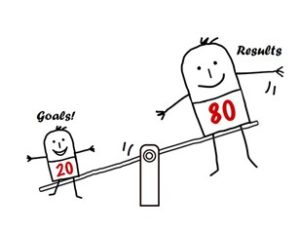
Goals are the 20%of efforts thatWhy do goals work?

We all know the obvious: they help keep you focused, and as Yogi Berra, the baseball catcher, said, “If you don’t know where you are going, you might wind up somewhere else.”

We have all heard about their importance.  But we may not have heard or understood WHY.

What is the underlying principle behind goals, and why do they work?  What gives them their power? And can you harness it improve your business and its bottom line?

Stick with me and find out…

==   ==   ==   ==   ==

It was one of those September days in the Midwest when the leaves were turning orange, and the wind was blowing.  I was in Chicago – the Windy City – where I attended a seminar downtown at one of its plush hotels.

The program was kind of out of my league – at least then.  The fee for three days was $7,000.  I was only attending the first day, which was $1,000 – still a lot of money.  But I was drawn to the subject, and I was familiar with the person who was putting it on.

There were aggressive young MBA types flying in from around the country and the world.  On the night before, at the hotel where the seminar was to be held, I saw several small groups in lively discussion around laptops – as if they were in the middle of inventing the next Big Thing.  I remember talking to one young man from Singapore and learning about the high-energy atmosphere of entrepreneurship there.

The seminar focused on building, buying, or overhauling a business.  The speaker was a self-made billionaire, a former management consultant, so his teaching fees did not come cheap.  This was not a seminar for dabblers!

The subjects discussed on the first day and, as I learned, on the other two days, were surprisingly uncomplicated.  They discussed the key ingredients to look for when deciding what business to build, buy, or grow.  These few key factors were introduced on the first day of the seminar and then expanded upon the other two days.

But it all started around one principle: the PARETO PRINCIPLE.

Many of you know the Pareto Principle and the Rule of 80/20.  This Principle has been used over the last 50 years by major manufacturing companies to improve the quality of their products.  The concept is easy to state but often difficult for entrepreneurs to apply.  It predicts that roughly 80% of valuable results come from just 20% of efforts.  In some cases, the ratio can even be more extreme so that 10% or even 5% produces 90% or 95% of the results.

Not all efforts are equal: there are the “vital few” efforts and the “useful many” efforts.  Workaholic entrepreneurs can struggle to put this concept into practical use.  We find that delegating a $20 an hour task is risky, so we will spend time organizing a bookshelf or driving to get office supplies ourselves instead of taking care of a potential $1,000 an hour task, or even a $10,000 an hour task.

As a non-business example of the 80/20 Rule, consider all the clothes in your closet.  I bet you wear just 20%, or less, 80% of the time.  Then, consider how you get to work – out of all the choices of roads to take, you use just a few of them.

Look at a winning athletic team.  Just a few players are responsible for 80% of its success.  This does not mean that the other players are not important – just not THAT important.

All efforts are just not equal or average.

How might this apply to your business?  Well, for example, 80% or more of customer dissatisfaction comes from 20% or less of your patients.  On the other hand, 20% or less of your patients account for 80% of your patient referrals.

As the CEO of your business, what are the vital few actions you can take that will produce the most results?  I suggest that defining the business’s goals, ensuring that your team understands them, and keeping these goals alive each week is key.

As Stephen Covey advises: “Begin with the end in mind.”  Goals are simply the end you have in mind.  On the higher end, they would include your mission, vision, and reason for them – your WHY.  They would also include the values you hold as standards of behavior and performance.

These greater goals would be manifested as products or outcomes.  For example, if your mission included helping people have healthy teeth, then a practical manifestation of this goal would be “Jim,” a patient, having his teeth cleaned today.  If your vision were a healthy and pain-free community, the practical outcomes would be 100 patients adjusted today.

As a doctor, what would be the 20% of your actions that account for 80% of your results?  I suggest letting the patient know that you understand their goals and work to help them achieve those goals at each encounter.

As the manager of your business, ensuring each team member knows the goals of their roles and helping them achieve these goals, with good coaching and communication, will produce 80% of their successful efforts.

It all goes back to goals.  

They are the leverage points that direct and amplify all your efforts.

But here is the truth you must understand:

A small amount of time consistently spent defining the goals of, and within, your business — and working out how to achieve them — are the vital few actions that produce most of your excellent outcomes.

Know before you go.

If you and your team routinely define and redefine your goals, both the higher ones and the practical ones, and work out how to better achieve them, you will have a more prosperous and stress-free business.

Get the goals right each day, and all else will follow in your favor.

Working towards a better future,

Ed

If you don’t have it yet, get my book to learn more about how to use goals in your practice. The Goal Driven Business.

***New Training Program***

Also, stay tuned for a new training program we will be offering on the Goal Driven System. It will be limited to just 10 offices and last for 6 months. Its goal is to train the business owner and manager/senior staff member on the Goal Driven System to transform their practice into a Goal Driven Business. A Goal Driven Business is a team of Goal Drivers. That is what this program will teach you to create. (What is a Goal Driven Business? )
If you are interested in taking the training program on the Goal Driven System, for you and 1 team member, please go here to schedule a time to learn more about it. Schedule a meeting with me.

Goal Driven.com
Petty Michel & Associates