
What Is Effective Chiropractic Practice Management?

You would think that management, by now, as a subject, would be scientific. That corporations would employ skilled managers with their MBAs from prestigious universities that effectively applied administrative technology to nurture their companies.

Nah, it’s not like that.

A research study was conducted by Nicholas Bloom* and others aimed at determining how effectively management procedures were being used in U.S. companies. They found that only 15% of U.S. companies scored above a 4 on a 5-point scale. More than 30% scored a three or lower. Companies outside of the U.S. scored much worse.

Management is primarily personality driven – a little like politics and show business. And sometimes, the mafia. Some companies do well because there is a dynamic genius at the helm. Others do well because they were there at the right time. Others appear to do well because of the money they borrow, steal, or collude with government regulators.

I know some very successful chiropractors who are good managers. But they were good mostly because of their temperament and not because of their conscious use of management techniques.

Unfortunately, most management focuses on supervision. It is a form of spectator-ism and policing. Like watching robots on an assembly line and reprimanding errors and deviations.

Good management focuses on improvement. First, keep things working, then how can we all improve it? It is servant based.

In my book, Goal Driven Business, I cover this as part of the Goal Driven System.

For practical purposes, management has two different functions:

1. Keep doing what works.

2. Continually look at how the procedures and systems could be improved.

If it worked yesterday, you should do it today and also tomorrow.

Then, improve it – little by little.

If you want to make a big change, when the entrepreneurial spirit hits you, do a trial run first. Don’t disrupt the systems that are working.

A good number of practice problems occur for one reason:

You stopped doing what worked!

This applies to the front desk, patient accounts, new patient onboarding, team management, and marketing procedures.

If it worked once, it would probably work again. Just improve it if it is outdated – and if that doesn’t work, revert to what worked.

I know – your workdays can get boring and sometimes you want to go and chase the shiny things. Fine. But keep doing what works until something proves itself to be better.

I will be teaching a management course later this year. If you are interested, let us know and we’ll get you on the waiting list. It will be for you and your manager. Each class will be small to allow for more personalized instruction.

Good management underlies all your activities – managing your patients, your practice, and even your life. And especially your future!

Seize the future with good management!

* Harvard Business Review, November 2012 Nicholas Bloom

—————————————————-

If your practice building efforts aren’t taking you to your goals, there are reasons — many of which are hidden from you.

Find out what they are and how to sail to your next level by getting and implementing my new book, The Goal Driven Business.

The Goal Driven Business By Edward Petty

Chiropractic Has Always Been Organic

 
Chiropractic has always been organic. Earth Day, goaldriven

You can improve your marketing by aligning your services with positive causes in society.

A fitting example occurs this time of year.

Earth Day is on April 22 (Saturday). It promotes a healthy planet and stands for protecting the earth’s natural resources for future generations.

Earth Day had several early separate beginnings but was finally pushed home by a senator from the great state of Wisconsin, also its former governor, Gaylord Nelson. The first Earth Day was in 1970 and “brought 20 million Americans out into the spring sunshine for peaceful demonstrations in favor of environmental reform.”

But Senator Nelson was also a proponent of natural health and fought for chiropractic.

In a statement to Congress in 1963, Nelson said, “Chiropractic has become increasingly accepted as a safe and effective form of health care…I believe it is time that Medicare beneficiaries be given the opportunity to receive the benefits of this form of health care.” Nelson’s efforts helped pave the way for chiropractic care to be included in Medicare in 1972.

If you distill it all down, it is all about health: a healthy planet and a healthy body, naturally.

People want this – your patients and your community. They want a healthy planet and a healthy body.

This may not be apparent because of advertising and corporate news. There is a relentless pitch to your patients and community to eat cheap bad food, that a toxic environment is no big deal (“move along, nothing to see here”), and that drug stores are health stores.

But despite the billions spent on promotion and lobbying for bad food, bad medicine, and covering up the poisoning of our planet, the innate (and tribal) wisdom of us all prevails. The sales of organic foods and health supplements are booming. The natural healthcare industry, including chiropractors, acupuncturists, and integrative health providers, continues to grow. And there is increasing concern about how pollution causes deaths and illnesses, not to mention climate change.

I bring this up for two (2) reasons:

Reason #1: Marketing: Chiropractic and Earth Day

By aligning your office with Earth Day, eco-conscious consumers who value natural and sustainable products and services will see your services as a desirable alternative to medical practices. You are the obvious choice as health doctors.

Years ago, we put together some posters and pins related to Natural Health Week, coinciding with Whole Earth Week and Earth Day. Some offices still use versions of them! (Link below.) You can do something similar this Friday, next week, or all month. For example:

  • Hand out seeds to grow vegetables in the backyard. Include a coupon for a family member or friend.

  • Support a local health food coop and bring in healthy muffins for your patients.

  • Create a community clean-up drive.

  • Partner with environmental and health organizations. You can share events, newsletters, and create allied relationships.

But there is another reason I bring this up.

Reason #2: This reason is BIG. It will have to wait till tomorrow,
Wednesday, April 19.

But please stay tuned!

See you Wednesday!

Ed

Link to Posters and References at our blog.


Tribal Knowledge Can Improve Your Practice

teams, management, chiropractic, knowledge

Mining the Underground Innate Knowledge of Your Team

You may not have run into this term before… maybe you have. It was new to me before I began putting together the notes for The Goal Driven Business.

In any case, it is a concept worth knowing and one you can use to improve your business. I’ll give you an example and then define it.

It was spring years ago, and I was meeting with a motivated practice owner who was already doing well. We were discussing marketing plans for the next several months, and some of our programs ended in June. We needed something that would work for July. So I said, “Why don’t we ask the staff for some ideas?”

We were scheduled for a team meeting anyway, which I attended. After the usual topics were covered, the doctor asked the staff for some ideas for marketing in July. Now, the doctor was relatively new to the community, and the team was long-time residents. Various ideas were thrown around, and one seemed to percolate and draw enthusiasm from the staff. A popular promotion that they had experienced as local consumers in their town was “Christmas in July.” Since their community was familiar with this promotion, they were sure it would work well if it were tied to a patient referral program.

Both the doctor and I thought it was a dumb idea. However, the staff was already in high gear planning the promotion by the end of the staff meeting. I suggested to the doctor that he let them run with it. He did, and as it turned out, it was a big hit. They had one of their best new patient and office visit months ever… in July.

At another office, some years later, I was helping the doctor work out her mission statement for the practice. She and her associate were hitting speed bumps trying to come up with a simple definition. I recommended putting it to the staff to see what they might come up with. At the next team meeting, the doctor discussed the idea of a global statement for the WHY of the office and its higher goals and asked them if they could work it out as an office mission by next week.

And that is what they did. The following week, the manager and staff presented the mission statement to the doctors. The doctor emailed it to me.

I didn’t really like it as it was long and too mushy, at least for me. But the doctor approved it and posted it in the reception area. The staff loved it. It fit their compassionate attitudes towards the patients and captured their existing relationship with them. They memorized it, and it was recited after every staff meeting. Their stats haven’t come down since. They are a happy and Goal Driven group!

In our consulting, we routinely encouraged the wisdom of veteran staff to be integrated into the management and marketing of the office. We didn’t have a definition for this knowledge, but it was effective nonetheless.

Here is the definition of Tribal Knowledge according to Leonard Bertain in his book, The Tribal Knowledge Paradox:

Tribal knowledge is the collective wisdom of the organization. It is the sum of the knowledge. It is the knowledge used to deliver, to support or to develop value for customers. But it is also knowledge that is wrong, imprecise and useless. It is knowledge of the informal power structure and process, or how things really work and how they ought to. … But more importantly, it is the untapped knowledge that remains unused or abused.

There is much more to this, of course. A valuable management and leadership skill is how to elicit tribal knowledge, decipher it, filter the practical from the impractical, and put it to use.

I try to keep these newsletters as short as possible. If you want to set up a time to discuss this subject more, just make an appointment (link below). No charge for subscribers to this newsletter.

Not everything can be put on job checklists. Job checklists are very useful, but there is a wealth of knowledge just under the surface with your team, even your spouse, that can be accessed and put to good use.

By creating a culture where it is safe to contribute learned experiences in team meetings, coaching sessions, and other opportunities, improvements in your practice can be made faster.

Seeking and honoring the tribal knowledge gained from the experience of your team respects them, whether the information is useful or not. This is the essence of creating a synergistic office – where team members help each other — to help more people become healthier.

Carpe Future (Seize the future)

Ed

Want to discuss how to uncover the Tribal Knowledge in your practice, schedule a short call with Ed here.

The Problem with Your Chiropractic and Health Care Marketing May Not Be What You Think

There could be a hidden barrier that jams your growth and holds you back.

MOST OFFICES WANT TO IMPROVE THEIR NEW PATIENT ACQUISITION. That is, attract more new patients.

At least, that is what many chiropractors and other doctors will say.

Oddly enough, that is not always exactly the truth.

Michel Killen, in his book Sell Futures, Not Features, says:

“Do you want more sales? The question should really be “do you really, really, REALLY want more sales?” This might sound insane and even obvious. Of course you want more sales, who doesn’t want more sales? However having taught and coached sales for a lot of people for a long time, this is often an underlying problem that has a tendency to sabotage our sales driving efforts. …I believe that people are creatures of goal pursuit, meaning they take actions which suit their goals. This means that if a business is struggling with sales, it’s usually because deep down a part of them doesn’t want more sales. This is extremely upsetting and even distressing to a lot of people, because of course they want more sales, everyone wants more sales!””

Well, I couldn’t agree more.

CONSCIOUSLY, you probably want more new patients as you know you can see more visits and, of course, you could use the increased revenue.

SUBCONSCIOUSLY, however, there is another story entirely. The devil’s advocate pipes up and says, “with more new patients, you will come home late, miss dinners with your family, your staff will make more errors, and your notes will start to backlog. You won’t have time to exercise, and your Worker’s Comp insurance will increase.”

But because you are a strong-willed entrepreneur and a bit of a rebel, you charge ahead and spend time and money on marketing. But after a while, you notice that your numbers don’t significantly increase.

Why?

There is a bottleneck somewhere in your office, a log jam, a Capacity Constraint.

The Theory of Constraints, originally discussed by Dr. Eliyahu Goldratt in his book, The Goal, has become a management science that implements a business improvement system. Simplified, it is a process that goes after the biggest constraint in any production process. Once that is fixed, management hunts for the next largest bottleneck, which continues as a never-ending process of improvement.

We adapted this, by the way, for practice management, in our Goal Driven System. The primary goal of the Theory of Constraints is profit. However, to achieve this, we need to look organizationally for the primary roadblock.

These constraints can be difficult to recognize sometimes. Partly because they are hidden and partly because of “damn-the-torpedoes” bias on the clinic director’s part.

For example, the front desk coordinator has been with the doctor for a few years and does a good job. The doctor returns from a new seminar, or someone new in the insurance department is hired, and things change. The doctor notices a moment when the front desk assistant is not busy and assigns them extra work. This happens a few times, and soon, the front desk has become a clerical department, filing insurance, ordering supplies, verifying insurance, and doesn’t have time to ensure all the patients are scheduled. When the phone rings, they kinda grimace and hope it’s not another new patient because they have more paperwork to do. Three months later, the doctor notices that the visits are down and spends more money on marketing.

But what is the real problem? The front desk is plugged up! Sure, some extra duties can be delegated to the front desk, but carefully, and ideally done at separate times when patients are not scheduled.

I have been able to increase patient volume and new patients by helping doctors locate the stuck points, the blockages in the office and open the flows. It could be a clinical assistant that is needed, a scribe, or replacing a staff member that really wants to work somewhere else. Maybe the staff needs better training, or intake forms massively simplified, or just a friendlier and less serious clinical director.

Constraints are like being stuck in a traffic jam. They wear your team down. And they affect your motivation and desire for growth.

Physical constraints result in mental constraints.

The real problem in marketing is not always with the marketing. It is often with the management. Being the entrepreneurial doctor you are, you know enough to make marketing work. You can make it work better once you fix the management of your practice and find the constraints and remove them.

Then, watch your volume pick up and your marketing really work.

Seize your future,

Ed

Want help removing all your constraints? Make an appointment for a quick all and I am sure I can help you uncover a probable bottleneck or two and give a you a couple simple solutions that could help.

Does Goal Setting Really Improve Performance? Ask Science.

young boy celebrating success
FOR THE WIN!
 
There you are, sitting at the team meeting at the beginning of the month.
 
What goals should you set for the new month?
 
And… does it really help? I mean, after so many months (and years) of goal setting, so many seminars, and books that say you should set goals — does it really matter if you set goals for this month?
 
And what kind of goals?
 
And, does your team really care?
 
And, do you? (lol)
 
Well, here’s the deal: YES, goals do matter.
 
Here’s some evidence from a study by Edwin Locke and Gary Latham, who summarized 35 years of empirical research on goal setting theory*. They found that setting specific and challenging goals led to significantly higher levels of task performance than easy goals or no goals at all. They found that goals:
  1. Direct activities towards goal-relevant activities and away from goal-irrelevant activities.
  2. Can be motivational or “energizing.”
  3. Affect persistence.
  4. Encourage people to use the knowledge they have acquired.
But goal setting is affected or moderated by many factors. For example, Locke and Latham found that feedback and commitment to goals were critical for goal attainment.
 
FEEDBACK
 
You and your team need to know how you did last month. You all need to know if you are heading toward your mission or away from it.
 
The clinic director or manager should individually meet with each team member and review how they did. This should be done in a friendly and collaborative manner, ideally each month.
 
The idea of employees being a TEAM also necessitates the concept of a COACH. So, the clinic director or manager must act as a coach and help individuals, and everyone achieve goals.
 
COMMITMENT
 
According to the Study, goal commitment is linked to the importance of the goal. In my experience, this is improved by:
 
  1. Examining the mission or why of the practice.
  2. Reviewing patient successes and outcomes.
  3. Allowing team members to participate in goal setting so that it is their goal, not management’s!
  4. An occasional group goal and game, with a deadline that may include a reward.
As part of the Goal Driven System, we emphasize 3 categories of goals:
  1. Production. These are usually monthly goals such as new patients, visits, kept appointment percentage, and case completions.
  2. Organization. These are important but not urgent goals, including training, catching up on backlogs, planning, and other activities. Because these are not always apparent, vital functions can become neglected. A checklist of duties helps with this, and then reviewing them monthly.
  3. Greater Goals: professional and personal. No one works just for production or organization, so setting goals for long-term achievements is essential. We aren’t just workers — we are dreamers and explorers. We like to adventure, and we like to play.
Goals are part of games, and games should be fun. We humans like games, from the Olympics to the most recent popular computer game. It is part of our nature.
 
My grandson just had his 7th birthday. He’s a big basketball fan. I gave him a couple of presents. The first one he opened and quickly tossed aside. The second present was a large book with photo’s of basketball players and their stories. As soon as the wrapping paper was off, he raised it over his head, cheering: “for the win.” And ran off with it like the wild boy he is!
 
So set goals and play the game.
 
Keep it fun and go FOR THE WIN!
 
Ed


The Patient Handoff

doctor and two women introductions.

Improving your patient’s experience.

There are subtle and brief moments in your practice when you and your team can earn or lose your patient’s trust. It can make the difference between your patient agreeing to your care program or finding a reason to delay the decision.

Excuses can be easy to dream up. There are hundreds of reasons why someone can’t, or won’t, agree to a care plan or follow through with their care. But the reasons presented may not be the actual ones.

Surveys show that customers cease their relationship with a business when they experience an attitude of indifference on the part of the employee or business. People hate to be ignored.

You know this, so you ensure you and your team communicate well with patients at the front desk and during the report of findings and case presentation. These are obvious communication events.

But just as important, but not always as obvious, is the communication that occurs when the patient is transferred from one staff member to another.

This is called the Patient Handoff.

For example, the doctor has spent time reviewing the exam and imaging findings with the patient and correlated them with their history. The doctor explains the health issues and the care plan to the patient. The patient nods in agreement. With other patients now waiting to be seen and the doctor feeling rushed, the doctor may leave the patient and ask another staff member to schedule the patient for care and to work out their finances.
It would take another 3-5 minutes for the doctor to introduce the patient to another staff member and relay the key information to them in front of the patient. It would be minutes well spent.

“Hi Betty (Patient Accounts Specialist). This is Sam. He works out at the same gym as I do over at Acme Fitness. He wants to keep up with his workouts so I have worked up a treatment plan to help him recover from low back injuries. I’ve included the info in the back (hands written report to Betty). Could you schedule him for his appointments and discuss his payment options?”

“Sam, any questions or comments?”

“No.”

“Ok, great. I look forward to working with you here at the clinic and also at the gym. See you soon.”

After the report of findings is a handoff event that can be too easily cut short or skipped altogether. Another handoff I have often witnessed omitted entirely is introducing the new patient to their therapy and rehab services.

We are all in a hurry, but these patient care transition points hugely impact how your patient experiences you and your clinic.

In sum, patient handoffs help with the following:

  1. The continuity of care ensures that the patient receives consistent and appropriate care throughout their treatment plan.
  2. Minimizing misunderstandings or errors in their care.
  3. Improving your patient’s satisfaction and trust in you and your clinic.

Take time to do thorough patient handoffs, and you will see retention improve, referrals increase, and happier patients.

Working towards a healthier future,

Ed

She Wanted to Teach Chiropractic Staff

Greater Prosperity through Goals, Leadership, and Teaching.

woman teaching to a crowdEffective leaders are, first and foremost, good teachers.

We’re in the education business. — John Wooden

Greater Prosperity through Goals, Leadership, and Teaching

A highly productive and prosperous chiropractic clinic always has a goal driven team for support.

Motivation is directly linked to goals and leadership. When anyone pushes their way towards their goals, they are leaders. And one of the primary methods of leading is through teaching.

This is how you lead your patients to their health goals – you educate them at the initial report, the progress report, and each visit where you Table Talk!

In a Goal Driven Practice, eventually, everyone takes a leadership role. And leaders teach.

Teaching, in and of itself, is motivational.

She Wanted to Teach

I will never forget an outstanding example of this, though disappointing in some ways.

One of our clients hired a woman to be his office manager. She had big goals while working at another chiropractic office but was not encouraged to pursue them. So, she found an office, one that we worked with, where the doctor supported her mission.

She was a powerhouse on the front desk, but also worked with the staff and the doctor on improvement projects. She told him that she would work with him for one year, and if the numbers reached a certain level, she would replace herself, receive a substantial bonus, and move on. However, she had a bigger goal in mind. She wanted to begin a team training program for other chiropractic staff throughout the state.

We worked together on this plan for the entire year. The office was already busy and doing well. But after she started, we saw the volume increase significantly. She was a great team trainer, and after a year, she won her first game. The numbers increased on a sustained basis by over 20%. The owner was very pleased.

The disappointment occurred when she visited doctors around the state to encourage them to have their staff train with her. She also promoted her services to the state association. The reception in all cases was mild. She could not convince the doctors or the association of the advantages of having their staff on a professional training program.

She eventually took a high-paying position at a corporation in another state.

Teaching is Leading

As the chiropractor, and the Clinic Director, you are a leader – and a teacher.

In a Goal Driven Practice, you also want each team member to be a leader. The fact is, in their own way, they want to be leaders. Maybe not on the stage or in front of an orchestra, but leading by actively pushing their way to their goals and the office’s goals as well.

Each one of your team members has professional and personal goals. Just like you do. These goals should align with the goals of the office. You can help to unleash the power of these goals, for yourself, and for each team member, in the following ways:

1. Accept the fact that pursuing goals is leadership. And a function of leadership is teaching.

2. Do your own in-office seminars. Teach your team how to achieve the goals of the office, and especially, why.

3. Meet with each team member and help them write down their professional and, optionally, their personal goals. Then, help them achieve these goals.

4. Have them teach. For example:

a. At occasional staff meetings, one team member can give a presentation on some aspect of their job, a core value of the office, or a chapter in a book or a video.

b. In one year (or two) after they are hired, require all staff to help you give the first half of a lay lecture.

A Goal Driven Practice is not dependent upon the doctor. Instead, it is dependent upon goals and, as such, is more profitable, provides better service, and is more fun to work in.

Seize the future and your goals,

Ed

Contact us on the link below if you are interested in discussing how we can help you create a Goal Driven Practice.

Also, read my book! 😊

*https://www.expressionsofexcellence.com/ARTICLES/wooden_interview.html

Contact Us

The Generosity of Service

How to be happier and more prosperous
One of the unique characteristics of Petty, Michel & Associates is that we visit offices and provide on-site coaching based on what we see.

I remember one doctor whom we worked with for several years. When I visited his office, as soon as he saw me, and the minute he was free, he’d say, “Ed, come on over here, let me check you.”

He didn’t ask permission.

He saw many patients in the morning and the afternoon and always took time over lunch for a workout.

He was focused on adjusting anyone in his sight. Patient after a patient. And because he was so focused, he communicated with certainty and authority and earned the trust of his patients.

If you can strip away from your mind all the administrative tasks, worries, and challenges and just focus on seeing patients, you’ll be happier and see more people.
All the “other stuff” slows down doctors, the administrative tasks that seem to multiply exponentially. Your mind can be either dominated by business concerns — or by the joy of giving and serving.

You have the skill and ability to help others, which must be honored and given full reign to be expressed to its total capacity. It shouldn’t be withheld or hoarded.

A well-trained team and a practice manager are vital. They allow you, and the other providers, to practice your art while they care for everything else.

I have talked to many doctors who visit third-world countries and flat-out adjust 100-200 people in a day. No admin interruptions, just individual after individual, courageously providing service and practicing their craft without concern about reimbursement. They have told me that they would get into a “Zone,” or into a flow… and experience an intense kind of present-time consciousness that they don’t experience in their offices.

Dr. Sid Williams, who founded Life Chiropractic University in Georgia, promoted the idea of “Lasting Purpose,” which was defined as “to give, to love, to serve in abundance without expecting anything in return.”

Being generous doesn’t mean giving your services away. Generousness is a mindset of abundance. It is not withholding your gift and craft but practicing your art freely and abundantly.

To do so, train your staff to take care of everything else and delegate the admin tasks to them. We can help with this. But it first starts by committing to a value of service generosity. In our company, Petty, Michel, & Associates, one of our core values is delivering services in “Abbondanza,” Italian for abundance.

In physics, every action has a reaction. This is also expressed in ancient texts: the more you give, the more you receive. You’re persuaded each day to get lost in admin concerns. Don’t. Get “lost in service.” Admin details need to be tended to, but only during non-patient time, and most should be delegated to your team.

Be a Giver and be generous. Educate, care for, and help more people. Take on this attitude, and you’ll have more fun and be more prosperous.

Ed

*Sid Williams quote: https://lifewest.edu/dr-sid-williams-honored-in-life-wests-sid-square/

Your Patient’s New Year’s Goals

Your patients’ goals are why we are here.

They are why your staff came to work today and why you went to your last licensing seminar.

Your patients’ goals are why you have a practice and are in business.

So, what are your patient’s goals? What do they want?

On the surface, it is usually to relieve discomfort or pain.

So, like you do, after your initial consult, exam, and imaging, you tell them the cause of their pain and present your treatment program. They nod in agreement, and you begin care.

But when the patient sees the staff member to work out their finances and scheduling, they may have a glazed look and not be too sure what you just told them. Something-something about submarines, or joints, or spondy low dices.

The next week you wonder where they are. Your front desk does recalls. You spend money on more marketing to get more new patients.

You may have experienced a version of this in the past.

And at home, the patient may even feel that they got what they wanted or thought that they wanted. Maybe they feel better. But did they really get what they wanted?

There is a quote questionably attributed to Henry Ford: “If I’d asked customers what they wanted, they would have told me, ‘A faster horse!'”

I get the point. But what people wanted, though they did know about a Model-T, was to travel faster with less horse poop.

You know that four adjustments, in most cases, won’t provide the health solution that the patient needs. But your patients don’t know what you know!

Was that why they didn’t come back for another visit, because you didn’t educate them enough? No.

Was it that you did not motivate them enough? No.

An excellent book on sales that I recommend is by Harry Browne, The Secret of Selling Anything. Brown points out that people are already motivated. 

You don’t have to motivate your prospective patient when you initially see them. You just need to discover what is already motivating them.

This takes place in your initial consultation and history, which I feel is the most crucial part of the new patient onboarding process.

Brown offers these three steps.

  1. Discover. Discover through intense listening what they want. For example:
  • What do you consider most important for you about your health?
  • What do you think is the biggest problem regarding your health?

These questions, and others, open the door to understanding what the other person wants. And if they know you understand them and are authentically interested, they will be more inclined to listen to you and trust you.

  1. Summarize. The second step is to summarize what the patient said about what they want. This brings out what they said on the table so that you both can agree. For example:
  • So, as I understand it, you are looking to get rid of the pain, not for just a week, but altogether so that you can get back to playing polo with your grandkids, correct?

Now you both can agree on what they want.

  1. Solve the problem. The third step is educating them on what you have found after your exam and imaging. But you direct the education to exactly what they especially want. Now they are interested because you are addressing the motivation that they already had.

This is a simple procedure that is genuine and caring. Not always easy to find these days, so you will stand out from others by using this method.

I would even spend time now and then rehearsing this. Even the pro’s practice.

Brown is not the only person who has offered this procedure as it is so fundamental. But we can never be reminded of the basics enough. He also said:

…the secret of success is:

 Find out what people want and help them to get it.

Help your patients achieve their goals in 2023, and they will help you achieve yours.

Seize 2023!

Ed

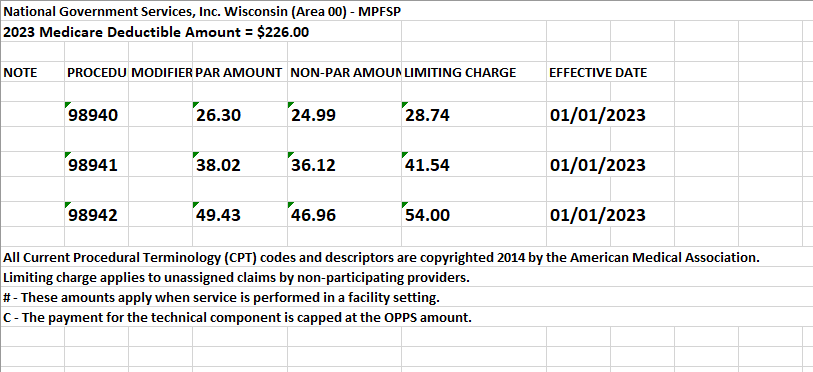
2023 Medicare Fee Schedule

Shown below is information regarding the 2023 Medicare Fee Schedule for Wisconsin Providers only provided by NGS Services and also a link to  CMS.gov for fee schedules in other states.

Wisconsin Providers:  Here is the 2023 Medicare Fee Schedule for your perusal.  Please make this accessible to you and your staff.


Onboarding for New and Veteran Employees

Just Focus on Goals and Expectations

The way you set up the initial relationship with your new employee will directly determine how well they perform in the first year of employment.

I don’t think that this is given enough consideration. You are in a rush to fill a position, and once you have done so, you are now just happy that it is done so you can get back to seeing your patients.

The new employee is given some training, but since everyone is busy, it is very brief and short-lived. As a result, the productivity of the new hire is held back.

New employees are not like plug-and-play appliances. Everything is new to them. The staff, the patients, the jargon, the flow of traffic, the procedures — all these which you take for granted, are to them, new.

The prospective new staff member never really knows what they are walking into. Is this going to be their best or their worst work experience? So, despite their smiling cooperation for the first few weeks, underneath, they may be worried that your business is not for them.

It can take 8 to 12 months for a new staff member to gear up to full capacity and performance. But the critical period in my observation is the first three months.

Orienting, training, and acclimating the new employee to their new job, new team, and new business is called onboarding.

Onboarding – the First 3 Months

You want each team member to be happy working with you and operating at close to their full capacity. This is what you want for yourself, right?

Once you make the decision and the new person is hired, your management work just begins.

A systematized onboarding procedure helps the new employee feel safe, that this is where they belong, and that they are important to you and your office.

As a result, a deliberate onboarding process will “increase new hire retention by 82% and improve the productivity by 70%.” (zippia.com)

I have seen this in action – both the right way and the wrong way!

We provide an onboarding checklist for our clients (which we are updating), but here are some fast tips:

1. Checklist. Assign the new employee a list of actions to be completed over the first 3 months that include orientation, study, and training. The checklist should also be assigned to a veteran staff member to help the new employee get through the checklist.
2. Ongoing meetings with the owner/doctor. You want to have the new employee have a good understanding of you and your history, goals, and plans to achieve them. Do this over lunch or coffee.
3. Relationship with goals. You want the new employee to have a relationship with the goals of the office. Go over:

a. The mission of the clinic and why this is the mission.
b. The clinic and team’s values. Who we are and how we are. (For example, we are care-aholics!)
c. The outcome of the clinic’s services. For example: happy, healthy patients.
d. Mission and outcome of their specific role.

4. Expectancy. They need to know that achieving the goals for their specialized role is what is expected. How they do it is important, but that they achieve them is most important.
5. Regular (weekly or biweekly) coaching reviews.

Re-boarding

You can do a version of this every 12 months with your key veteran staff. Why not?

Next to your skills, your reputation, and your patients, YOUR PEOPLE are your most valuable asset in your practice. Take care of them, especially when they begin, and they will help you take care of the practice.

Ed


Practice Fundamentals – Communication and Control

“Get the fundamentals down and the level of everything you do will rise.”
— Michael Jordan

It’s always the basics. The fundamentals.

This is what all efforts to improve performance – and health — go back to.

All of your efforts in practice management boil down to communication and control.

All the books on procedures, patient management, and practice management can be distilled down to communication and control. Those are the basics you need to get to your goals and those of your patients.

  • Doctors, and staff, that have excellent communication with their patients have many referrals and a busy practice.
  • Doctors who communicate well with their staff have a happy and full practice.
  • Doctors that have positive control with their patients see their patients succeed.
  • And business owners that have proactive control over the office – are prosperous.

Of course, the inverse of these facts is also true. Whether out of fear, confusion, or fatigue, when these fundamentals are not administered, things don’t go well.

Communication

I was recently helping a doctor and the practice manager improve their patient financial consultations. The manager and doctor had worked out what to say that they liked. They called it a “script.”

A few months passed, and I noticed their patient retention had not improved. Neither had collections or other metrics. When we did some training on how the patient consultations were performed, we found that the staff focused on the memorized script, not the patient. Their communication was robotic, and they never got to know the patient. We replaced the script with a simple outline and let the staff get to know the patients. Visit average and collections improved.

Good communication is alive, interested, and empathetic. It results in understanding.

Control

Another office we worked with complained about low collections. They had plenty of new patients — the veteran doctor got great results. After investigating, we found that the report of findings and treatment plans were rarely completed, and scheduling was hit-and-miss at best.

And that’s not all. The doctor and staff often came to work just a few minutes before patients came in. Sometimes they came in late.

This office was out of control — and so were the patients.

Positive control is moving a project, patient, or condition from one status to a predetermined goal. This is what a procedure does. A well-run business has procedures, protocols, and systems that it adheres to achieve its daily and weekly goals.

Management

Management is implementing effective procedures, with excellent communication, to achieve goals.

In all your practice improvement efforts, check first if the procedures are being done, and then if they need to be improved or removed. Then, look at the quality and quantity of communication used to implement the procedures.

Improve the fundamentals — your patient and team communication and control — and you will have a prosperous and happy 2023.

Seize your future – with a smile!

Ed

What gets measured gets done


Your Goal Driven Analytics Scoreboard

Sometimes you can’t see the forest for the trees.

Sometimes you think things are worse than they are.

But then again, sometimes you think things are going better than they are. And then, BANG! Poop hits the fan!

What is the best way to determine how your business is doing?

Your Scoreboard

Your numbers are the best indicator of your Key Performance Indicators. They are your dashboard. Your Google maps. Your altimeter, as you take your business off the runway and up towards your goals.

In our consulting work, too often we see major management changes based on a minor error, hearsay, or emotions. This can have long-term devastating results.

On the other hand, improvements that show up on the stats can be ignored if no one is watching them.

One office we worked with continued to see an increase in new patients referred from a local gym. But amidst the busyness of the daily patient care, they hadn’t noticed. Since we closely monitored their numbers, I saw this increase in new patients from a local business on their New Patient Tracker. After discussing this with the doctor and manager, they finally took action to strengthen this valuable relationship. Last I heard, they are continuing to get referrals from this location.

You can miss the good things — as well as the coming crash. Numbers help you predict what needs fixing before things get ugly and what needs reinforcement to keep the good times going.

Ultimately, statistics tell you if you are moving towards your goals or away from them.

Unfortunately, most offices do not keep clear and consistent track of their numbers.

As a result, business owners do not get the information they need to manage their business properly. Software can spit out reports which can help, but they are not enough. And usually only partly used, if at all.

Here are some fast tips for your stat analysis scoreboard:

  • Key numbers. Monitor numbers week-to-date and month-to-date, especially new patients, visits, charges, and collections.
  • Individual providers. If you have multiple providers, find some way to measure their production. This can help both of you manage performance.
  • Percentages. Use percentages, such as visits divided by new patients, to give you an idea of how long your patients are staying with you.
  • This year to last year. You should be able to compare this year-to-date with last year-to-date.
  • Line charts. We use line graphs plotted over a couple of years. These clearly show what is trending — up or down.
  • New patients. Track the sources of your new patients as well as the types of new patients.
  • Weekly reports. Have someone in your office give you a daily, or at least a weekly and monthly statistical report.

Keeping statistical analysis in place has proven so valuable for offices that many clients have asked us to keep providing their stat analysis for them years after completing an intensive service with us.

While this is not a major service we offer, we realize how useful it is in our Goal Driven System of management.

Therefore, we have decided to start offering our Goal Driven Analytics program as a service to more offices.

We are only taking 5 new clients on this program for now, first come, first serve.   It is moderately priced and, as most of our clients can verify, managing by the numbers is invaluable. To learn more about the program, we’ve posted some more info, with the link below. If interested, just reply to this email, and we can set up a time go over the details.

But whether we provide you with your statistical analysis or you set it up yourself, I can’t recommend a more valuable management tool for managing your business profitably. Not only is it effective, but it is fast!

Your analytics scoreboard will help you smoothly navigate to your goals.

To your greater prosperity,

Ed

More info on the Goal Driven Analytics Scoreboard.

Grateful for the Future

Gratitude is not only the greatest of virtues, but the parent of all others.

(Cicero, Prolancio, 100 BC)

As many of us in the U.S. prepare for our annual Thanksgiving events, I wanted to offer a short perspective.

Daily events challenge us, and we struggle to deal with them as best as we can. Events in our offices as well as in our communities, country, and the world can be daunting.

So, it helps to pause, more often than we do, and appreciate the advantages we have from those who have come before us. Likewise, to be grateful for the people we know: our family, friends, and those with whom we work. And, of course, our patients. In small ways and large, we all help each other.

But I also want to mention our future and the opportunity it gives us all.

As we move through the Holidays and winter sets in up here in the Northern Hemisphere, the New Year comes at us again too soon. We live in uncertain times, but as business owners and health mavericks, now is not the time to hunker down as if to hibernate and hope that any storms that occur may pass us by.

They won’t. But we can prepare and seize the opportunities that lie ahead.

Forward-minded entrepreneurs always find a few new approaches to making things better while many business owners remain on the sidelines, wary of jumping into the game and fully committing.

The future offers us the opportunity to play and enjoy the thrill of creatively making a difference, however difficult.

So, enjoy the Holidays, and all those close to you, near and far, in the present and respects to those who have passed. Take time to nourish yourself and those around you. There truly is much to be thankful for!

But while doing so, also appreciate the freedom we all have to make a better practice and a better life in the years to come.

Seize the Day and Seize the Future. (Carpe Diem, Carpe Futurum)

With Gratitude for all you do,

Ed, and all of us at Petty Michel

Chiropractic Patient Education Prompters – Table Talk Grows Your Flock

Imagine this scenario:

Written on a white board near the chiropractic patient adjusting area:

Last to show and the first to go.

Patient: Hey Doc, what does that mean, written on the white board there?

Doctor: Hi Sam, glad you asked. Just a reminder for me to explain that pain usually shows up after a health problem is present for a period of time, and usually goes away or lessens during the early part of our program of care. In other words, the pain can go away but the issue that caused it can still be present.

Patient: Oh, I got you! So, even though I am feeling much better, I better stick with the program, is that it?

Doc. Yep!

===

You know patient education is important. It improves outcomes. It improves retention. It improves referrals.

This is a simple procedure to improve your patient education: Assign a creative staff member the task of writing images or sayings that prompt the patient, or prompt you, to talk about a health subject. That’s it!

It prompts TABLE TALK.

Table talk is the BEST form of patient education and, for that matter, promotion. It comes from you, the doctor, during the most transformative time in your office.

Here are a few sample subjects you could post on a white board near your adjusting table:

  • How does chiropractic work?
  • Above Down Inside Out
  • Dr. You
  • Does chiropractic help with headaches?
  • Last to Show First to Go
  • Time, Repetition, Effort! [It takes time to restore your health, it has taken a long time for you to get into this condition. It takes repetitive work, like orthodontics. We will give you our best effort, you will have to do the same,]

Add a drawing now and then:

  • How is pain like an iceberg? (Draw an iceberg. [Iceberg Symptoms on top of the water, cause below in the water.]
  • How is spinal health like a rusty hinge? [This is when your vertebrae wears away when it becomes stuck.]
  • What happens to your tires when they are out of alignment? [Disks wear out faster like tires out of alignment.
  • Car Parked a garden hose. [When the hose is stepped on or kinked the water does not flow 100%. The same is true when you have a subluxation and your nerves are impinged. This affects everything your nerves are connected to.]
  • Safety Pin.
  • Orthodontics.

Just so you don’t get too serious, add a joke now and then:

  • I had to turn down the landscape company today…

****They wanted too mulch

  • The bartender says “Sorry, we don’t serve time travelers in here.”

****A time traveler walks into a bar.

===

This procedure doesn’t cost you. Like chiropractic (or our consulting!), it pays!

But only do it for two months at a time, otherwise it will lose its novelty for you, the staff, and patients. Run it 2- 3 times each year.

Once a month, meet with your team and come up with some new patient education prompters. This is also another way to educate your team in the process.

Keep the conversation going.

The more they know, the further they’ll go.

And seize the future.

Ed

Improving Patient Follow Through: The new patient log and checklist

Working with different offices, we are always reminded of the fundamentals that apply universally. For example…

Once your patient has committed to getting better, it is your job, and everyone else on the team, to help them achieve their goals.

But in the busyness of everyday office interactions, essential steps along the way can become abbreviated or dropped out altogether.

At one office I recently visited, the patient visits and income were diving downward on a monthly trend. And this was occurring even though the new patient volume had been pretty steady.

When I inquired with the front desk staff, they told me that patients were sick, had money problems, were busy, and blah blah blah.

I asked if this was a new phenomenon. Did patients suddenly become poor, was there a new pandemic? What?

Didn’t get any real answers, as they were busy on the phones doing recalls trying to get people back in the office. The doctor wasn’t sure what was happening. To his credit, he loves adjusting and focuses on providing outstanding care – which he does, usually at a high volume.

Long story short, after investigating, I discovered that the doctor had changed up his treatment procedure slightly, and staff positions had changed. As a result, new patient financial consultations had dropped out. The patients had been getting excellent care but had no idea about their payments and were only scheduled for one visit at a time.

This was a pretty big change! A critical procedure just silently disappeared without anyone really noticing. (Sometimes it is hard to see the forest for the trees. Plug: Consulting doesn’t cost. It pays!)

Everyone at the office is a veteran, hard-working, and goal driven. A great team. But this missing procedure was costing them thousands and preventing patients from getting the full benefit of care.

We implemented several solutions that have worked for other offices.

One solution was the New Patient Log and Checklist. I gave them a sample to customize. It is a lined sheet on a clipboard. Each new patient is listed vertically on the left column, followed by other columns stipulating key actions that should occur on each patient. The Log would include such things as:

  • Report of findings and Tx Program.
  • Multiple appt. card.
  • Financial Consult.(When, by whom.)
  • First adjustment call.
  • Attend NP workshop.
  • Source.
  • If referred by patient, what is pt.’s name?
  • Thank you card to referring patient?
  • Type [ WC, PI, C, etc.]

You could add more columns, but the most vital aspect of this Log is this: it must be assigned to someone. You and the team can review the NP Log during your morning meetings or at weekly team meetings.

One of the lessons here is to always look for what you and your team are doing or not doing before you look to the environment for why your practice may be slipping – or booming!

And help your patients achieve their health goals by ensuring that they complete all the steps necessary along their health journey to achieve their goals.

Stay Goal Driven for a happier future!

Ed

PTC and the Subtle Art of Being There

It was in the 80s at a Parker Seminar, which was in Reno that year, that I first heard the term.

In the opening session, Dr. Jimmy Parker talked about PTC. I was attending as a guest with a chiropractor who introduced me to chiropractic. What an introduction!

Dr. Parker explained that PTC stood for Present Time Consciousness. (Parker had quite a few of these abbreviations!) He explained that a doctor could deliver a much better adjustment if their attention on the patient were in the present time, not thinking about past issues or on future concerns.

I have come to learn that this is a vital but easily overlooked skill.

You can tell when someone is 100% paying attention to you, or maybe not quite, or maybe not at all. And this makes all the difference in the patient’s trust in you, how long they stay with you, and whether they refer others to you.

But maintaining PTC can be challenging in a high-volume chiropractic office or any health office. How many thousands of adjustments does it take until all patients start blending into to one?

A doctor who worked with Clarence Gonstead told me about one evening when he was shadowing Dr. Gonstead. It was around 9 p.m., and the reception/waiting room was full. The doctor said to me that he exclaimed to Dr. Gonstead that his waiting room was still filled with patients. He said that Dr. Gonstead turned to him in the hallway before they went in with the next patient and said, emphatically, “No. I only have one patient, and that is the one I am with now.”

That sounds like he was present with each patient, and perhaps that is at least one reason he was so successful as a chiropractor.

I have seen more than a few techniques, or hacks, that help keep doctors, and support staff, in the present with each patient. For example

  • Completing the visit.  Some doctors soundly end each visit, often confidently saying, “That was a good adjustment, and I am satisfied.” Ending one visit before starting the next visit creates a micro-break, a little space between visits.
  • Break up the day. Different approaches to breaking up the day seem effective. For example, busy offices usually have varied but ritualized lunch breaks. These might include such activities as weight training or exercise, marketing, team workshops, lunch with the spouse, guitar practice, you name it. Mid-morning and mid-afternoon 5-minute breaks can also be helpful. (Stay away from social media!)
  • Remove distractions. You want to remove distractions that can pull your attention to future challenges or past mix-ups.  Pre-shift and short weekly meetings can be helpful in this regard by sorting out administrative issues so that you are free to focus on patients – in the present.
  • Cricket clicker! I remember one doctor telling me that he used a steel clicker, a “cricket clicker.” He would click the clicker just before the next patient visit, which would help him mentally begin the next visit.  (Whatever works!)

I suspect that this is a high-level technique. One for the masters. It can’t be canned. Perhaps it is beyond technique. When accomplished, when you are totally present, the patient innately feels that you are there for them and them alone, and this perhaps speeds their recovery.

I would be interested to know how you maintain Present Time Consciousness. You can add your thoughts here on our blog.

Staying engaged in the present for a better future!

Ed

The power for creating a better future is contained in the present moment:
You create a good future by creating a good present. (Eckhart Tolle)

In Praise of Geekiness


Are you a chiropractic geek?

Are you a health geek?

Here is Merriam Webster: Geek: “…a person with a high level of knowledge or skill in a field…” “an enthusiast or expert especially in a technological field… [The word geek has] seen increasing use with positive connotations, showing membership in a specialized group (film geek, beer geek) rather than social awkwardness.”

I like the word geek because it indicates someone who specializes in a field and is so engaged that they are not especially concerned with keeping up with what is accepted conventionally. In other words, they are a bit of a rebel.

Steve Jobs, for example, was a geek. A core value of Apple was a “power to the people” idea, that anyone could have a personal computer, not just the big corporations.

Wouldn’t Clarence Gonstead have been a geek? It would be difficult to find many chiropractors who were, or are, as engaged in chiropractic as he was or worked as hard.

I remember years ago when talking with a chiropractor over lunch and all he could talk about was the X,Y,Z axis, something about Euclidean geometry, and bilateral symmetrical function. I was trying to keep up! But there he was, in practice for over twenty years, talking excitedly about the last few patients he had seen. He was a chiropractic geek, for sure.

He also had a million-dollar practice with a very strong practice manager.

Great athletes are geeks in their field, studying and training harder than most. Same with musicians or chefs.

But it is easy to get distracted from your game. Collections, bills, staffing, procedures, marketing, insurance, taxes, and everything that goes along with running a business can cut into your productivity and dilute your concentration on your services.

Don’t let it.

Only the offices that give the highest quality services and deliver the best outcomes will survive, let alone thrive. Organize your administration such that it does not dampen your eagerness to engage with each patient, and continue to study and enhance every detail of your clinical skill.

And as a plug, this is why I wrote the Goal Driven Business – to help doctors be doctors, unfettered by administration, and free to express their skills and interests in their profession.

Organize your office so that you can focus on the science, art, and philosophy of your profession. Do so that you can look at chiropractic and its results newly each day, as if you just discovered its powerful potential to help people become healthier. Go deep on every level and rediscover your profession again, for the first time.

Be a geek.

Goal Driven to seize the future,

Ed

Case Management for Better Service and Retention

Start Each Day with Service First

Do you want a fast, simple and very effective procedure that

  • Improves patient retention
  • Improves patient referrals
  • Improves patient service
  • Improves team coordination and morale.

Beginning Each Day With Service Goals for Each Patient

Too often, we start our days by first looking at the appointment book when the patients are already waiting for us. The staff may not know what special needs each patient has, or they may have been told something by a patient that should be passed on to the treating chiropractor.

A brief review of each patient can help coordinate patient services with the entire team.

Case Management Meeting Procedure

Meet with your team about 20 minutes before you see the first patient each morning. Review the patients individually that are coming in that day. You may not need to go over every patient, especially if you have a full book.

Discuss each patient and what the goal of their next visit should be. Do they need therapy or rehab procedures? What kind? Is it time for their progress exam? Did they voice a concern to a team member that you need to know about? Do they need another financial consultation or educational materials? Should they bring in their spouse?

You can also discuss new patients – what do we know about them? Are they a friend of Rihanna or Marge Simpson? Do they live in the high-rent part of town or in a trailer down by the river? Are we all looking forward to meeting them?

More Than Case Management – Keeping It Fun.

Aside from case management, the morning meeting helps get the day started. Everyone can see how each other is doing, say Hi, and be on deck all set for the day.

I have seen chiropractic offices do short exercises (practice what you preach!), such as a plank or wall sit exercise.

I have seen jokes told. For example, everyone is assigned a spot on the Bad Dad Joke Rotation. One joke per day. The most joke for the week (the best one) gets free lemon and beet juice!

You can set reasonable goals for the day – new patients, visits, case completions, etc.

You can add a motivational quotation or review the mission or a core value.

I have personally seen this applied in many offices. Often, the primary chiropractor would get to the morning meeting first, and anyone who came in late was duly noted!! One office did this procedure in the morning and then again before the afternoon crowd came in after lunch.

Assign this as a procedure to your manager, case manager, or front desk coordinator. But make sure you support it 100%.

I have seen case management meetings work for a few months and then, like many procedures, fall by the wayside.

It only works if it is done.

In the end, everything we do is to help each patient reach their goal of better health, and this is the ultimate goal of case management meetings.

Over to you!

Carpe Posturum! (Sieze the Future)

Ed

Goals, Motivation, and Discipline

“People often say motivation doesn’t last.
Neither does bathing — that’s why we recommend it daily.”
(Attributed to Zig Ziglar)

I want to thank you for continuing to subscribe to this newsletter.

It has morphed into a kind of Tuesday’s Tips for Goal Drivers.

It includes weekly practice development tips, reminders, nudges, and even sometimes…insights. We include what we have seen that works, or doesn’t, in all types of chiropractic and other offices.

This newsletter has gained momentum over the last year from the publication of my book, The Goal Driven Business. It is written for that part of us that strives to achieve our goals.

The value of goals just can not be overstated. But “goals” cover a wide range of concepts and so can become confusing or even worse, boring.

But by frequently reconnecting with WHY you do WHAT you do, what you do becomes easier and more effective. And even more fun.

Why you do what you do is your motive — or your motivation.

Motivation to achieve your goals is senior to organizational procedures — but still needs organization to support its drive. When organization fails, as it often does, motivation is weakened. And organization is directly dependent on having the discipline of doing what needs to be done.

I don’t see the subject of discipline brought up too often in practice management conferences or discussions. It’s embarrassing, perhaps. Whether it is coming in late to see patients, not doing a thorough case review, or neglecting your support team, the little oversights can take a toll on our motivation.

Attending new seminars can give you a temporary buzz and momentarily motivate you. But unless you and your team have the discipline to stick to your values and procedures, the drive to your goals will lose its energy.

In his book Good to Great, Jim Collins talks about how successful businesses create a culture of discipline. He says, “It all starts with disciplined people…Next we have disciplined thought. You need the discipline to confront the brutal facts of reality, while retaining resolute faith that you can and will create a path to greatness.” “Finally, we have disciplined action.”

In a less academic way of saying the same thing, Mike Rowe said, “Work ethic is important because, unlike intelligence, athleticism, charisma, or any other natural attribute, it’s a choice.”

The way to stay motivated is to stay true to your mission, values, and procedures and to frequently take time to face the “brutal facts” of your performance and your WHY.

Like bathing, the process never ends… and keeps you clean!

Seize your future,

Ed