
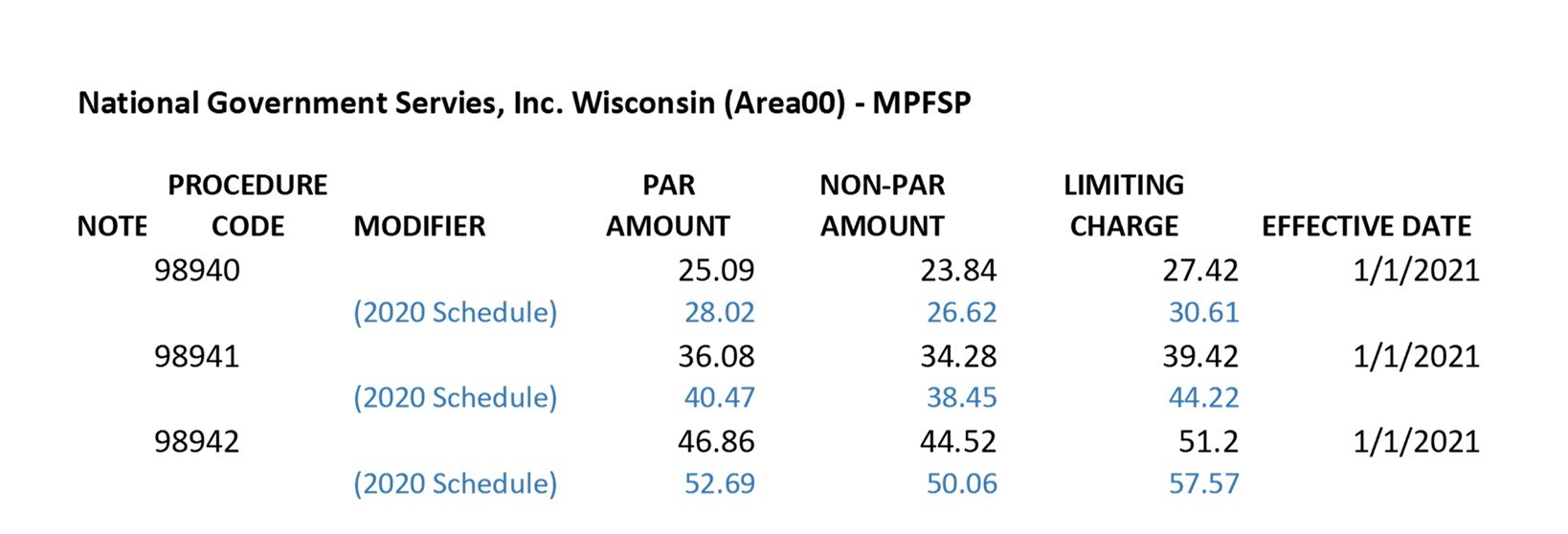
The 2021 Medicare Chiropractic Fee Schedule was recently released.
Download the image here: 2021 NGS CMS Medicare Fee Schedule Chiropractic

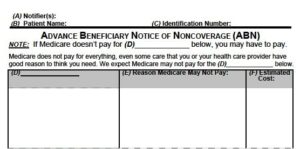
Medicare has released a new ABN which will be implemented starting January 1, 2021. There are two versions, an English and Spanish version. Click the link to download now.
Remember . . .
The ABN is required for your Medicare patients to sign when:
They transition from Active Treatment to Maintenance or Wellness Care.
The ABN is voluntary when:
It functions as your financial policy, and the patient is still on Active Treatment.
GUIDELINES:
Questions? I am here to help! Contact me at lisa@pmaworks.com, or call 920-334-4561
Lisa
“Increasing your collections through better billing and documentation”

The Centers for Medicare and Medicaid Services(CMS) recently released a new ABN Form.
The ABN, Form CMS-R-131, and form instructions have been approved by the Office of Management and Budget (OMB) for renewal. The use of the renewed form with the expiration date of 06/30/2023 will be mandatory on 8/31/2020. We are including the links to the forms for your convenience and they can also be viewed at the CMS Web-site.
In addition to the expiration date on the form, there are a few other minor changes. If you have further questions please feel free to contact Lisa at 920-334-4561.

Have you ever . . . Wished there was an easy way to make sense of the array of insurance networks out there? Should I be in? Should I opt out? Here’s a guide for you and your staff to follow to help you decide whether pursuing a specific insurance contract, and staying in, is worth your time and investment:
First, determine which companies you are in network with. Do you have a contract? What are your provider obligations? Are you getting reimbursed what the contract’s fee schedule says it will reimburse? Do you have a profile set up with the national Council for Affordable Quality Healthcare (CAQH) universal provider database and is the information current, and reviewed quarterly? There is no charge to create and maintain your profile in this credentialing database.
Second, make sure you know if you are currently enrolled in Medicare and if you are a participating or non-participating provider. Are you also currently enrolled as a provider in your state’s Medicaid program?
Third, audit your patient demographic. Run a report in your practice management software. What percentage of your reimbursement is coming from insurance? What percentage is coming directly from patients? Which payers are you mainly seeing patients from? Are you finding that patients are requesting you be in network with a certain company? Who are the main employers in your area insured with? Are you enrolled as a provider with the Veteran’s Administration in your area?
Fourth, develop a spreadsheet called “Insurance Networks” to help you and your insurance department keep the information organized and up to date.
Once you have a grasp on the above, you’re ready to determine if you need to pursue network participation with additional companies. Treating this like a sales or business venture, you’ll want to have insurance companies coming to you and requesting you be in their network. Remember, it is to their benefit and their obligation to keep their paying policyholders happy. Patients should feel free to call their insurer requesting you be on their plan. Patients have done this, and outcomes have been successful. Why? Because the worst phone call an insurance company can receive is from an upset policyholder who can’t afford to see their favorite doctor who is helping them (that’s you!) because the doctor is not on the plan.
Things to consider prior to enrolling in a plan include:
Now, you are on all the plans that are making your pocketbook and your patient happy. What do you need to do to maintain your in-network status? You will need to notify a payer with updated clinic information anytime there is a change in information you submitted at enrollment. This includes phone number change, address change, adding a new provider to the office.
You will also need to make sure you are tracking re-credentialing timeframes for each insurance company. Typically, the recredentialing process for commercial payers is every three years but since your enrollments with each payer fall on different dates, your re-credentialing due dates will vary. Your Medicare re-credentialing is every five years. Re-validation with Medicaid programs is typically every three to five years, depending on your state’s standards. For example, it is every three years in WI and every five years in MI. Many of the larger commercial payers such as Blue Cross, Humana, United Healthcare/Optum Physical Health, use CAQH to approve your re-credentialing. Those who do not will send a written communication via mail or email letting you know your recredentialing is coming due and will include the applications and instructions. Make sure to track these dates in your insurance spreadsheet.
We’ve just touched the surface of network plans and credentialing. Email me for assistance with how these processes work for your practice. You may reach me at lisa@pmaworks.com
Happy Credentialing!
Lisa
“Increasing your collections through better billing and documentation”
I wanted to pass along the following communication from Trizetto to help you with a smooth transition.
Please share it with your insurance and billing team so they can plan accordingly. Remember, claims will not go, and EOBs will not be accessible during the time-frame of 11:59 p.m. CST on March 14, 2019 until approximately 11:59 p.m. on March 17, 2019.
If you are not a Trizetto/Gateway EDI client, you can disregard the information below.
Sincerely,
Lisa Barnett
“Increasing your collections through better billing and documentation.”
Important Message from Trizetto Electronic Claims Submitter
RE: Microsoft Azure® Migration
Dear Valued Client,
In order to ensure the most secure, reliable and highest performing platform for our services, TriZetto Provider Solutions, a Cognizant Company, will migrate data from our St. Louis data storage facility to the Cloud-based Microsoft Azure® platform.
Why Are We Migrating?
A cloud-based data center will align data transport security protocols to industry standards while also providing significantly enhanced information security and opportunities for growth. We believe the benefits of this migration far outweigh the costs, and that our clients will benefit greatly from this transition. Benefits include:
How Will Your Organization Be Affected?
The transition of data will have a direct impact on our clients. Because of the migration, clients will experience an extended outage starting at 11:59 p.m. CST on March 14, 2019 until approximately 11:59 p.m. on March 17, 2019. During this time all applications will be inactive and no incoming transactions will be accepted for processing.
TPS is working diligently to ensure a seamless transition. We have chosen to put this project into effect over a weekend to minimize impact to our clients. We apologize for any inconvenience this may cause.
If you have any questions or concerns, please reach out to our customer service team at 800-556-2231 or physiciansupport@cognizant.com. Thank you for your patience and support during this time.
-TriZetto Provider Solutions
Welcome to your best chiropractic year!
Commercial health insurance carriers such as United Health Care and Anthem BCBS can offer their customers, who are also your patients’ employers, two different health account savings options:
An employer can also directly offer the benefit of their employees signing up for a Flexible Spending Account.
What is a Health Reimbursement Account? (HRA)
A Health Reimbursement Account (HRA) is an account that your patient’s employer funds to help the employee pay for covered healthcare services. The patient cannot put monies into an HRA, as the account is owned by the employer. This includes paying for services (chiropractic office visits) that apply to the patient’s deductible. The patient can begin using their HRA on the first day of the plan year. Since the patient’s employer controls the fund, the employer has the ability to make the rules on when and how the patient can use the money. Additionally, there are coinsurance-only HRA plans available, whereby the patient’s employer will pay only coinsurance amounts.
The patient does not have to pay taxes, state or federal, on HRA monies, so it is a tax savings. The HRA cannot earn interest as it is not a personal bank account.
How do you, Doctor, get paid? Once claims are submitted to the insurer, the insurance carrier will pay, as long as the patient has funds in the account. You will typically, but not always, receive two EOBs/remittances for the same DOS. This is usually due to that first charge going to the patient’s PCP and then getting denied and forwarded to the employer. Referrals from the patient’s PCP to your office is not a requirement tied to an HRA.
There is only one account set up for all covered dependents on a plan. The employee does not report the HRA monies to the IRS.
Takeaways:
Health Savings Account (HSA)
A Health Savings Account is a savings plan set aside for taxpayers who enroll themselves in a high-deductible health plan. They can be offered by your patient’s employer as an employee benefit, or the patient may elect to sign up independently. The benefit here is that the funds are not subject to tax liability upon deposits. Moreover, if there are monies left in an HSA, they can roll over into the next year. When your patient’s health plan offers this type of plan, they are provided with a debit or credit card to make their eligible health service purchases. Both the patient and their employer can contribute to the fund. The patient must report this account to the IRS when they do their taxes.
Takeaway:
Health Savings Accounts are not owned by the patient’s employer. All taxpayers with high-deductible health plans are eligible and must report this account to the IRS when doing taxes.
Employer-based Flexible Spending Accounts (FSA)
An Flexible Spending Account is a special account the patient puts money into to pay for certain out-of-pocket expenses such as medical related, dependency related, and a limited dental and vision plan. This arrangement also has a tax-free benefit. The list of all eligible expenses can be found on the IRS website at: https://www.irs.gov/newsroom/irs-plan-now-to-use-health-flexible-spending-arrangements-in-2019
The employer owns this account.
A frequently asked question I get is, does an FSA cover massage?
Answer: Yes, it does with the ordering physician (chiropractors included) writing a note of necessity for the massage therapy.
When there are monies left over in the account at the end of the year, the employer has two options they can offer their employees:
Takeaway:
There are several eligible out of pocket expenses that an FSA will cover. Click on the IRS link for more information: https://www.irs.gov/newsroom/irs-plan-now-to-use-health-flexible-spending-arrangements-in-2019
SUMMARY
If your patients struggle to keep their appointments due to financial concerns ask them if they have one of these savings accounts that might be able to supplement payment of their care and keep them on their treatment plan.
Oh, one further heads-up to our profession just finding its way down the pipeline . . . you may have or will be receiving a letter from a TriWest Family Alliance group out of Arizona promoting their billing services on behalf of VA offices. This letter is being distributed nationwide. Please note we have researched this, and credentialing and contracting with this group is optional. If you already have a contract with your VA, you may continue treating VA patients as usual. There is no change in their referral of patients to you, or the preauthorization process.
If you have any further questions, don’t hesitate to reach out to either myself or Dave.
Please feel free to forward this article to your insurance department.
Adios for now!
Lisa
“Increasing your collections through better billing and documentation.”

OK, I admit it. Medicare is not the most glamourous topic to write about, nor does much of it pertain to our world of the chiropractic profession as we know it. However with that said, I am doing due diligence for you and fulfilling my duty to inform you of the necessary requirements a Covered Entity must follow (that’s us included!) to keep the Office of Inspector General off our backs and to help you take preventive measures so you’re not sending back reimbursement money you earned from providing patient care.
Because . . . based on my observations in the field – and this is a review for those of you who read our PM&A articles and utilize our library- how many of you know, for example, what a Part C Medicare plan is? How many of you know that all Part C providers are required to undergo annual Fraud Waste and Abuse training?
Second example: How many of you are aware that Medicare, starting in April of this year and going into April of 2019, is sending all of their beneficiaries new ID cards in an effort to do away with social security numbers for the sake of safeguarding identification?
So how do my two examples above directly impact you, your practice, and your bottom line?
Let’s circle back to the first example. A Part C Medicare Plan is known as a Medicare Advantage Plan. It oftentimes covers more services than a straight Medicare plan does. HMO/PPOs such as Humana and Blue Cross Blue Shield have developed their own Medicare Advantage Plans and offer them to their policyholders, your patients. A patient who signs up for an Advantage Plan must also be enrolled in Medicare A (hospital), and Medicare B (outpatient provider services). Medicare Part C providers to date have been required to, annually, undergo what is called Fraud, Waste and Abuse Training. Let’s take each of the three words and define them from the Medicare and Medicaid world.
*Downcoding is also a misuse of billing codes. Stop doing it. Although not intended to increase reimbursement it is a red flag to Medicare, and your services will be questioned as to if they were “medically necessary.”
Back to the training . . . I urge you now to complete this training by the end of December. It is intended for doctors and staff. Download the PowerPoint below, read thoroughly and after completion have each staff and doctor sign off to attest, they read through the PowerPoint. The sign-off can be as simple as logging signatures and completion date in a notebook or a spreadsheet. It is not necessary to print out the PowerPoint. Oh, and many insurance contracts require this training as a contract obligation to be part of their network as well. You can access Medicare’s training PowerPoint here: Fraud, Waste and Abuse
Referring back to the second example of new Medicare cards. You can review our previous article and checklist here: New Medicare Beneficiary Indentifiers to be Assigned Your Patients
Your staff should be asking Medicare patients for their new cards, making a copy, and making sure the address in your practice management program matches the address the Social Security office has on file. If there is a mismatch like the patient has moved and not updated their address, you will have problems getting reimbursed. Make sure your Insurance Profiles in your programs have the new Medicare IDs.
Stay tuned for more helpful articles like this. If you have any questions on the above, contact me! I’m here to help.
Lisa Barnett
920-334-4561
lisa@pmaworks.com
And remember . . .
“The Future Will Be Our Results” (Clarence Gonstead, D.C.)

Beginning in April 2018, through April 2019, The Centers for Medicare and Medicaid Services will re assign all Medicare Beneficiary Identification (MBI) Numbers, and re-issue cards to your Medicare patients and Medicare Railroad retired patients. Social security numbers will no longer be used. Instead, a grouping of numeric-alpha characters, such as 1EG4 TE5-MK72, will be assigned.
Things to Keep in Mind:
If you have any further questions, we’re here to help make sure you get reimbursed in a timely manner. These changes are coming. Give us a call!
Happy New Year!
~Lisa
Lisa Barnett
Services Consultant/Coach
920-334-4561
lisa@pmaworks.com
www.pmaworks.com
New ABN Form and Implementation Instructions
Frequently asked questions and answers for the ABN form
New ABN English 2017(PDF) – Form CMS-R-131 goes into effect June 21, 2017. You may begin using the new one now(April 2017), but on and after June 21 per CMS, you may not use your current ABN.
New ABN 2017 (DOC) Form CMS-R-131 goes into effect June 21, 2017. You may begin using the new one now(April 2017), but on and after June 21 per CMS, you may not use your current ABN.
New ABN_Spanish 2017(PDF)-Spanish Version Form CMS-R-131 goes into effect June 21, 2017. You may begin using the new one now(April 2017), but on and after June 21 per CMS, you may not use your current ABN
ABN-Use(Doc) How and when to use the Advanced Beneficiary Notice for Medicaid Services
Script-for-ABN-form(DOC)– Script for explaining the form to the patient
Final Revised ABN-2012- Advanced Beneficiary Notice for Medicare Services – expires June 21, 2017.
Ms. Lisa Barnett with Petty, Michel and Associates specializes in preventing Medicare Audits. She has helped those who have already been targeted find a fast and safe way out of trouble.
You are not alone…. Things do Happen…..
You are busy and possibly you have overlooked a certain requirement. Your computer has gone through updates and you have not kept up. Or possibly your documentation is simply inadequate in the eyes of medicare or the government.
Whether you are faced with a prepay audit or a post payment audit. I can help !
With 10 years of experience in the chiropractic industry and with documentation; and a chiropractic advocate for 30 years I care and I want to help.
Call today for your complimentary phone consultation and record review. 920-334-4561

The Medicare Audit Preparation(MAP) is available to chiropractors nationwide. This is an emergency response program and on-site appointments are scheduled based on availability. Do NOT send records without calling us first.
The MAP program covers up to three full days (24 hours) in your office, plus 90 day off-site follow up as needed. The cost is $4,995 prepaid*. PM&A management clients can receive a 20% discount if they are active and current members.
Call for terms and conditions for this service. 920.334.4561
Have you received a fax or letter from Center for Medicare/Medicaid Services regarding Comparative Billing Reports? Don’t panic – call me and I will provide an onsite assessment at your practice to ensure your documentation, billing, and coding stay compliant.
Call Lisa: nine two zero 334-4561
Email Lisa: lisa@pmaworks dot com
New Info on Medicare!
Happy Holidays Chiropractic Friends!
First snowfall always seems to bring renewed energies and hope – my wish is you experience this, too.
Are you ready for January 2017? Ready or not, here it comes. Today I want to introduce and give you some of the latest and greatest on what’s happening with the new Medicare reimbursement model also beginning our new year.
To start with, six new acronyms to introduce to you: MACRA, MIPS, CHIP, APM, SGR, CPIA
Here’s a bit of background for you regarding the initiative. In April 2015, President Obama signed into law the Medicare Access and CHIP Reauthorization Act 2015 (MACRA). This is an act to transition Title XVIII of the Social Security Act to the Medicare sustainable growth rate and strengthen Medicare access. How? By improving physician payments and making other improvements, like the Children’s Health Insurance Program. We could say MACRA is the umbrella to the program.
What is the purpose of the change in reimbursement model? The purposes include simplifying reporting for the convenience and ease of the providers participating; decreasing the current costs of healthcare, allowing patients the best quality of care; and to make patient information sharing safe and easy. The blueprint for pay for performance is the Merit-Based Incentive Payment System, and the goal is to create an acceptable payment system for physicians and the program.
Who are the stakeholders in the broader MACRA program? They include beneficiaries (your patients), businesses, payers, providers, and state partners.
Are you eligible to participate?
Both participating and non-participating providers are eligible to participate if you meet both of the following criteria: 1) Have seen 100 or more unique patients in a year, and 2) Have billed for covered services at $30,000 or more a year. You are exempt from participating in 2017 if 2017 is your first year as a Medicare provider. You are also exempt if you do not meet one of the two criteria above.
How will it work?
CMS has indicated through various webinars that they will notify via written communication if you are or are not eligible to participate. Once you learn of your eligibility, the program will require participating providers to report on three categories for the Merit-Based Incentive Payment System:
Additionally, if you are eligible to participate and choose not to, there will be a negative adjustment of 4% to your Medicare reimbursement. If you are eligible and do choose to participate, you may receive a positive adjustment of 4 to 9% depending on your level of reporting involvement, as well as a minimum 0.5% bonus for exceptional performance if your final reporting score meets or exceeds a certain point value.
You will have two reporting options: You may report for the entire 2017 calendar year, or you may report for the partial year, one quarter, and may begin no later than October 2, 2017.
PM&A will continue to monitor any changes to the above information.
In addition, I will be conducting onsite MACRA readiness assessments at chiropractic offices and am available to visit yours. Please contact me if you are interested in learning more!
Best,
Lisa Barnett, Consultant
Petty, Michel & Associates
Call: nine two zero.334.4561
Email: Lisa@pmaworks dot com
Download a PDF of this article
Hello Friends in Chiropractic!
Hope you had an awesome summer and took several opportunities to soak in some UV and Vitamin D.
This month I’d like to both expand on my July Medicare Documentation article and coach you on self-auditing evaluation and management (E/M) coding for reimbursement. Are you consistently under-coding your E/M services? It is not benefiting you to do this because more than likely you’re meeting required elements and not getting the best reimbursement available.
So, what exactly does an auditor, be it Medicare or a Commercial Payer look for in determining reimbursement for your evaluation and management services? It is pretty simple and based on both quality and as it turns out, more importantly, quantity of certain elements. Let’s look in depth how you can self-audit your E/M services*:
First, a coding history and review. In 1992, the current E/M codes were introduced as a result of a ten-year study by CMS(Centers for Medicare and Medicaid Services) and the AMA(American Medical Association). Then in 1995 and 1997, CMS and the AMA developed documentation guidelines (DG) for use of these E/M codes.
Without re-inventing the wheel, let’s lay out how you determine which code to use for your patient evaluations and management of care. To review,
Charting out information from CMS and ACA’s ChiroCode book, here is what we have as quantifiable elements to determine which code to bill for. Keep in mind that Necessity of Care drives our discussion below.
History, Exam, Complexity of decision-making are the three main elements in the evaluation and management note.
Let’s now diagram out for you each code and corresponding description of each element, using both New Patient and Established Patient criteria. What differences do you see? Which descriptions share commonality?
NEW PATIENT
| CODE | HISTORY | EXAM |
COMPLEXITY OF DECISION-MAKING |
| 99201 | Focused/Minor severity | Focused | Straightforward |
| 99202 | Expanded/Low-to-moderate severity | Expanded | Straightforward |
| 99203 | Detailed/Moderate Severity | Detailed | Low |
| 99204 | Comprehensive/Moderate to high severity | Comprehensive | Moderate |
| 99205 | Comprehensive | Comprehensive | High |
ESTABLISHED PATIENT
| CODE | HISTORY | EXAM |
COMPLEXITY OF DECISION-MAKING IN MANAGEMENT OF CARE |
| 99211 | No key component(s) required | No key component(s) required | No Key component |
| 99212 | Expanded/Low-to-moderate severity | Expanded | Straightforward |
| 99213 | Detailed/Moderate severity | Detailed | Low |
| 99214 | Comprehensive/Moderate to high severity | Comprehensive | Moderate |
| 99215 | Comprehensive | Comprehensive | High |
Building on that, here are the quantified components indicating the minimum number of each component’s required presence in the note to code appropriately and at the maximum level:
NEW PATIENT
| HISTORY | EXAM |
COMPLEXITY OF DECISION-MAKING |
||||||
| Code | Chief Complaint | HX of Present Illness | Review of Systems | Past Family/ Social HX | Exam (1997 DG) | Diagnoses | Data to be reviewed; # of Complaints | Risk Factors |
| 99201 | 1 | 1 | N/A | N/A | 1 in affected body area | 1 | 1 | Minimum |
| 99202 | 1 | 1-3 | 1 | N/A | 1-5 | 1 | 1 | Minimum |
| 99203 | 1 | 4+ | 2-9 | 1 | 6-11 | 2 | 2 | Low |
| 99204 | 1 | 4+ | 10+ | 2-3 | 12+ | 3 | 3 | Moderate |
| 99205 | 1 | 4+ | 10+ | 2-3 | All components | 4 | 4 | High |
All 3 elements are required in the new patient note to consider reimbursement: History, Exam, Complexity
ESTABLISHED PATIENT
| HISTORY | EXAM |
COMPLEXITY OF DECISION-MAKING |
||||||
| Code | Chief Complaint | HX of Present Illness | Review of Systems | Past Family/ Social HX | Exam (1997 DG) | Diagnoses | Data to be reviewed; # of Complaints | Risk Factors |
| 99201 | 1 | N/A | N/A | N/A | N/A | N/A | N/A | N/A |
| 99202 | 1 | 1-3 | N/A | N/A | 1-5 | 1 | 1 | Minimum |
| 99203 | 1 | 1-3 | 1 | 1 | 6-11 | 2 | 2 | Low |
| 99204 | 1 | 4+ | 2-9 | 2+ | 12+ | 3 | 3 | Moderate |
| 99205 | 1 | 4+ | 10+ | 2+ | All components | 4 | 4 | High |
Two (2) out of the 3 elements are required in the established patient note to consider reimbursement: History, Exam, Complexity
As you may deduce from the above established patient table, 99211’s are rarely used in chiropractic offices. Can you see why?
Additionally, give your current score an extra two points for management of care, i.e., reviewing old records and summarizing in the note stability/worsening of condition, or, two points for obtaining history from someone other than the patient. Add one point for diagnostics performed and reviewed, (i.e., x rays).
Finally, make sure to attached your -25 modifier on all E/M codes if you are giving a CMT on the same DOS.
Have a specific patient in mind and you’d like to find out if you coded and billed at the most appropriate and highest level? Contact me on how you can qualify for a complimentary audit! Call 920.334.4561 or email lisa@pmaworks.com
Sincerely in Chiropractic,
Lisa Barnett,
PM&A Coach and Consultant
Where Managing by Numbers and Progress Says It All.
My purpose is to be the Best Chiropractic Advocate in the World
*EHR systems may already have built-in features to automate the components for you via their macros/templates.References:
List of Components:
History of Present Illness – Elements:
Location (example: left leg); Quality (example: aching, burning, radiating pain); Severity (example: 90 on a scale of 1 to 100); Duration (example: started 3 days ago); Timing (example: constant or comes and goes); Context (example: lifted large object at work); Modifying factors (example: better when ice/heat is applied); and Associated signs and symptoms (example: numbness in toes)
Review of Systems:
Constitutional Symptoms (for example, fever, weight loss); Eyes; Ears, Nose, Mouth, Throat; Cardiovascular; Respiratory; Gastrointestinal; Genitourinary; Musculoskeletal; Integumentary (skin and/or breast); Neurological; Psychiatric; Endocrine; Hematologic/Lymphatic; and Allergic/Immunologic
Past Family/Social History:
Past history includes experiences with illnesses, surgeries, injuries, and treatments/medications. Family history includes a review of medical events, diseases, and conditions that may place the patient at risk. Social history includes an age-appropriate review of past and current lifestyle activities.
To download the article in it’s entirety click the here [LINK]

We know all too well how keeping abreast of all the changes in the insurance world can sometimes be overwhelming for your practice so we wanted to simply help you out by sharing some recent information regarding ICD-10 codes.
ChiroCode Institute recently published the changes to ICD-10 Codes that are going into effect October 1st. While there are thousands of code changes, we have listed below the codes most relevant to chiropractors. To download a printable copy of this list click here [ICD-10-Changes-Oct-2016]
ICD-10 Reference:
Gwilliam, Evan M, DC MBA BS CPC CCPC NCICS CPC-I CCCPC MCS-P CPMA, ChiroCode Institute
If you have any questions regarding these changes Petty, Michel and Associates would be glad to help guide you in the right direction. Please email to services@pmaworks.com or call us at 414-332-4511. We are here to help!
HIPAA, Covered Entity, OSHA, HITECH – – Compliance. What’s happening in the world of compliance and why do you as a chiropractor need to be educated and remain in the know? Find out below . . .
First and foremost, according to the Health and Human Services (HHS), chiropractors are included in the covered entity category, and this is regardless of whether or not you have received Electronic Health Records incentive monies. Covered entities are required by federal law to comply with all areas of protected health information and employee safety standards. Impact of non-compliance? In February 2016, a covered entity was fined $239,800 for non compliance.
Further, according to a March 2016 survey among small practices designated as covered entities, 60 percent of the 900 plus professionals surveyed are still unaware of pending compliance audits, and 58 percent have not appointed a securities/privacy officer in their practice. Audits to our profession are forthcoming, and we cannot opt out. Keep reading on how to safeguard yourself and your practice. Also keep in mind that it takes approximately 40 to 50 hours to develop and secure a compliance program.
The three main areas of compliance you need to be aware of, educated in, and be an active participant include: HIPAA, OSHA, and IT Securities.
Health Insurance Portability and Accountability Act
The Health Insurance Portability and Accountability Act (HIPAA) law of 1996 was enacted to improve the portability and accountability of health insurance coverage, and it brought individual privacy rights to patients and requires that we notify them of their rights. It also serves to eliminate fraud, waste, and abuse in healthcare. The focus here is to safeguard your practice by securing personal (patient) health information (PHI) and personal identifiers, be it paper or electronic (ePHI). This can include data encryption, secure messaging, compliant Cloud storage, compliant software, and unique password setups. One of the areas I assess when I visit a clinic is locating where the patient paper files are kept and if they are well out of viewing from others.
Your HIPAA requirements to be compliant at the clinic level include:
OSHA
The United States Occupational Safety and Health Administration (OSHA) Act was signed by President Nixon in December 1970. It is designed to protect worker safety and promote healthy work environments. Some of you Docs have been involved in workplace safety and onsite workplace assessments in factories. Kudos to you! You were advocating OSHA’s mission by: Educating your client and their employees on workplace safety by conducting posture and ergonomic assessments, and finding the best ways for workers’ compensation patients to get back to work and continue contributing safely and appropriately within their restrictions.
At the clinic level (can be delegated), your requirements to meet OSHA requirements include:
Information Technology (IT) Security/HITECH
The Health Information Technology for Economic and Clinical Health (HITECH) Act, enacted as part of HIPAA and the American Recovery and Reinvestment Act of 2009, was signed into law on February 17, 2009, to promote the adoption and meaningful use of health information technology. Section 1176(a) of the Social Security Act was revised during this timeframe to allow for significant monetary penalties up to $1.5 million for breaches/violations of protected health information. However, an interim revision (later known as The Omnibus Rule) set prohibitions on enforcing such significant monetary penalties if it was found in investigation that the covered entity did not know and with the exercise of reasonable diligence would not have known of the violation. In these cases, the breaches were punishable under the lowest tier of penalties, and further, prohibited the imposition of penalties for any violation corrected within a 30-day time period, as long as the violation was not due to willful neglect. A final ruling in January 2013 reiterates all of the above standards.
Your responsibilities to get IT Securities compliant include:
Impact of non-compliance? Another covered entity was fined $25,000 for posting patient information online.
Feeling overwhelmed? We can help. Contact me on how you can get an initial Compliance Assessment and a Medicare Documentation Assessment with a Report of Findings sent to you, for a ridiculous low price of $299!*
References:
*Mileage cost may apply.
Have you ever thought you could be both a great documenter and repeatedly educate your patients on their innate intelligence . . . if you only had the time? Keep reading on how to both bulletproof your documentation for a potential audit and maintain the energy of our profession’s principles.
Let’s help build your ammunition.
First . . . did you know that the US Health and Human Services advised Medicare to target chiropractors to curb questionable and inappropriate payments, projected at $280,000,000? Seriously! And clinics are, as I write this, being audited. How do I know? Because we’re receiving phone calls and emails asking, “What do I do? I received a letter from Medicare.” As a result, I’m traveling around to help chiropractic offices prepare.
To insure yourself and what you’ve worked hard for, make sure your documentation (that is, every single note in the patient’s file/your EHR software) is citing the following information:
Let me be clear: The above documentation requirements are not PM&A’s. They are Medicare’s.
Other Tips:
In closing, get out there, do what you do best to attract and help anyone with a spine, and follow the above documentation requirements to armor yourself in the event of an audit by Medicare and other payers. Need help staying relaxed and focused, and getting paid? Give us a call. That’s why we’re here.
Sincerely in Chiropractic,
Lisa
Lisa is now providing a no charge initial consultation regarding your Medicare documentation. You can contact at (920) 334-4561 or by email at Lisa (at) @ pmaworks.com
More information on Lisa[LINK]
Download a printable copy of this newsletter [June newsletter]
Download a customizable copy of the Checklist: [Medicare Documentation ChecklistDOC]
Print Checklist (PDF)[Medicare Documentation Checklist-PDF]