Chiropractic Has Always Been Organic

 
Chiropractic has always been organic. Earth Day, goaldriven

You can improve your marketing by aligning your services with positive causes in society.

A fitting example occurs this time of year.

Earth Day is on April 22 (Saturday). It promotes a healthy planet and stands for protecting the earth’s natural resources for future generations.

Earth Day had several early separate beginnings but was finally pushed home by a senator from the great state of Wisconsin, also its former governor, Gaylord Nelson. The first Earth Day was in 1970 and “brought 20 million Americans out into the spring sunshine for peaceful demonstrations in favor of environmental reform.”

But Senator Nelson was also a proponent of natural health and fought for chiropractic.

In a statement to Congress in 1963, Nelson said, “Chiropractic has become increasingly accepted as a safe and effective form of health care…I believe it is time that Medicare beneficiaries be given the opportunity to receive the benefits of this form of health care.” Nelson’s efforts helped pave the way for chiropractic care to be included in Medicare in 1972.

If you distill it all down, it is all about health: a healthy planet and a healthy body, naturally.

People want this – your patients and your community. They want a healthy planet and a healthy body.

This may not be apparent because of advertising and corporate news. There is a relentless pitch to your patients and community to eat cheap bad food, that a toxic environment is no big deal (“move along, nothing to see here”), and that drug stores are health stores.

But despite the billions spent on promotion and lobbying for bad food, bad medicine, and covering up the poisoning of our planet, the innate (and tribal) wisdom of us all prevails. The sales of organic foods and health supplements are booming. The natural healthcare industry, including chiropractors, acupuncturists, and integrative health providers, continues to grow. And there is increasing concern about how pollution causes deaths and illnesses, not to mention climate change.

I bring this up for two (2) reasons:

Reason #1: Marketing: Chiropractic and Earth Day

By aligning your office with Earth Day, eco-conscious consumers who value natural and sustainable products and services will see your services as a desirable alternative to medical practices. You are the obvious choice as health doctors.

Years ago, we put together some posters and pins related to Natural Health Week, coinciding with Whole Earth Week and Earth Day. Some offices still use versions of them! (Link below.) You can do something similar this Friday, next week, or all month. For example:

  • Hand out seeds to grow vegetables in the backyard. Include a coupon for a family member or friend.

  • Support a local health food coop and bring in healthy muffins for your patients.

  • Create a community clean-up drive.

  • Partner with environmental and health organizations. You can share events, newsletters, and create allied relationships.

But there is another reason I bring this up.

Reason #2: This reason is BIG. It will have to wait till tomorrow,
Wednesday, April 19.

But please stay tuned!

See you Wednesday!

Ed

Link to Posters and References at our blog.


Failure to Follow Through

It is the ‘follow through’ that makes the great difference between ultimate success and failure, because it is so easy to stop. — Charles Kettering

Failure to Follow Through

If it worked once it probably will work again

There is a management disease that many businesses, including chiropractic and other health practices, can suffer from. It is called “Failure to Follow Through.”

I noticed this at one of the first offices I worked with in Northern California – years ago. Their numbers were down. When I visited their office on a hot summer day, the reception room was empty, and few patients were scheduled. I noticed they had a thick binder of photos of patients and staff on the lower shelf of a dusty bookcase. The photos showed happy staff, doctors, and patients. There were also patient success testimonials, several years old.

We all met together for a staff meeting. I asked the doctor and staff if they could name a few specific actions they did back then. I said, “let’s start with marketing.”

Well, it turned out that they ran advertisements for a bi-yearly promotion. So I asked if they had done this in the last few years. “No” was their answer.

“What else were you doing at the time,” I asked. They said they always discussed financial and scheduling arrangements away from the front desk. Are you doing that now? “No.”

What else were you doing during that time? “We used to call the new patient after the first adjustment.” They also did progress exams. “Doing it now?” “No.”

The list went on and on.

Being the brilliant practice management scientist that I am, I encouraged them to re-implement what they had been doing. They did, and a few months later, the office was filling up again.

Practice Management

If it worked once, it probably will work again. Make minor improvements as needed, but why change the system if it is working?

Well, you can get bored, right? Or a staff member who knew the system left and their duties were not replicated by someone else. Or, everyone gets bored, so you feel the need to change things to bring excitement back into the office, and key procedures quietly start disappearing.

Discontinuing your successful procedures can create a roller coaster ride for your practice, with numbers going up and then down. And this can cost you thousands, even tens of thousands of dollars.

A checklist of successful procedures is essential, but that is not enough. They need to be reviewed regularly.

That, too, is not enough. We need to keep the practice environment fresh and lively while still maintaining those activities that are helping us grow and develop. We are not on an assembly line, and we are not robots!

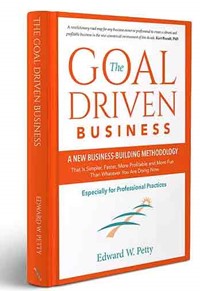
I cover this in my book, The Goal Driven Business. (See Goal Driven Principle #17, Goals, Games, Groundhog Day). This is part of the Goal Driven System of practice development and includes checklists, reviews and coaching, and other components, such as gamification.

Gamification is a new term for an old principle: we like to play games! As video games became more prevalent, businesses saw that they could adapt elements of gamification to help engage employees and customers. Nothing new, really.

To make your office feel new again, you can think of a new promotion for this summer or new colors to paint the office. Spend a morning reviewing your goals, mission, and policies, and then go to a spa for a reward! One office creates a health theme each year and makes t-shirts promoting the theme for staff and patients.

Keep it fun — but stick to your winning ways.

Patient Management

ALSO… like practice management, patient management can also be affected by failure to follow through. Your patients need help to adhere to their treatment plan to achieve their health goals.

Stick-to-itiveness is simply being true to our goals.

Make improvements along the way and keep it fun. But help each other and your patients follow through.

Your goals are waiting for you!

Ed

BARC Basic Activity Recovery Cycle

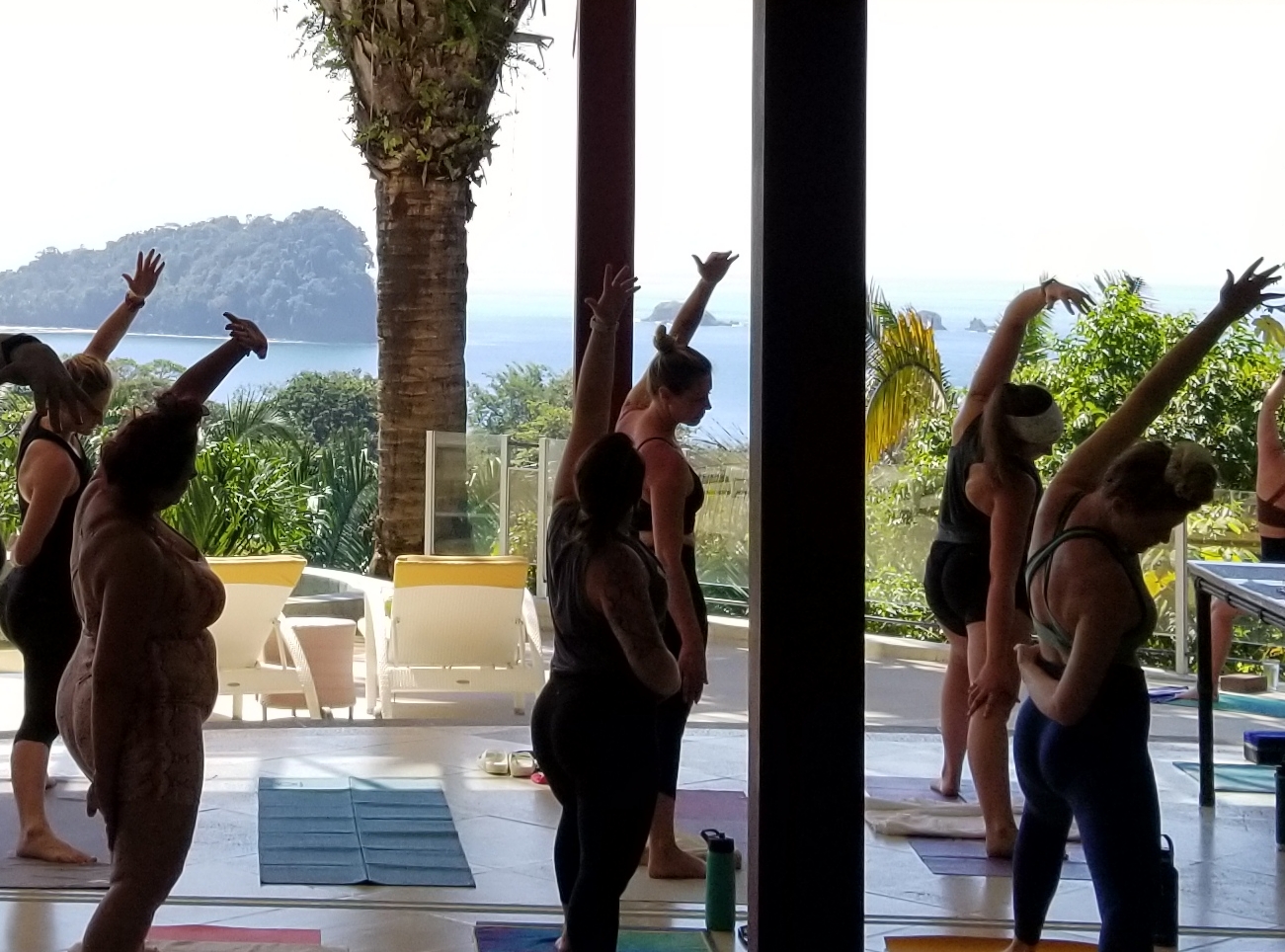
yoga helps chiropractic care and practice management

Otherwise known as taking a break

We need to take breaks.

Small breaks every few hours, longer breaks every week, even longer breaks every several weeks.

Our bodies and our minds require periodic interruptions from our work, according to the Basic Rest-Activity Cycle theory, as discussed by Loehr and Swartz in their book, The Power of Full Engagement. We need to take time away whether we agree to it or not, it seems.

The authors present evidence that supports this theory and explains this cycle as activity and then recovery.

They say:

“We can only push so hard for so long without breaking down and burning out. Stress hormones that circulate chronically in our bodies may be temporarily energizing, but over time they prompt symptoms such as hyperactivity, aggressiveness, impatience, irritability, anger, self-absorption and insensitivity to others.”

“We live in a world that celebrates work and activity, ignores renewal and recovery, and fails to recognize that both are necessary for sustained high performance.

“The simple, almost embarrassing reality is that we feel too busy to search for meaning.”

So take small breaks and then larger breaks to disengage so that you can better engage with your patients and with each other to provide better service.

And support your team to do the same.

I’m not promoting this so you can let up on your production goals or so that you can be nice to your team. Far from it.

Production goals (New patients, Visits, Collections) need to be balanced with organizational improvement goals. AND THESE need to be balanced with greater meaningful goals.

So take some time to surprise your kids with a fun adventure, have a long lunch date mid-week with your spouse, spend a day volunteering, or travel to Costa Rica to play in the waves and take in some yoga.

Like I’m doing now!

Carpe Futurum (Seize your Future)

Ed

How to improve performance by taking more breaks is thoroughly covered in my book The Goal Driven Business which you can purchase here.

Goal Driven Business


Practice Fundamentals – Communication and Control

“Get the fundamentals down and the level of everything you do will rise.”
— Michael Jordan

It’s always the basics. The fundamentals.

This is what all efforts to improve performance – and health — go back to.

All of your efforts in practice management boil down to communication and control.

All the books on procedures, patient management, and practice management can be distilled down to communication and control. Those are the basics you need to get to your goals and those of your patients.

  • Doctors, and staff, that have excellent communication with their patients have many referrals and a busy practice.
  • Doctors who communicate well with their staff have a happy and full practice.
  • Doctors that have positive control with their patients see their patients succeed.
  • And business owners that have proactive control over the office – are prosperous.

Of course, the inverse of these facts is also true. Whether out of fear, confusion, or fatigue, when these fundamentals are not administered, things don’t go well.

Communication

I was recently helping a doctor and the practice manager improve their patient financial consultations. The manager and doctor had worked out what to say that they liked. They called it a “script.”

A few months passed, and I noticed their patient retention had not improved. Neither had collections or other metrics. When we did some training on how the patient consultations were performed, we found that the staff focused on the memorized script, not the patient. Their communication was robotic, and they never got to know the patient. We replaced the script with a simple outline and let the staff get to know the patients. Visit average and collections improved.

Good communication is alive, interested, and empathetic. It results in understanding.

Control

Another office we worked with complained about low collections. They had plenty of new patients — the veteran doctor got great results. After investigating, we found that the report of findings and treatment plans were rarely completed, and scheduling was hit-and-miss at best.

And that’s not all. The doctor and staff often came to work just a few minutes before patients came in. Sometimes they came in late.

This office was out of control — and so were the patients.

Positive control is moving a project, patient, or condition from one status to a predetermined goal. This is what a procedure does. A well-run business has procedures, protocols, and systems that it adheres to achieve its daily and weekly goals.

Management

Management is implementing effective procedures, with excellent communication, to achieve goals.

In all your practice improvement efforts, check first if the procedures are being done, and then if they need to be improved or removed. Then, look at the quality and quantity of communication used to implement the procedures.

Improve the fundamentals — your patient and team communication and control — and you will have a prosperous and happy 2023.

Seize your future – with a smile!

Ed

Going Public or Going Purpose

Be like a juvenile delinquent!

The chiropractic model for care follows three main stages, according to many patient educational articles. These are 1) Relief, 2) Correction and 3) Maintenance and Wellness.

I am sure it could be nuanced into other levels or worded differently, but these three make sense to me — so much that it inspired me to write a book – The Goal Driven Business.

But I had another inspiration.

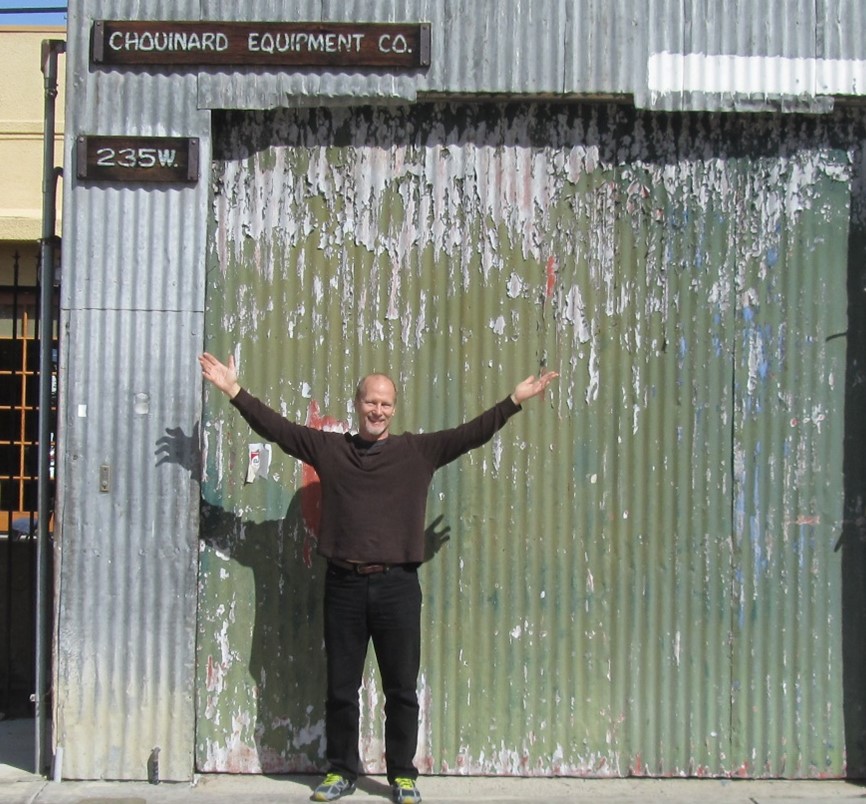
I read a book about a young French-Canadian rock climber who lived in Southern California and was not finding the equipment he needed. So, he became a blacksmith and started making his own. In the late 1950s and ’60s, he started the Chouinard Equipment Co and made climbing gear for other climbers. He also wanted better outdoor gear, and so founded Patagonia, a clothing company.

The name of the book was Let My People Go Surfing. It was by Yvonne Chouinard and tells the story of how he grew Patagonia.

Patagonia, now a 50-year-old company, has done very well financially. It has also done very well for the quality of its products and services and its employees. But it is also driven by the goal of making Earth healthier.

Patagonia demonstrates three goals I believe every business has: 1) profit, 2) expert service and people, and 3) higher purpose. In my book, I reference examples of how the best companies focus, knowingly or unknowingly, on these three goals.

The best offices I have worked with over the years have also been committed to these three goals. They cared about providing the best service to their patients, but also to their staff. They were committed to helping as many people as possible be healthier. And, of course, they insisted on profits.

Chouinard, with his family, own Patagonia.

That is until this month. Valued at 3 billion dollars, Chouinard announced that they are giving the company away. He could have sold it to … Amazon, for example, or they could have made it a public company. Instead, he donated it to a fund called the Patagonia Purpose Trust. He says, “Earth is now our only shareholder.”

“Instead of “going public,” you could say we’re “going purpose.” Instead of extracting value from nature and transforming it into wealth for investors, we’ll use the wealth Patagonia creates to protect the source of all wealth.”

I encourage you to look into Chouinard’s lessons on business, which he acquired through trial and error as we do! I have some links over on the blog (see below.) There are many business lessons to learn by studying the trials of other business owners in different types of businesses.

But I guarantee you that if you commit to these three goals, in the long run, just like with your patients, your business and your life will thrive.

And one other note!

I think ol’ Yvonne would have been a natural chiropractor. He reminds me of you guys. In an interview in 2017, he says:

“One of my favorite quotes is if you want to understand entrepreneurs, study the juvenile delinquent because they’re saying, you know, this sucks. I’m gonna do it my own way. And that’s what the entrepreneur does. They just say this is wrong. I’m gonna do it this other way. And that’s the fun part of business actually.”

So, have fun, and seize the future,

Ed

For links and other references, go to our blog here: Goal Driven

Ed Petty in front of Chouinard Equipment Company, Ventura California


Patagonia home page
https://www.patagonia.com/home/

Interview with Chouindard
https://www.npr.org/2018/02/06/572558864/patagonia-yvon-chouinard

News articles
https://www.reddit.com/r/climbing/comments/xebzib/yvon_chouinard_gives_patagonia_to_charitable/

https://www.inc.com/yvon-chouinard/patagonia-ceo-let-my-people-go-surfing-why-company-mission-is-not-profit.html

Book
https://www.barnesandnoble.com/w/let-my-people-go-surfing-yvon-chouinard/1124064053?ean=9780143109679

Are You Ready For Flu Season?

Are ready for flu season?

Big Pharma is.

If you haven’t seen the ads yet, you will soon. And so will your patients and potential patients.

It’s just business. “The global influenza vaccine market size was valued at USD 7.02 billion in 2021. The market is projected to grow from USD 7.54 billion in 2022 to USD 13.58 billion by 2029.” (Market Research Report, Fortune Business Insights, Sept 2022)

So, what does this have to do with practice and business development?

Your Unique Selling Proposition

In a practical sense, you are the uncola of the cola healthcare world.

You are health doctors – not disease doctors or drug doctors. However you want to frame it, you can define what you do as different than the pharmaceutical alternatives in such a way that you stand out from the crowd.

Remember, it is not necessarily what you do that counts. It’s what you stand for.

You stand for natural health. As Simon Sinek reminds us, “People don’t buy what you do; they buy why you do it. And what you do simply proves what you believe.”

Better Service and Better Health

In my book, the Goal Driven Business, I reference how consumers want more information about their services and products. Especially in this age of abundant and ready information. Patient education is not a chore, it is a service that, if it is well presented, patients appreciate.

But even more, you know about the immune system and what improves it. But natural approaches to boosting the immune system are not emphasized by the medical “information” that is promoted and posted. But you know better: adjustments, exercise, vitamin D, C, and all the rest. Acupuncture too!

It does take a little more time to educate your patients and community. But think of it as a clinical service that makes you unique and special. Think of it also as a marketing expense.

Pride and Purpose

There might be another reason to educate your community on natural approaches to viruses, one that is more personal.

You might feel that your patients and neighbors are being misled and that vital information is being kept from them. You may want to right this wrong!

And lest anyone tries to reframe you as unscientific, the leading cause of death is errors in medicine.(2)

So… the Flu Season is on its way. Go for it!

Enter the race and position yourself and your team as the good guys, the Natural Health Clinic that gets results. And by the way, don’t overlook that you all need to practice what you preach!

There is a very large portion of the population that is seeking a more natural lifestyle. Google search terms show strong interest in natural remedies. You will appeal to them — they are just looking for a health-oriented team to help them maintain and improve their healthy lifestyle.

Seize Your Future,

Ed

Links to the above references and others on the blog, here:

Learn how to create a Goal Driven practice that is more profitable and fun – get The Goal Driven Business

The Missing Role in Your Practice

The cause of almost all relationship difficulties is rooted in conflicting or ambiguous expectations around roles and goals. Stephen Covey

The reason many offices have a difficult time growing has to do with missing roles.

A role is the identity assumed to perform a series of tasks that produce a specified outcome.

In the hundreds of offices that we have visited over the years, the doctors take on essentially two roles: doctor and owner. This works in the beginning for a few years as the practice grows. In time, however, the practice begins to roller coaster. Numbers go up, then they go down, cycling up and down until everyone fatigues and just settles.

There are several causes for the Practice Roller Coaster. There are hidden barriers that hold an office back and sabotage its growth. These are covered in my book, The Goal Driven Business.

One of the barriers has to do with a missing role that most business owners overlook. Can you guess which one that is?

Let’s look at goals: What is the goal of a doctor? “A healthier person,” right?

What is the goal of a business owner? A secure and solvent business. Dividends from ownership.

What is missing? The doctor can achieve their goal by seeing 10 people a week. As a business owner, they can keep their overhead very low – perhaps working out of their home. But is that what you really want – to see 10 people a week out of your house? Overhead is low and you are getting good results. So, what is missing?

The CEO – the chief executive is the missing role. The goal of a CEO is a very profitable business that operates at full capacity providing world class service and delivering extraordinary results.

The CEO is the chief manager, leader, and marketer, which are the three functions that drive the business to its goals.

Sometimes we hear the doctor being referred to as the “boss,” but boss is not a well-defined role. “Boss” is generally recognized as the person who gives orders and makes decisions. However, it is an overlay of an existing role, as in a “bossy” doctor or “bossy” owner. The role of a CEO is much more than this.

Most providers are too busy providing services to do much managing – and besides, they are paid for their services, not their managing or leadership. Doctors are trained to manage patients, not businesses.

Still, this is a role that must be fulfilled as distinct and separate from the owner or provider roles if the business’s full capacity is to be achieved.

Three Functions of the CEO

The role of CEO includes these functions:

  • Leadership: Leadership is all about goals. It defines where you are going and why and helps everyone you work with embrace this knowledge with commitment. Leadership includes your mission, long-range plans, values, and … the insistence upon achieving them.
  • Management: Management deals with how to get to the goals. Management works to ensure that people and procedures are effectively working and improving.
  • Marketing. Marketing includes procedures and projects that help generate new patients/clients and retain them. Marketing is business, and business is marketing.

Once your practice is at least at 50% capacity, a couple of hours spent each week on effective leadership, management, or marketing activities as a CEO is worth 8 hours or more doing anything else. For example, time spent going to a seminar – perhaps 20 hours including the transportation, may increase your numbers for months afterward. A little can go a long way.

Because the role of practice CEO must be very part-time, we have developed the Fast Flow CEO System for the Goal Driven Business. This can take as little as 2 -3 hours per week, depending on the scale of your business. Here are five components of the Fast Flow CEO System:

  1. Get Out to Work On. Regularly take time to get out of the business so that you can work on your business.
  2. The CEO Works for the Business. The business does not work for the CEO. Sure, the business works for the doctors so that they can provide better service to the patients. But that is for the doctor. Sometimes called “servant leadership,” the CEO is the Chief Coach, helping others understand the goals and how to achieve them.
  3. Team Members. The CEO works to create team members who take on a portion of departmental management, marketing, and leadership.
  4. Manager. The CEO creates the role of manager and delegates a team member to assume this as a part-time role. The manager can take on much of the CEO’s daily and weekly duties.
  5. Study. The CEO studies leadership, management, and marketing to improve their skill as a CEO. Leaders are … readers!

Certainly, all this requires some skill and training – and coaching! But just clarifying the role of CEO and its expectations as distinct from the roles of owner and doctor (or “boss”) will significantly improve your chances of breaking out of the Practice Roller Coaster and achieving your goals.

Ed Petty

March 14, 2022

Motivation

No matter how many goals you say you have or how you write them out, unless you have the motivation to achieve them – you won’t.

“Motivation is the driving force behind the energy required to complete a task… a person’s willingness to exert physical or mental effort in order to complete a goal or set aim. (Psychology Dictionary.org)

This is a key element in a Goal Driven Business.

You first need to define your goals – and they must be practical as well as meaningful. But you also need the drive to achieve them. Without the drive, the motivation to get to where you want to go, you are just a poser in the business world.

(Case #345) The doctor and I had discussed a plan to motivate his team and increase production. This was many years ago. Over lunch, we had a team meeting to announce the plan to his other two doctors and about 10 support staff. He announced that if certain goals were met over the next 7 months, everyone could get a trip to Hawaii.

Everyone was shocked. Including me! The doctor and I had discussed a two-month plan for rewards based upon a modest performance improvement – but not Hawaii and not the increase in production he wanted. He came up with this on the spot during our meeting.

But that afternoon, amazingly, the phones lit up. People were calling in for appointments. (Never mind that this was an example of Innate or Quantum Entanglement!) As I recall, they had their best month ever. But unfortunately, they soon realized that the goals were unrealistic, they had little support to achieve them, and the doctor saw that he couldn’t afford it even if they did reach their goals. The practice subsequently went into a long-term slump.

==================================================================

What is the lesson? Well, there are a few of them, but I want to focus on motivation.

While it may seem like people become motivated because of the “carrot,” or the reward, there are deeper reasons – or principles.

Edward Deci, along with others, put forth a new framework for motivation called Self-Determination Theory. Essentially, it states that we are all driven by intrinsic goals as part of our fundamental nature. Our reward comes from the satisfaction we feel from the achievement more than from any external prize.

These are the three intrinsic goals we all share:

AUTONOMY. We all want to play in our own sandbox! We need to feel in control of our own corner of the world. Just like we don’t like insurance companies intruding into our clinical decisions, staff does not like being micromanaged.

COMPETENCE. We all want to be superheroes! Deep down, the prospect of becoming more skilled, more masterful, and better able to be in control of our environment is a drive we all have.

CONNECTION. We all want to be part of something bigger than ourselves. This manifests in two ways: a) being part of and working with a supportive group or team, and b) working to help bring about something more significant than our paycheck or the accomplishment of our everyday tasks.

The office staff was excited to go to Hawaii, but this was not necessarily because they could lie in the sun. It was because it was a huge goal that gave them a very large sandbox to play in – together – to work for a very large result.

Self-Determination Theory is why games work. In Kevin Werbach book, For the Win, he discusses the subject of Gamification.

“For thousands of years, we’ve created things called games that tap the tremendous psychic power of fun. A well-designed game is a guided missile to the motivational heart of the human psyche. …monetary rewards aren’t even necessary because the game itself is the reward.”

Whether it is a sporting event, video game, or Sheepshead (a popular game of old-time Wisconsinites, so I’ve heard), we love our games. And I think we need them.

But it all goes back to the principles of Self-Determination Theory.

Remember when you started your business? The challenge that lay ahead? The new business card that identified you as the hero to conquer new plateaus?

Those drives are still there and can be rekindled, regardless of prior disappointments.

As Soon as You Make a Goal—You Have Created the Potential for a Game.

Win or lose, IF the principles of Self-Determination Theory are in place, you will be motivated and so will those with whom you work.

Apply these principles to yourself and your team – for the game, for the fun, and for the win!

Seize the Future,

Ed

For more information on how to apply self-Determination Theory, games, and motivating yourself and your team, please purchase the book,
The Goal Driven Business. [Link to sell page]


Goal Driven Job Descriptions

playbook goal chart

In a Goal Driven Practice, Goal Driven Job Descriptions are short, fast, and to the point.

And they are used!

They help improve the quality and quantity of services and are motivational.

So, how is this different from other job descriptions?

Most job descriptions are usually a hodge-podge and catchall of unrelated tasks. For example, the front desk job description may include getting supplies, taking x rays, calling attorneys, and scheduling patients. Billing may include marketing and equipment repair.

Staff will do the tasks assigned but end up zigzagging from one function to another, losing focus on what they are doing, and often disengaged in their activities.

In typical job descriptions, the goals are not clearly defined, measured, nor are the expectations stated. Further, employees don’t always see or get recognized for the results of the work detailed on their job descriptions.

Yet another failing of most job descriptions is obvious – they just aren’t used.

Let’s look at how to power up job descriptions so that they are Goal Driven.

Many job descriptions contain the duties of several different roles. A role is an assumed identity. For example, in a restaurant, there are the roles of a server, cashier, dishwasher, and chef, or cook. In a small restaurant, one person may take on a number of these roles, and all these roles would be their job description. Hence the idiom: “chief cook and bottle washer.”

But to be effective, each role needs to be separated, well defined, and organized with the other roles.

In a Goal Driven Practice, job descriptions are broken down into different roles and described in job checklists.

The job checklist begins by clarifying the goals. This includes the mission, the outcomes, what is used to measure performance, and the level of performance expected of that role.

For example, for the role of Patient Accounts, the mission might be something like: “To help the patient pay for all of the services they received in such a way that they will continue to receive services.” The outcome might be a zero balance or “no accounts receivable more than 30 days.” The statistics used to measure this role could be the “percent of collections to adjusted services.” And finally, the expectation might be something like: “All patients very happy with the encounters with Patient Accounts and continuing with their services, with a collections percent of at least 95% of adjusted services average.”

We now list the most important procedures to achieve this goal. The CEO of the office defines WHAT the goals should be – that is leadership. But the manager and those working in patient accounts would work out HOW the goals would be achieved.

Encouraging the team member to define the best procedures to achieve their goals empowers them and gives them autonomy and responsibility for their role. According to Self-Determination Theory, real motivation is intrinsic. It comes from one’s desires and needs rather than external rewards or threats. Edward Deci, in his book Why We Do What We Do, says people “strive for personal causation.” (This is more fully covered in my book, The Goal Driven Business)

If the cook understands that their goal is to make tasty meals that the customers enjoy and for which they will pay, they can be more responsible for how best to achieve that goal.

A team member may have five or more roles, each with a job checklist, as part of their job description. As the doctor and owner, you may have 25! (And if so, that could be a big capacity barrier right there!)

Once the goals are clearly defined … and kept in mind, the rest of the checklist can be easily worked out.

Once per month or more, you or the manager can meet with each team member and do what we call a Coaching Review. This is a fast review of employee performance: at what they are excelling and at what they need to improve. In addition, the job checklist can act as an assessment.

But it is all geared around the goals of their roles. You also ask them what could be added or changed to improve both the quantity and the quality of their outcomes. They can make the changes to the job checklist and make sure you have a copy.

None of this takes a long time to do each month.

Management of your office is not just about getting procedures done. It is about constant improvement in the quantity and quality of their goals.

You may have told your patients something like: “If you do not make time for your wellness, you will be forced to make time for your illness.”

The same applies to managing your business. “If you do not take time to improve your procedures and your people to achieve the goals in their roles, you will be forced to make time to rebuild your practice.”

Steven Covey, in his book The 7 Habits of Highly Effective People put it simply and best:

Begin with the end in mind.


Ed

The Goal Driven Front Desk

A dynamic front desk can increase your visits by 20%, maybe more if you have the room. On the other hand, a dysfunctional front desk can constrict the flow of patients and hold your office back.
I have seen instances of both.
There is much more going on and at stake at the front desk than most doctors and staff appreciate.
Ordinarily, you would think that the billing department is the most demanding. There are hundreds of details that need to be learned and followed with excellent discipline. This position requires professionalism and expertise.
But this function is not on the front lines of the constant patient, phone, and doctor interactions and interruptions. Managing patient accounts can be regulated and organized to maintain a calm and comfortable workflow.
Therapy and adjunctive services are often undervalued, but the patient flow is usually smooth, and they are not faced with unexpected patients or phone calls.
It is interesting to note that the front desk has the highest turnover in most offices.
But properly set up and managed, this department can be an engine of growth and stability in your office.
Let’s look at some of the more important attributes of the front desk:
  1. It represents you and your services. It is your ambassador to the world outside your office. The front desk reflects what you stand for and the quality of your services.
  2. It is the first and the last contact – and impression –with anyone in the office.
  3. It can convert inquiries to new patient appointments.
  4. Rapport and relationships. The front desk can provide world-class service to patients, improving patient retention, reviews, and referrals. (The 5 Rs)
  5. Direct marketing. The front desk can directly promote clinic services to patients, hand out coupons, and promote upcoming events to generate patient referrals.
  6. Team member support. The front desk can support the insurance department and all team members to create a positive, upbeat day every day.
  7. Case Management. The front desk can contribute to case management by relaying any comments or observations relative to the patient’s care to the doctors.
  8. Fully Scheduled Day. The front desk fills the appointment book and keeps it full.
Let’s imagine an ideal front desk and put it at a “5” on a 5 Point Scale.


5. GOAL DRIVEN FRONT DESK. The appointment book is full. The front desk staff are cheerful, having fun doing their jobs, and genuinely interested in every patient and phone inquiry. They sincerely care for each patient and non-patient. They have a strong intent on helping patients complete their programs by keeping their appointments. They personally and professionally want to achieve the mission of the office and encourage patients to help them accomplish this mission by bringing in family and friends. They also help the rest of the office achieve the office’s mission. They are sending out positive “vibrations” to help more people. They are proactive and Goal Driven.


Below this level, we find the front desk that is struggling.


2.5 A COPING FRONT DESK– The appointment book is 50-70% full. The front desk is trying, but it is not keeping up, which creates a bottleneck to patient flow. (Subluxated) Even though the staff wants a full appointment book, subconsciously, they don’t want any more work until they catch up.


2. A SLOW FRONT DESK. The front desk operates at a “comfortable” 40-50% capacity. The staff is pacing themselves, keeping up with computer tasks, insurance, and following the scripts for phone and patient encounters. However, they are mostly disengaged from the front desk and office goals.


1-2. GIVEN UP and BORED. I only describe this because I have seen this condition. The staff is ignored or badgered. In either case, they feel relegated to a 4th class employee. They hide out and pretend to work, essentially having quit and just waiting until something better comes along.


You can create a Goal Driven Front Desk. It is not achieved overnight, but once it is established, you’ll be close to a dream practice and a Goal Driven Business. We will cover some tips on how to create a Goal Driven Front Desk in another newsletter.


In the meantime, stay Goal Driven,


Ed
“Your brain sends out vibrations all the time, and your thoughts affect your life and other people’s. They pick up these thoughts and get changed by them.”
– Bruce Lipton (Biology of Belief)

Faith Demands to Make a Difference

GoalDriven.com - Faster to a Better YearDecember 30, 2021

A year ago, who knew what the next 12 months would be like?

Yet, here we are today.

As the New Year is just before us, again, one can only wonder at what the future holds. Is this the “New Normal?”  How far will it shift in the next twelve months? For you, your patients, and your business?

Whathe goal driven businesstever new realities lie ahead, we are ready to help you and your business. We will be launching a new approach to practice and business building with the theme of Faster to Your Future in January. It is based upon the book the Goal Driven Business.


But just before we start the New Year, I wanted to pass along a message of encouragement.

It often amazes me that with all the wars, both “hot” and cold, the greed, the fear, and tyranny, with all of mankind’s utter insanity over the centuries, we are doing as well as we are. Somehow, as Abraham Lincoln predicted in his first inaugural address in 1861, “…the better angels of our nature…” came through and prevailed. Whatever challenges we may have, his were enormous. He was facing a nation divided, secession of the southern states, the policy of human slavery, civil war, and a world of other conflicts.

But in the end, there is something about the Innate Goodness of Life that seems to propel mankind forward towards a better future, however slightly. I think that the more we trust in the Better Angels of our Nature, and in the Goodness of Life itself, the more sure our road will be toward a better year for us all and a happier future.

“I have one life and one chance to make it count for something . . . I’m free to choose what that something is, and the something I’ve chosen is my faith. Now, my faith goes beyond theology and religion and requires considerable work and effort.

My faith demands — this is not optional — my faith demands that I do whatever I can, wherever I am, whenever I can, for as long as I can with whatever I have to try to make a difference.”

― Jimmy Carterjimmy carter supervising

So with this, we look forward to working with you to help make 2022 both prosperous and rewarding.

With admiration from all of us at Petty Michel and Associates,

Ed

The Problem With Seminars

the problem with seminars

I am all for seminars. Been to many myself. I know I have gotten useful information and, no doubt, have benefited from them.

But, their usefulness is often wasted.

I just talked to a business owner that came back from a seminar he and his doctors and staff attended. He told me that they have started hitting their best-ever weekly numbers. His office manager told me that everyone is excited.

For now.

I have seen it time and time again… go to a seminar, get stoked, come back, numbers go up for a month or so, and then everything returns to how it always was. In essence, the seminar was only a short-term, “acute care” fix that addressed symptoms. Nothing was really improved or corrected.

There is a solution on how to benefit the most from seminars. I discuss it in my book, The Goal Driven Business, from which most of this article is quoted from. The following is a story related to me from a chiropractic staff member a few years back:

“Our office was really slowing down last year. So, the owner decided to take everyone out of town to a weekend business seminar. The speakers discussed new and efficient methods for doing our work. It was entertaining and informative. Plus, we also gained some great marketing ideas. It was a fun seminar, so we were all excited when we returned to work after the weekend.

“On Monday, we agreed to get together at lunch to discuss how to implement what we learned. Some staff members had to take care of urgent matters first, so our lunch meeting started 30 minutes late. Once we finally got together in the break room and started eating, we began a good meeting, but then customers begin arriving for their afternoon appointments. We had to call the meeting to an end without getting through very much of our agenda, but we agreed to continue the meeting the following week. Turns out, we never did meet again about the seminar.

“But we were still pretty motivated from the out of town trip to the seminar and, as I recall, we had one of our best months ever. It’s my job to clean the break room and, after a few months, I noticed that the binders of information we received at the seminar were never opened; so I stored them for future reference. Now it is almost a year later, and everything is pretty much back to the way it was before we went to the seminar. Some of us are a little burned out and I don’t think we ever did implement anything from that seminar.”

Sound familiar?

I bet it does. I have seen it play out almost exactly the same way countless times. Starting, and not following through. No management and marketing system is set up, and no time scheduled to ensure the system is followed, and no lasting improvement is realized.

And I am sure, for most of us, this phenomenon applies to our personal lives as well. For instance, how is your exercise program coming along? Hmm? You’ve set goals to work out more often and eat better, right? To work ON your body, not just in it. Yet, my guess is it’s been pretty hit and miss.

We want to improve, we make improvement goals, but what happens? Why can’t we achieve them? Consistently. Is it that we’re all too busy? Too lazy? There seems to be no solution, so we accept our condition and do our best.

Yet, there IS a solution, and it’ll seem like science fiction—but, it’s actually a science fact.

The Goal Driven System of Business Development covers 20 Big Shifts, or actual office adjustments, that need to be made to reach your goals — and stay there. It takes you out of the Practice Roller Coaster that forces you to finally “settle” and accept a lower level of success because the stress of the ups and downs becomes too much.

Here’s how to get the most out of seminars from The Goal Driven Business.

goals lab goaldriven.comBIG SHIFT #1: Introducing the Goals Lab
You can’t improve your car while you’re speeding down the freeway. You must take it to a mechanic at a garage. Athletes and musicians alike spend time away from their audience to practice their game skills or their music, always improving their performance. Businesses need to do this as well. But where? And when?


The answer is you need to create a Goals Lab where you go to work on your business.

Your Goals Lab is a special place, a laboratory, an oasis for change. Here, you can think, study, learn, practice, become inspired, and have conversations. Here is where you go to reset your thinking and improve your actions—and the actions of others in your office as well.

I call it the Goals Lab, but you can give it another title, if you wish. Whatever you call it, this is the first Big Shift you’ll take on your journey to achieving your new goals.

Goals Lab to engineer your best route to your goals, Goalddriven.com

Why do you need a Goals Lab? Because you simply cannot focus on the other Big Shifts when you are in your office, juggling customers, staff, bills, phone calls, emails, vendors, and everything else that consumes your energy and brainpower.

Management companies and consultants may have advised you to work on your business, not just in it. While the idea of working on your business, as opposed to in it, is a clever and useful concept, I have rarely seen it applied consistently or comprehensively. Why? Because real business improvement can be more demanding than meets the eye. It is a separate activity that requires its own distinct time and place, and it has its own rules which must be followed to be effective.

I use the term Goals Lab because it is a virtual location that you visit to improve business performance. As an example, you spend most of your time with your car driving it. But you also take time to take your car to a special place where you let a mechanic work on it.

Not knowing about this place, this Goals Lab, its rules, and how it operates, is a fundamental reason why all your management books, marketing manuals, and practice improvement notes from seminars rarely get implemented.

Your Goals Lab has been mostly hidden from you. It almost has a fourth-dimensional location, which is outside the time and space continuum.”

Why don’t we spend more time on improving the business, not just working in it?

This is the real question, and it is answered in the book, The Goal Driven Business. You can read about it now, or wait for my next article where I explain WHY business improvement is so difficult and what to do about it.

Meanwhile, keep improving.

Ed

Learn more about book and get it here: https://www.GoalDriven.com

the goal driven business by edward petty

Tempus Fugit (time flies)

As the ancient Greek reminds us, Time Flies — and July comes at us fast.

We are halfway through the year – 2021!

While enjoying the summer, I suggest you take a Half-Time Break and reassess, readjust, and recommit where needed. That is, reassess your progress so far this year.  Make any adjustments to your yearly plans. Recommit to your higher goals.

This is a team exercise. You can discuss with each team member first, but I would focus on the four categories below:

                What are the goals for the rest of the year?

  1. Yourself as a professional?
  2. The office as a whole?
  3. The quality of service/outcomes of your patients?
  4. Yourself personally.

You can reprint this and send it out to your team as a memo next week. Then, meet as a group in the following weeks to discuss.   Here are some tips you can pass on to the staff and doctors:

  1. Goals for yourself as a professional. How are you going to improve your level of competence as a support professional or doctor? What subjects do you want to study, or skills you want to improve, in anatomy, customer service, chiropractic, chiropractic history, marketing, health care in society, etc.
  2. Goals for the entire office. Review the mission, core values, and outcomes of our office, and from these, consider what improvement goals we could set for the next six months.
  3. Goals for the services we provide our patients? Consider such things as faster service, more complete outcomes, more fun for the patients, and more engagement with our mission.
  4. Goals for yourself personally. This is personal and can be private. It can be discussed, but that is optional. This might include such things as more time with nature, family, exercise, prayer, recreational reading, a new hobby, and travel.

Enjoy your summer but be PROactive and meet with your team to plan out the rest of the year. Keep it fun. You can meet at the lake, in the park, by the mountains or near the sea. Integrate health and an unquarantined life into your work meeting.

But remember… TIME WAITS FOR NO ONE.

Carpe Diem,

 Ed

ALSO, if you haven’t yet — buy my book now while it is still only $8. The Goal Driven Business.   It will help you achieve your goals.

The Future Belongs to the Best

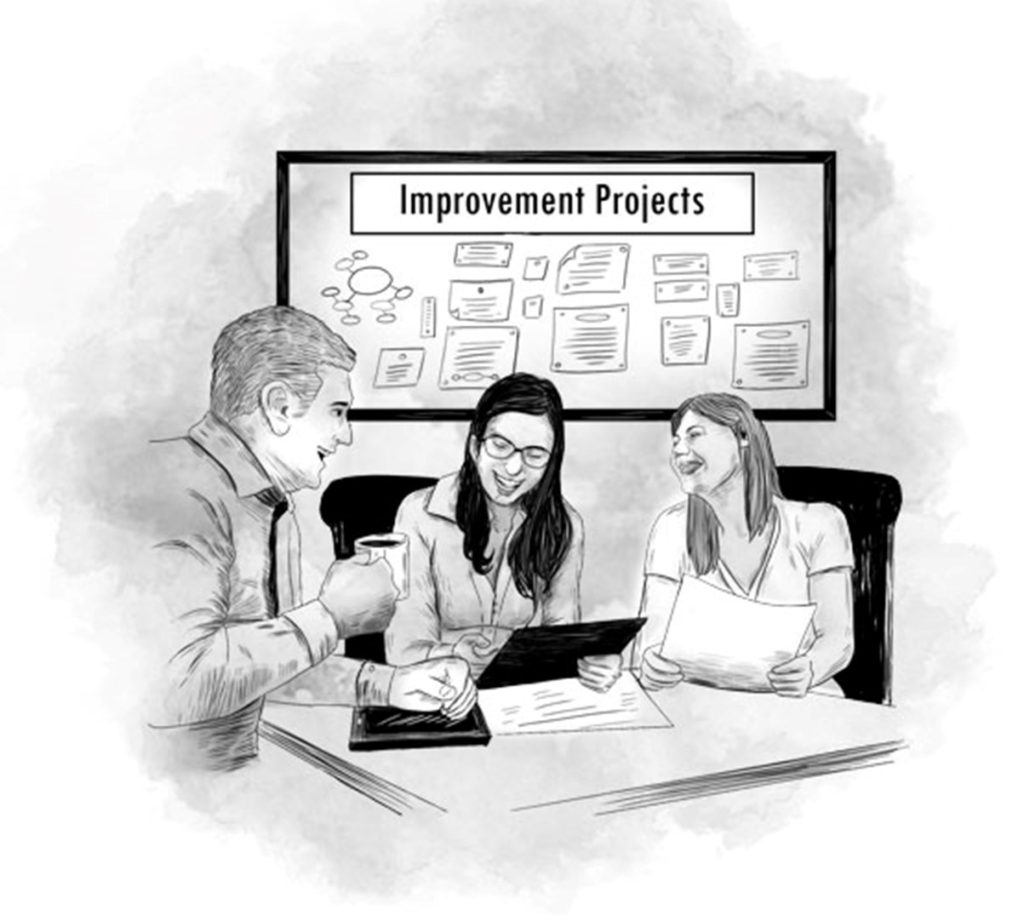
Time spent on business improvement projects in your "Goals Lab," or during down time. From GoalDriven.com (c)2021

A few years ago, a staff member at an I office visited confided in me and told me the following story:

Our office was really slowing down last year. So, the doctor decided to take everyone out of town to a weekend practice management seminar. The speakers discussed really cool methods for doing our work. It was fun and we learned a lot. Plus, we also went over some great marketing ideas. We were all pretty excited when we returned to work after the weekend.

On Monday, we agreed to get together at lunch to discuss how to implement what we learned. Some staff members were still dealing with patients, so our lunch meeting started 30 minutes late. Once we finally got together in the break room and started eating, we began a good meeting. We were interrupted with a few phone calls, and some patients started arriving early for their afternoon appointments. We had to cut the meeting short and didn’t get to discuss much of topics of the seminar, but we agreed to continue the meeting the following week.

As it turned out, something always came up each week and… we never did meet again about the seminar.

But we were still pretty pumped from the seminar and we had one of our best months ever. It was my job to clean the break room and, after a few months, I noticed that the binders of information we received at the seminar were still on the break room table, never opened. I stored them away for future reference.

“Now it is almost a year later, and everything is pretty much back to the way it was before we went to the seminar. The numbers are back down, some of us are a little burned out, and I don’t think we ever did implement anything from that seminar.”

Sound familiar?

I bet it does. I have seen it play out almost the same way countless times.

We are in the improvement business. We help people improve their health. We should be able to do the same for our business and for each other. In fact, if you are not constantly improving, your patients will seek practices that are.

In this new decade, apart from the many new events and changing tides of culture, technology, and mega-corporate influence, your future success is up to you. And it will be primarily based on the quality of your service and your outcomes – the experience your customers receive.

A report from a survey by Microsoft underlines this:

“As customer expectations continue to climb, it becomes more challenging for brands to set themselves apart from the competition. Markets are increasingly crowded, and both price and product are being steadily overtaken by customer experience as the number one brand differentiator” (Microsoft 2018, State of Global Customer Service Report).

More than any other short-term marketing tactics you may be using, only the best offices will thrive in the long run. And those will be the offices that are working on consistent improvement. Mediocrity could get you by in the past. But now, the future belongs only to the best.

But I have noticed that most offices just do not spend enough time consistently on improving their performance. After studying this for some time, I have observed a number of obvious and even hidden barriers that prevent us from working on improvement. I will explain what these are in a later article, but the following steps can help you ensure that you work ON your business to improve it, not just work IN it.

Your Improvement Clinic – Your Goals Lab

  1. Time spent on improvement doesn’t cost. It pays! Some business owners are concerned that time spent on improving the business or staff is too costly. It can be if the training or planning is poorly done. But remember that:
    a. Better team efficiency generates better revenue.
    b. Better trained and focused team members generate better revenue.
    c. Better outcomes generate better revenue.
  2. Head Coach. As the owner and CEO, you are also the Head Coach. How your team does – the business – is in large part based upon your coaching.
  3. Give it a name. In my new book, The Goal Driven Business (to be launched on July 4th of this year), I use the term Goals Lab as it is a location where you can go to work on getting to your goals faster. It could be your breakroom, a restaurant, a park, the reception area – anywhere really. You can call it your Practice Field, Improvement Dojo, or Mystic Garden! Just consider it a place and time that is separate from your time with patients.
  4. What gets done.
    a. Team meetings for communication, review, coordination, and planning.
    b. Team training and practice.
    c. One-on-one training and practice.
    d. Personal training, study, meditation.
  5. Schedule these routinely – weekly, monthly, quarterly, and as needed.
  6. No interruptions, no calls, 100% attention present.
  7. Be challenging. You don’t get better unless you question what you have been doing to see how it could be better.
  8. Go over this with your team. Let them know that they, too, are coaches. And players as well. So, improvement is a team activity, one that requires responsibility and professional discipline.

Your car mechanic can’t work on your car when you are driving it down the freeway. You can’t see patients while they are driving their forklift at work or cooking dinner for their kids at home. You need a separate time and place dedicated to work on improvement.

Your goal is to create an expert office that generates expert results and gives your patients the best experience they can receive from any other comparable health care business.

Imagine your business being so good that patients not only drive in from across town, or even across the state, but fly in from all across the country to receive your services. Imagine that there is such a demand for your care that you even build a motel next to your facility to accommodate the out-of-towners.

Well, there was a Doctor of Chiropractic who was just that good. His name was Clarence Gonstead. His advice?

“Practice. Practice. Practice. Never stop.”

Ed

Ed Petty - author

The Morale Virus: What doctors say and how they are combating it

Over the last few months, I have been noticing a particular phenomenon in offices that I don’t think I have seen before… maybe ever. It is like noticing a slight hand tremor that you never knew you had or a buzzing sound from outside that has become increasingly loud and annoying.

2020 was a long year, a stressful one. And you all have been in the thick of it. Daily, seeing more people in one day than most providers see in a week – or more.

My old football coach, Johnny Pappa from Davis, made a big impression on me as a young freshman when he said: “When the going gets tough, the tough get going.” In my then youthful life, I had never heard such profound words. They still apply – especially to you. You are tough!

But stoicism has its limits. The cognitive dissonance can finally get to you.

One doctor expressed to me extreme frustration about two young and very healthy patients, who exercised, got adjusted, ate well, took their vitamins, but decided to discontinue taking their outdoor walks for fear of COVID.

Another doctor, venting his dismay, told me that he couldn’t bear to watch the medical bureaucrats talk about masking and vaccinations as the only remedies to COVID when he knew of so many methods that have been demonstrated to ameliorate the virus. “People are frightened and told to stay at home, don’t socialize, wear a mask if you go out, and wait for the vaccine. That’s it? That’s all you got for people? This really shuts people down.”

One doctor I talked to who, after dealing with depressed and suicidal patients, many of them vets, has become depressed himself. Another wonders what the hell is happening to our chiropractic colleges – have they all been taken over by medical bureaucrats? Is chiropractic finally squashed?

Your good nature can become frayed, your patience worn thin, and regardless of your professional composure and your disciplined countenance, the stresses can have an affect. I mention this because most of you are tough as nails – you have successfully dealt with many types of stressful situations in the past, as a doctor, professional, and for many of you, a business owner.

Morale Virus

So if you are feeling a bit off, recognize that you might be affected by a contagious “Morale Virus.” The Morale Virus is what I call the social sickness that occurs as an emotional response to continual fear-baiting. Frightened, your patients are told they can’t do this and shouldn’t do that.

The Morale Virus is not caused by hardship itself. It is caused when you are pushed into a corner and given no way to fight back. You tend to give up. (Or go stark raving mad!) (Reminds me of the movie, One Flew over the Cuckoo’s Nest when the star, McMurphy (Jack Nicholson), says: “You guys complain how much you hate it here, and then don’t even have the guts to leave! You’re all crazy!”)

There has been a constant assault of bad news emanating from officials and authorities. Yes, and I know the media plays a part — it is mostly owned and controlled by just a few rich people and corporations who have their own agenda — namely, more money. But still – no one buys boring newspapers. Sensation sells the news, and we, the consumers, buy it. We listen and read the “news” that riles us up and confirms our bias. Social media does the same, times ten.

Dirty Laundry (Song by Don Henley) 

I make my living off the evening news
Just give me something, something I can use

People love it when you lose. They love dirty laundry
We got the bubble-headed bleach-blonde who comes on at five

She can tell you about the plane crash with a gleam in her eye
It’s interesting when people die, give us dirty laundry

Morale Virus Disinfectant

Here are some ideas on how you can fight back, disinfect your office from this disease, and better help your patients regain their spirit of hope, kindness, and free enterprise. And yours as well.

Good Vibe Year

One doctor we work with likes to anchor her practice around a yearly theme. For 2021, she is calling 2021 the year of Good Vibes and has events planned to support this philosophy. And just to reinforce the idea, she has T-Shirts made that say Good Vibes. (And by the way, she has a bustling two-doctor office.)

Study. Acquire More Knowledge. Teach

Fear is often a byproduct of lack of knowledge – so arm yourself with the facts.

For example: Roommate 1: “Oh my god! (A panic shout is heard.) The television isn’t working and the game is on. What will we do?” (Drama ensues.) Roommate 2:(Calmly) “Check the remote for new batteries.”  Roommate 1: “Ah, that fixed it, thanks.”

Study, use critical thinking, avoid bias – your own and others. Go to the sources – research studies and from people who are actually working on what you are studying. Then, please educate your patients and clients on how to be happier and healthier. And educate your team, help them increase their knowledge. Arm them as well. Doctor comes from the Latin to docere – “to show, teach, cause to know.”

Leverage Point

What area in your office, if changed, will produce the most significant effect?

Obviously, first and foremost is the doctor. Each day should be a trip to the playground, the ski slope, the baseball field, the dance floor. Ideally, each day is a fresh opportunity to accept the privilege of helping as many people from suffering as possible, to teach them, and have fun doing so.

In most offices, I would also say it is your front desk. The front desk’s power is so poorly recognized in most offices that at least 20% or more production is lost. A vibrant, aggressively friendly, caring, mission and goal-oriented front desk can and will boost your volume – this week. Front Desk team members may need more support and less admin (billing) duties. They may need a better understanding of the mission and how your office is helping people.

Entrepreneur Harder

During cultural upheavals and shifts, entrepreneur businesses remain and often thrive. New opportunities open up. More established and larger companies are weighed down by dogmatic rituals, have high overhead and many vice presidents, and vast networks of suppliers. Change is difficult. But not for the entrepreneur. Most entrepreneurs are all too “change-happy.” You can adapt, innovate, and overcome quicker than companies who are afraid to or can’t. So what if in-person care classes are out for now? Get everyone on a Zoom class, give them a secret word. Test them when they come in again and if they answer correctly, give them a gift – a bottle of Vitamin D or a lunch at another patient’s business.

Stay Out of the Weeds

One doctor told me that her solution was to “stay out of the weeds.” To stay in her lane and just keep helping people and not get caught up in the storms of controversy. I suggest that this is the best course of action. You want news? Sensational news…? Just listen to your patients and staff and community. But stay on the fairway and don’t get sidetracked, mentally or in real life.

Goals

Stay with your goals. Goals are agreements that you made with yourself, and usually others. If you stay true to them, they will lead you out of the den of the morale sickness. Staying true to your goals is a point of integrity. Your goals are not in the weeds – they are straight ahead. Figure out new and better ways to get there or resurrect old ways that worked. Fall down 7 times, get up 8. Each day and each week — begin with the end in mind.

Your goals are in three categories:

  1. Financial. This includes marketing and production.
  2. Service. Developing individual and team expertise with constant improvement..
  3. Purpose. Your higher purposes, those goals outside of work that are greater than this week and that are most meaningful need to be integrated into your work-life.

The Future is Bright and Roaring!

We have seen harsher times. The past is easily forgotten, and we think we are in the worst of times. Well, the 1918 flu was much worse than COVID. Plus, we were sending our young boys to suffer in horror and die in the trenches in Europe in the Great War. But society prevailed and soon ushered in the Roaring 20’s, a time of economic growth and cultural freedom.

Prepare to roar!

Carpe Deum (Seize the Day)

Ed

Ed Petty - author

This is such an important subject, I encourage you to share it with your team and colleagues:  To print out a hard copy

Tent Poster – Mental Toughness – Goggins

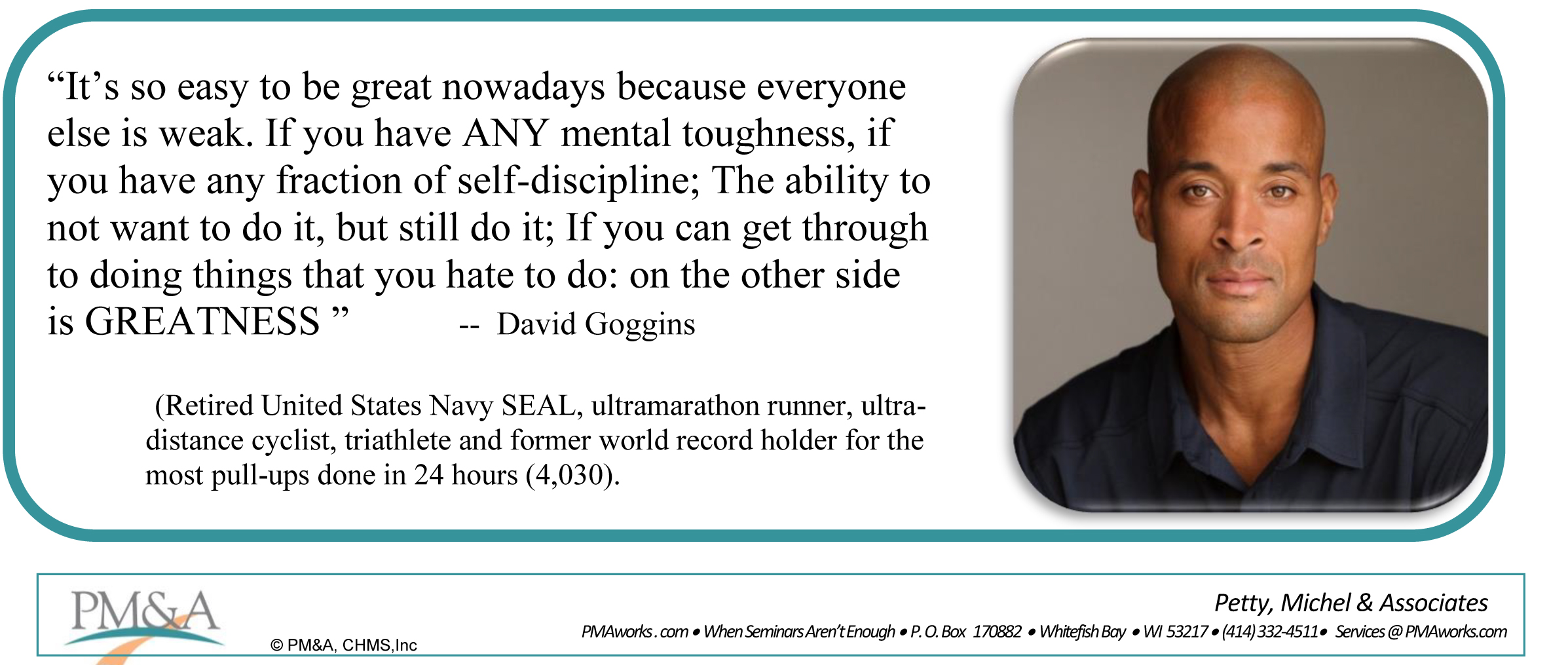
“It’s so easy to be great nowadays because everyone else is weak. If you have ANY mental toughness, if you have any fraction of self-discipline; The ability to not want to do it, but still do it; If you can get through to doing things that you hate to do: on the other side is GREATNESS ”

— David Goggins


For a printable version of this tent poster visit: Mental Toughness:Goggins

Goal Driven: Faster to Your Goals!

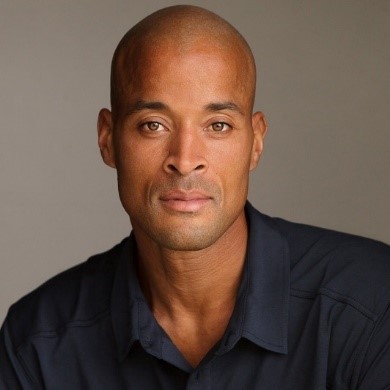
David Goggins

Now and then I see a motivational talk that I find inspiring.

It doesn’t happen too often.

Below you will find links to an interview with David Goggins. I can’t say much about it other than I found it inspiring and relevant. He reminded me that by pushing through, and not dodging from, discomfort when working toward important goals can lead to success and fulfillment. An important lesson for us all.

David talks about how he achieved his goals. He is an American ultramarathon runner, ultra-distance cyclist, triathlete and former world record holder for the most pull-ups done in 24 hours. He is a retired United States Navy SEAL who took part in the War in Afghanistan and the Iraq War.

Please watch it. If it resonates with you, you may want to watch it with your team and discuss afterwards.

Sincerely,

Ed

Photo from Wikipedia
Thanks to Dr. Maxwell for the reference.

Links to interview:

NOTICE: Some use of profanity #@!*#!

  1. 57 minute version: Search David Goggins on Impact Theory, With Tom Bilyeu. https://www.youtube.com/watch?v=78I9dTB9vqM&pbjreload=10
  2. 23 minute version: Abridged version: The Most Motivational Talk EVER! – David Goggins
    https://www.youtube.com/watch?v=oIrT1eHs1b0 
  3. 10:30 minutes How to Conquer Your Mind and Embrace The Suck  

Special Promotions: When Your Motive Meets Your Mission

When I was a boy and I would see scary things in the news, my mother would say to me, “Look for the helpers. You will always find people who are helping.” — “Mr. Rodgers” (Fred Rodgers)

Many offices (chiropractic, dental, etc.) hold special events, such as a “Kid’s Day,” a “Patient Appreciation Day,” an anniversary party, or in-office workshops. (We have links to examples below.)

The objective is usually to generate new patients, increase goodwill, and motivate existing patients. Sometimes these events are productive… and, as you know, sometimes they aren’t.

To be effective, you have to offer something that the patient, or prospective patient, considers valuable. It could be a workshop on practical health tips or a discounted service for a patient’s family member.

This is obvious and I am sure this is what you aim for. But there is another ingredient that you may not have considered that will make your events even more effective.

Link your promotions directly into your office mission.

Your mission is to help people. You may have it more fully defined in a “mission statement,” but it comes down to helping people achieve their health goals. Your mission is altruistic and socially responsible – you aren’t selling oxycodone at the pharmacy, high fructose corn syrup drinks at the grocery, or glyphosate at the local Round-up store. You are the good guys.

Your community will support you to the degree that they understand your pure altruistic motives. Why? Because the members of your community, by and large, are altruistic too. Your neighbors also… want to help people.

It is not a dog-eat dog world like social media or the “news” wants us to believe. Money is made from controversy and opposing sides and so it appears like we are fighting our local townsfolk… or should be. But behind all wars there are vested interests. Fear and anger motivate people and help sell media, advertising, and weapons.

But the truth is, the vast majority of us want the same things and we are not as divided as we have been manipulated to believe.

The organic food business has been growing, as have companies that sell organic clothes. Pesticides, herbicides and other poisons are not only bad to eat, they are also not healthy for the workers that bring these products to us. People are realizing this. “Fair Trade” coffee has become a major selling point. More companies are integrating social responsibility initiatives as part of their long-term strategies…for good reason.

In a study done in 2015, it was shown that consumers wanted to take personal responsibility for social and environmental issues and indicated that they looked to companies as partners in pursuing improvement efforts.

“The leading ways consumers want to get engaged with companies’ CSR [Corporate Social Reasonability] efforts are actions tied directly to their wallets, with nine-in-10 just as likely to purchase (89 percent) as to boycott (90 percent) based on companies’ responsible practices.

“If given the opportunity:

  • 80 percent would tell friends and family about a company’s CSR efforts
  • 76 percent would donate to a charity supported by a company they trust
  • 72 percent would volunteer for a cause supported by a company they trust
  • 72 percent would voice their opinions directly to a company about CSR efforts”*

How do you better apply this public trend?

You can encourage your patients to make appointments for themselves, and their family and friends, in exchange for making to make donations to a needy local charity. You can have them volunteer at a food pantry or a shelter with you and your staff – and offer all who participate a free service.

Integrate you mission in all your promotions on a regular basis and you will create a positive “network effect.” Other residents who volunteered will begin to promote your business on their own – even if they never step in to your office.

You should be way past working for United Health Care and Big Insurance. You should work for your patients and their causes – which are yours as well.

If you lead all your promotions with your heart, with your mission, with your higher goals, and deliver excellent outcomes with extra-ordinary services, your patients and your community will support you.

You are “The Helpers.”

Be true to your higher goals and all else will follow.

Ed Petty

*References:
http://www.sustainablebrands.com/news_and_views/stakeholder_trends_insights/sustainable_brands/study_81_consumers_say_they_will_make_
https://www.forbes.com/sites/sarahlandrum/2017/03/17/millennials-driving-brands-to-practice-socially-responsible-marketing/#61519f914990

Links to special promotions article and list of special promotions

Special Promotions-What They Are

List of Special Promotions-2018

The Merry-Go-Round: Planning for a Prosperous Practice in 2018


Progress in practice is made by steady persistence and passion.

In Angela Duckworth’s new book, she calls this “Grit.”

Think of evolution, think of growing crops… think of growing children!  Whether it is child development or practice development, growth is achieved through steady and unrelenting nurturing and adjusting according to circumstances.

I recommend you take some time to do some planning before the New Year gets in high gear. January and February are good months to do this.  Do it by yourself – and do it with your team. But…

Don’t reinvent the wheel… Just make it go faster with less effort.

 The Vital Few

A few of our actions are always more productive than most of the other actions that we do. Unfortunately, we can get distracted and spend far too much time on activities that, in retrospect, just don’t give us that much of a return.

The “vital few” actions that have helped you the most will be camouflaged, even countered, by the “trivial (but useful) many.” This is a term used by Nathan Juran, famous for his approach to business and quality improvement and the Pareto Principle.

And, I would like you to consider this: In many respects, your business has succeeded in ways that – perhaps – you have not yet recognized.  Therefore, I don’t recommend abandoning all you did last year and start chasing the newest “shiniest” procedures that seem appealing.

The key is to dust off all your actions from 2017 – review everything you did — and see the great things that worked and the victories you and your team achieved.

Then, just find better approaches to do more of this!

Diamonds in Your Office

The idea of having diamonds in our backyard, a story made famous by Russell Conwell (1843 – 1925) of the 1800s, applies. There are many variations, but it goes something like this: there once was a man who wanted more wealth, so he sold his house and left in search of diamonds. Years later, penniless, he happened back to his village where he roomed at a shelter for the poor. The shelter was supported by a grant from a local resident. In inquiring who the resident was, the diamond searcher discovered that it was the person to whom he had sold his house.

One day he paid a visit to his old house, now renovated into a beautiful estate. He talked to the new owner who told him that he had become rich. He said that when he bought the house, he needed to do some digging in the backyard where he discovered thousands of diamonds.

The moral of the story is obvious: you already are rich – you already have the diamonds. You just need to polish them.

Many of the components of your future success are already in your office. But we overlook them, or use them once and then forget about them, like teenagers looking for the next new article of clothing to make a fashion statement.

As entrepreneurs, creatively – we are all looking for that next dopamine high… and seek the next new “shiny” thing.

You have a show on the road. Just make it better. Make it fresh. Set a new standard, and make a new game to “level up!” Add a few new things here and there, but keep doing what is working.

Looking for Your Diamonds

Review what has been working for you. Reaffirm it and keep at it. Look at what hasn’t worked that well and fix it so that it does, or drop it like barbell that you have been holding over your head for too long.

By yourself, and later, with your team, here are some areas to look into:

____1. Review Your Mission Statement. Does it apply? How? Does it need to be customized? Beyond your mission, what is your WHY? Does the mission satisfy this?
____2. What Are Your Outcomes? For example: “People relieved of pain, healthier, educated so that they can and will continue to improve their health… and refer others?” You can also define Minimal Viable (Valuable) Outcomes, e.g., “A patient who accepts care.” Etc.
____3. How Is the Office Vibe? This is determined by your values and how everyone is living up to them. Are these values posted for all to see and check how they are “measuring up?” Are they defined? Do we need to add more, change some, delete some? Should we better define each value? Should we add:

• Trust. Are we worthy of trust with our patients and ourselves?
• Mission Oriented. Do we help each other cheerfully achieve our mission – each day?
• How well are we living up to these?
• How can we live up to these better?

____4. How Were the Numbers? Up, or down?

• When the numbers went up, what did, or didn’t we do? How can we improve upon this?
• When the numbers went down, what did, or didn’t we do? Should we improve or discontinue those actions?

____5. Individual. What can each one of us do professionally this next year to improve our ability to contribute to our team and its mission?

Some of this should be on simple, brief checklists and memo’s. Add it to your Practice Playbook. Document it so that it can be referred to for training and coaching in the future.

Merry-Go-Round

Imagine that your practice is a merry-go-round, the kind you find at children’s playgrounds.

It takes a lot of energy to push it and get it going. But… once it is moving, it takes less effort to gradually get it going faster. And faster! And faster…

Take some time to review how you are pushing your merry-go-round. What procedures worked better for pushing it faster? Focus on these… Makes these better.

Go faster… and push less.

And as you do, watch those, including yourself, hold on tighter and smile bigger.

Enjoy the ride!

With admiration,

–Ed