Chiropractic Practice Management, Marketing, and Leadership Recorded Training Webinars

This is a list of our practice development recorded webinars.

Each is a recording of a slide show driven lecture, each filled with an abundance of practice information derived from in the field work – and plenty of slides!

Currently, you have to be active on a PM&A program. By this summer, these will be available on and individual basis for a small fee.

 Chiropractic CEO Webinars

 Creating your Dream Team Summary and VideoA virtual “live” interview with the doctor and staff of a true chiropractic dream team. Find out what they do to achieve high numbers, profit, and fun.

 The Fast Flow Practice CEO  -55 minutes webinar video and summary.
One of the biggest challenges in running and growing your business is the time it takes you away from seeing patients and from your family.  We have solved this with what we call the Fast Flow Practice CEO System.   A new system derived from old principles.
Management by the Numbers: 44 minutes – Summary and Video
Management is a subject that has techniques to help you go from where you are to where you want to be.  Management By the Numbers (MBN)  can be faster and more accurate than other forms of management, and help build staff morale and make it more self directed.

Capacity Constraints : 33 minutes – Summary and Video
Do you work hard but you just don’t get as far as you should? The reason may be that you are running into unseen bottlenecks that are choking off your production and suffocating your growth. This is the subject of Capacity Constraints.

How to Be an Effective Practice CEO  Video
If you are struggling with the ups and downs of a stressful practice, or have finally “settled” into a comfort zone producing much lower than you know you are capable of, this program is for you.

~~

Chiropractic Office Manager Webinars

 Chiropractic Manager Webinar – Roles and Goals  Summary, Video and Study Guide
What Are The Key Roles In Your Office? A hidden barrier in many offices has to do with confusing roles and job duties. Clear these up and see how much smoother patients and paper flow, and happier the team becomes.  Small office or big health business, clarify these 8 roles and the numbers will go up.
 

Chiropractic Manager WebinarJob and Performance Reviews    Video
Employee reviews are often neglected, or are dreaded by employee and doctor. This webinar covers the basic steps to make them effective and positive for both doctor and employee.  Approx 37 minutes.

Chiropractic Manager Webinar – Motivating Your StaffVideo  Ms. Phyllis Frase shares 5 secrets to keeping yourself and your staff motivated.

 Chiropractic Manager WebinarTeam Meetings   Summary, Video and Study Guide. This is an overview of 8 essential actions to help you improve your meetings and make them faster, more fun, and more effective. Plus, different types of short meetings that your team can grow.

 Chiropractic Manager Webinar –  The Office Manager Job Description  Summary, Video and Study Guide. This class covers 17 essential duties of the office manager. Both the doctor and the office manager should watch and discuss these duties.
 

Chiropractic Manager Webinar-  How to Best to Train Your Staff  Summary, Video and Study Guide This webinar covers eight tips  to improve the performance of your team.  Training plays a big part in team building.
 

Chiropractic Manager WebinarHow to Hire the Right Team Member   Summary, Video and Study Guide.
This webinar  covers eight priniciples for hiring the right team member from knowing when to hire, who to hire and how to hire.
 

Office Manager Webinar – It’s All About the Patient, the Doctor and the MISSION [Summary, Video and Study Guide]
There are procedures to help the patients and procedures that help the doctor help the patient and then there is Everything Else.  Tips on how to deal with Everything Else. (30 minutes)

Office Manager Webinar- Part IITips and Tricks to make the office more efficient[Summary, Video]
Part II reveals tips and tricks of what an office manager can actually do in the office on a day to day basis to make things run smoother and  significantly improve the volume and quality of services. (55 minutes)

 Office Manager Webinar- Part I – Fundamentals of Practice Management [Summary, Video]
Part I covers the fundamentals of Practice Management (55 minutes)


Chiropractic Marketing Webinars

Innate Marketing  (55 minutes) – Webinar plus Summary.
There are stories that float around every now and then about how some offices can simply “think”  “New Patients” and they come in.
Are these stories an urban legend? A myth, or a fact? Can staff or doctors “concept” new patients in the door. Is this true? If so, how can you do this?  10 steps to help you generate more patient visits through “concepting.”

Chiropractic Special Promotions  (55 minutes) – Webinar plus Summary.
This webinar covers different promotions by month. You will learn 2-4 different practical promotions for each month of the year. More importantly, you will learn how to organize them so that they are time effective and productive.

Patient RetentionSummary and Video
If you understand the underlying basics of patient retention your appointment book should always be full.  Covered in this webinar is: Patient retention should be based on Principles – not gimmicks. Where are we you taking your patients? Why they quit?  The cost of not getting them there.

 Chiropractic Patient EducationSummary and Video (45 min)
We go over 7 basic strategies that cover the entire horizon of patient education and explain why it is so necessary to educate your patients if you want them to be healthier.

 Infomercials.Summary and Video .
Whatever happened to Infomercials? They’re still around and they still work. And you can do them very inexpensively. You just need to know how. This webinar will give you practical examples and include forms for you to use in producing your own amateur and informational marketing that can help you create more new patients and keep the ones you have.

 Internet Marketing and Social Media. – Summary and Video . This webinar covers some fundamentals regarding social media, Facebook, and general Internet marketing. (35 minutes) (not yet posted)

 The Art of Spinal Screenings.Summary and Video . Spinal Screenings – The Queen of External Marketing.  Everyone has done at least a few  spinal screenings. You have probably had some success with them. But how much better could you do if you knew the fundamentals of this time tested external marketing activity?  This is a three part series on spinal screenings. This session we will review the most fundamental principles of screenings. Get these, and all else will follow.(45 minutes)

 Scheduling Screenings and other External Events Summary and Video .  How to Schedule External Events And Create External Referral Sources.  Types of events, Outcomes, Purpose. How to plan the events and get them scheduled.(30 minutes)

Marketing Tips: Earth Day, Spring Promotions, and other TipsSummary and Video This webinar covers: Powerful internal marketing script, Report of findings referral procedure,  upcoming spring promotions, with special attention to utilizing Earth Day as an opportunity to promote your services.

Short Overview of Chiropractic Marketing Management with Some Marketing Tips Summary and Video   This is a short version of marketing management and some tips for the upcoming months. What are the three levels of marketing?  What part does communication have in your marketing?  How to engage your patients in your marketing efforts.  Upcoming special promotions. (30 minutes)

Marketing Management, Part I and Part II – This is the longer version of how to manage your marketing, and why.

Chiropractic Marketing Management – Session ISummary and Video The Why, What and How of Marketing. Getting your Marketing off the Ground. (55 minutes)

Chiropractic Marketing Management – Session IISummary and Video  Specific Marketing Manager Duties – Your Job Description.  General Overview of the Most Effective Marketing Procedures in Each of the 11 Marketing Categories (55 minutes)
 

10 Strategies for Improving Patient Retention

In our recent webinar on patient retention, we reviewed basic procedures that can be used to decrease patient drop outs.

More significantly, we looked at a new or model for practice retention that many businesses are now using successfully.

If your visit average is less than 60, then you can benefit from the material we covered.

The old approach to patient retention is focused around patient control procedures designed to “plug up” the “leaky bucket.”  These still work and we covered some of the more effective procedures.

But this approach tends to address the symptoms more than the causes.  A more effective approach is focuses on teamwork.

Patients, like customers, want two things: results and a “good feeling.” The “good feeling” is a product of how much each doctor and staff member genuinely cares about that patient at the time he or she is interacting with that patient.  Patients will even tend to stay with a doctor and a practice if their results are not satisfying IF the service is extraordinary.

An effective method of improving patient retention includes role playing the “moments of truth” each team member has with patients. These include phone and walk-in greetings from the front desk, patient encounters with the doctor, therapist, and with the billing department for financial consultations.

Here are ten strategies you can put into place to keep your chiropractic patients coming back.

10 Strategies To Improve Patient Retention

__1. Love The Services You Provide.   If you don’t love what you do, how can you expect your patients to?   People buy based upon confidence – and if don’t have faith, confidence and love for your services, your patients won’t either and they won’t come back. (They won’t refer either.)

__2. Love Your Patients.  People can tell if you are being real, or just reading a script. You see it when you go to the chain stores and the checkout clerk says “hello”, or “have a nice day.”   They say the words, but it isn’t genuine.  They just don’t care. Practice and improve these “moments of truth.”

__3. Their Goals. Be goal oriented with your patients. Get them to set and commit to a goal for improving their health. Keep them recommitting.

__4. Coaching Patients.  Once you have their commitment, you now can use your patient control techniques. The webinar included a short presentation on an effective patient recall system used many years by Linda Skiles, former Chiropractic Assistant of the year in WI. The forms discussed in the webinar are located on our PM&A members site.

__5. Education to Make Your Patients Self-Motivated. Would you as a chiropractor, or experienced chiropractic team member, stop getting adjusted? Of course not.  And why not?  Because you know it how important adjustments are to maintaining your health. You have been educated.

__6. Help With Finances. Third party pay is confusing. Financial concerns can be embarrassing for your patients. Providing friendly and easy access to personal help in working out paying for their services can assist keeping your patients coming back.

__7. Stand for Something.  Your mission has to extend beyond relieving pain, just like Apple goes beyond computers or Starbucks beyond coffee. If you honestly embrace a greater purpose, your patients will see why you do what you do, not just how you do it. They will want to support that purpose as well by getting adjusted regularly

__8. Family.  People like to belong to communities. We like to have friends. Some offices call their patients “Practice Members”, while others have “wellness clubs”,  and advisory committees.  However you do it, your patients should feel like they are part of your inside circle.

__9. Measure, review, improve. Constantly work on improving your service.  That which you don’t improve upon eventually atrophies.

__10. Take care of each other.  We spent a lot of time on this one, but need to spend more. One of our webinars later this year will zero in on how this action helps create a winning team.

As it turns out, the way you treat each other is the way you will treat your patients.

The webinar is located on our PM&A members site now. PM&A Members: Marketing Training/ Patient Retention

[Download version of this file for your staff meetings and reference: 10 Strategies for Patient Retention. ]

Your Chiropractic Root System and Patient Retention, Referrals, and ROI

Updated: April 2016

When people go to the grocery store for produce they are mostly just interested in their plump cucumbers, zucchinis, or other vegetables.  They don’t much care about the garden that actually produced these nutritious wonders of nature.

But a lot of work goes into a well managed garden. If you don’t take good care of your garden, you won’t have its fruits and vegetables.  It’s that simple. And a good part of a garden takes place underground in a network of roots.  Roots provide water and minerals to the plant, and keep it in place when the wind blows.  The top part of the plant, its stem, can get mowed under by a lawn mower (I have done this) and the plant comes back to life – because of its strong root structure.

Your office is kind of like a garden.

It produces healthier people. You take care of your team, polish up your systems, do some training, and you will continue to have a productive “health garden” that produces healthier people.

And the roots? 

In this analogy, the root system is the loyalty and good will of your patients. Here’s how:

Many offices struggle to get new patients.  Even offices that have been in business for years and years.

Why?  No roots.

If some doctors spent the same time and attention – and money, on giving extra care and service to their existing patients as they did on trying to hustle up new patients, they would have more patient visits than they would know what to do with.

Why?  First, because the service and care was SO extraordinary, patients would refer their family and acquaintances because they would want them to receive similar treatment as they had.

But more obviously, existing patients would never drop out of care. (Some would, of course.) They would continue to come back for wellness visits. How busy would your office be now if all the new patients you ever started still came in for services? You couldn’t handle…there would just be too many patients!

Over the years, there have been many studies to support the fact that it is more expensive to chase after new patients than it is to keep the ones you have.

 “A common rule of thumb is that the marketing costs of landing a new customer runs three to five times the costs of retaining an old one.” (Total Customer Service, Davidow)

Some articles talk about it costing 10 times the amount to get a new customer as to keep the ones you have.

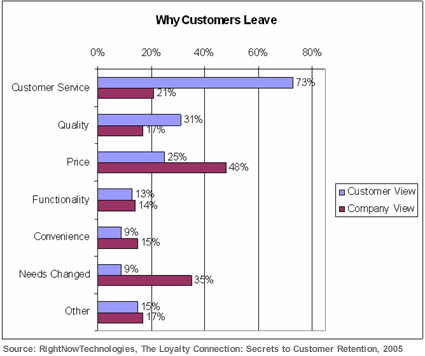
I am all for getting new patients, but do you also keep your existing patients? And do they refer family and friends and work associates? And why do your patients leave? An interesting survey pointed out that most companies believed it was because of price, or that the needs of the customer changed. However, from the point of view of the customer, they left because of poor service. (The Loyalty Connection: Secrets To Customer Retention And Increased Profits By Bob Thompson, CEO, CustomerThink Corporation Founder, CRMGuru.com, March 2005)


There are a number of procedures to improve your services to patients – to help generate stronger and more productive “roots”, or healthy patient relationships. Let’s focus on the most fundamental: Communication.  To put it more accurately, let’s call it “conversation.”

BEGINNING THE CONVERSATION

A conversation is a dialogue, a giving and receiving of communication back and forth. It is an interactive exchange of thoughts. It shows that you respect the other person and that you are interested in them and what they have to say.

Many patient conversations are one-way, from the staff and doctor to the patient. They are also rote, robotic, and too scripted to be genuine.  Do an audio recording of how the front desk answers the phone or how you do a consultation and you might be able to see room for improvement.

The conversation usually starts with the first phone call. Does the prospective patient feel that the front desk is listening – really? Is she interested, or just reading her script and trying to get to her next task and hang up the phone?  Does she introduce herself and show interest and even gratitude for the call?

It is these little things that make such a big difference.  Think about how you like to be treated when you contact a business…

In the consultation, do you really listen and seek to understand the patient, even though it is like the 5 millionth time you heard about someone’s low back pain?

In your report, do you have a conversation with the patient, or do you just rehearse your script to the patient while they are nodding in appeasement?

You see so many patients… and have so many tasks… that real conversations are too often sidelined.  You don’t have much time, usually. But in the time that you do have, you have to be present. You have to be THERE, with all of your attention on the patient, and not on your next task.  That moment with that one patient will never happen again. It is its own time that just you and that person share.  The Japanese have a saying for this: “Ichego Iche.”  One time, one moment. This is a plaque that is often found in tea rooms in Japan.

You have started to create a relationship.  Now, you have to continue to nurture it. This is done by continuing the conversation – and of course, great clinical and administrative service and care.

With each patient encounter, you have to be interested, attempting to understand and then get understood. Improve this and you are well on your way to better patient retention and referrals.

CONTINUING THE CONVERSATION

But when your patients are not with you, you have to find ways to continue the conversation.

How?

Your Newsletter.
You can easily set up an email newsletter with an a provider such as Constant Contact or Mailchimp. Send these out monthly or even twice per month. The most important aspect of these letters is to keep them real, personal, as if you were writing to a friend.  It could simply be a few paragraphs from the doctor relating a recent case success, or a home health tip. You can also include patient testimonials and a review of a recipe.

But we are inundated each day with hundreds of emails so keep in mind that old fashion snail mail still works, and in fact, works better.  It does cost, of course, but the return on investment makes it worth it.  A hard copy newsletter will have “shelf life,” and can be read and reread.  Most emails are overlooked -there are just too many of them.  Send out a hard copy newsletter every 4-6 months.  It can even just be a one page foldover, self-mailer.

Other Mail.
Cards are very considerate. Just think about the few you receive. You may still have them! A system can be set up to send out birthday cards, welcome cards, humorous reactivation cards, bereavement cards, and congratulation on starting your “wellness program” cards, as well as other cards each month.  These all help keep the conversation going.

Social Media.
Facebook is your primary social media with your patients. This can be similar to your newsletter.  Like email, it has become glutted with ads and “content” information.   Ask your patients to “LIKE” your page so that they can stay in touch with the office and receive new information about health and upcoming office events.  Some offices even hold special contests only for their Facebook “friends.”  Then, post regularly fun and education information. For example:

 “Our patient, Burt, just got accepted back into his hockey league thanks to chiropractic. Here is a photo of Burt and Dr. Smith and his new puppy eating apple pie made by Rose, a long time patient who can’t stop bringing us apple pies!” (Of course always get patient approval to post their picture.)


Upload patient testimonials, in writing or even videos. If they are interesting, other patients can comment, or even share.  And if anyone does comment, make sure that you comment back.

Delegate these types of communication to your team, but you have to be the one to ensure that the conversation continues.

If you have good roots, there is nothing to fear.  Insurance reimbursement can decrease even more, the economy can decline, staff changes can occur, but if you have taken good care of your patients, they will take good care of you.  Conversations with your patients will help nurture a strong “root system” that will keep your office productive, no matter the storms that may come.

SUMMARY – TAKE AWAY:

 When the patient is on the phone or in the office:

  • Be present and attentive.  (Present Time Consciousness “PTC” as Jimmy Parker would say.) Be genuinely interested.
  • Seek to understand the patient.
  • Get your point understood and have a conversation.

When the patient is out of the office – continue the conversation:

  • Snail mail real newsletters and cards mailed.
  • Emailed newsletters.
  • Get Facebook “fans” and post local/personal news.

Chiropractic Marketing Tips for The Holidays And The Start of the New Year

Due to popular demand,  I am posting notes from our October teleclass on marketing over the Holidays.

Teleclass Outline with Ed Petty  — Notes

All marketing is broken down to:

1.    Procedures. These are either special, one time events, or standard recurring. Some have the purpose of immediate results (direct marketing), some more long term (indirect marketing).

2.    Motivation. Desire. Wanting to implement these procedures. (Discipline.)

3.    Marketing management.  Review, Planning, Implementation.

Motivation: You are listening (or reading this) so you are motivated.  But you have to get others motivated as well. You have to get and stay inspired.  It is Ok to be a cheerleader.  What’s wrong with a little cheer? And the more you cheer.. the more you find to cheer about!

The  Marketing Manager System:

  • Meeting weekly: Review/make plans/Implement (assign steps/dates)
  • Who is responsible and responsible for what
  • Calendar Special Promotions/Events
  • Checklist of Recurring Procedures/Events


Procedures: Special events/promotions

NOVEMBER

  • Holiday Turkeys (Care to Share) (Ham for Christmas)
  • Donation Programs: Shelters, Toys for Tots, Coats for Kids, Food for Families
  • Scheduling Patients over the Holidays. (Plan ahead so they keep up with their care.)

DECEMBER

  • GNO (Girls Night Out/ Shop Before You Drop)
  • Gift coupons
  • Saturday with Santa
  • Poinsettias (with gift coupons)
  • Planning, training – sharpen the saw.
  • Do scheduling for new year: “Flexibility Screenings” with gyms,  lunch and Learns with businesses
  • Gifts for Allies  and those who referred: Box of nuts, organic flowers, cups, pens, caps, t-shirts. Cards.

JANUARY

  • Lending Library: Supersize Me, Fast Food Nation, King Corn, Sugar Blues, Food Inc. End of Overeating
  • Workshop on Nutrition and Fitness
  • Annual Reactivation Program
  • External Workshops, Screenings, and networking

FEB

  • Doctor’s With A Heart Donation Program
  • Have a Heart – Oklahaven Children’s Chiropractic Center – link
  • Valentine’s Gift Coupons

MARCH

  • Leprechaun Appreciation Day (Kid’s Day) link

Procedures: Recurring

Community Education: Talks or Awareness Weeks

  • Nov: Flu
  • Jan  Feb Food, Supplements/ Fast food Series —  With  a Dietitian and a trainer. February: Heart Heath- blood pressure
  • March: Headache Awareness Week

Communication Channels

  • Newsletter
  • Email Newsletters – NEW SERVICE FOR 2010 – We will do this for all clients on Standard Management Programs or higher.
  • Press Releases
  • Ads on other special newsletters: Chamber of Commerce, YMCA, Church Bulletins
  • Web site/Face Book – Fan /LinkedIn

Internal Recurring:

  • Morning case management meetings – (include a joke.)
  • Staff meetings
  • Patient Success Stories, Upbeat Atmosphere:  Take a “vibe check”:  too seriousness or pleasant can welcoming atmosphere. Where’s the party?
  • Spinal Care Class
  • Whiteboard
  • Brochures
  • Staff education
  • WOC (Whip out card)
  • Mission