They both can be expensive, so what service gives the greatest “bang for the buck?”
I go to seminars. I like them. In fact, I hope to see some of you at the WAVE, sponsored by Life West in San Francisco this weekend (8/1/2014). (If you are going please contact me by calling the office number below and it will forward to my phone. It would be great to say “hi” in person!)
Seminars provide a good opportunity to get away. B.J. Palmer talks about this, of course, in his Rule Number #9. (1)
Also, by disengaging from your work, you can better re-engage in it when you get back. The science of this is discussed in a book called: The Power of Full Engagement.
Plus, networking. Nothing like meeting new people and hearing how and what they are doing and trading fish stories – even if they are often embellished. (“Don’t tell fish stories where the people know you; but particularly, don’t tell them where they know the fish.” Attributed to Mark Twain.)
And, they can be entertaining.
Plus, you can learn things. Learning new things that work and unlearning things that don’t work is probably the MOST important skill you can have. And it is getting more important every day. Our world is changing SO fast that in order to keep up, you have to really spend time and money learning.
“The illiterate of the 21st century will not be those who cannot read and write, but those who cannot learn, unlearn, and relearn.” ― Alvin Toffler
However, there are drawbacks.
Seminars: the Sage on the Stage
First, there is the expense of the seminar. Actually, by comparison, most chiropractic seminars are dirt cheap compared to other seminars that run into the thousands. The expense is in the travel. The hidden expenses add up considerably, especially if you take your staff, which you should now and then.
Then, there is the actual content – the information being imparted. Much of it is motivational and that is nice. However, the seminar speaker does not know you. He hasn’t been to your office, your home, talked with your staff or know your family. He hasn’t read your town’s newspaper or seen your patients. He doesn’t know your situation. He teaches you a procedure that sounds good in theory and may have even worked in his office 15 years ago, for a while. He may be entertaining, or coercive. But, often only 10% of what is taught at a seminar is applicable to you and your office. And of that, very little gets implemented, and in two months, less than 5% of the seminar may be in operation at your office. The following is an example that shows how much useful information gets reduced down to actual implementation in most offices.
Actual Value of Seminar (approximate percentages)
- Motivational (can sometimes be excellent, but is very temporary.)
- Percent of information verifiably valid: 70%
- Percent of information comprehensible, heard, or understood: Of the 70%, one half is comprehended, heard, or understood, leaving 35%)
- Percent of information applicable to your particular city, staff, patient base, your style and personality, etc.: Of that 35%, perhaps 15% isn’t applicable, leaving you with 20%.
- Percent of information that can be implemented in your office: Of the remaining 20%, perhaps only half can get applied, leaving 10%.
- Percent of information that gets applied: In two weeks time, only 5% gets applied.
- Percent of information that stays in application: After two months, only 1-5% percent of the original information is still applied.
- If you had spent $2,000 on a seminar program, using the rough example above, you would have wasted all but 5%, or $1,900.
This example is a little harsh, I‘ll admit, but I wanted to make a point. But you know what? Even this small percent may still be worth attending the seminar.
Coaching – The Guide from the Side
Our company grew because doctors did not or could not adequately apply what they heard at the seminars. Starting out many years ago, I remember seeing doctor’s shelves full of binders, VHS cassettes, and manuals that were barely touched since they were brought home from the seminar.
So, back in the late 1980’s, we came up with our niche and our identity, encapsulated in our tag line:
When Seminars Aren’t Enough sm
Good coaching, helps you and helps your team discover what systems work best for you, and then helps you make them better – over and over until your TEAM becomes expert.
A good coach, like a competent doctor, has the experience to quickly identify what needs to be worked on that can bring about the quickest improvements. This is what we do. We have become skilled at spotting the key leverage points (3) in an office and have developed new and effective methods to make the changes necessary for faster improvements.
But, we do this as your guide. We don’t impose a particular patient system into your office. You are unique and what works for a doctor in Nebraska may not work for the same one in San Diego. We help you discover what works best for you and help your team get better at supporting you.
A good coach trains, advises, nudges, listens, counsels, teaches, and when possible, even does some of the work. And is this effective? You sure as hell bet it is! We have been doing this for nearly 30 years and those doctors that have worked with us know this to be true.
But the real reason for coaching is economics: bottom line, baby! Return on Invest. ROI. Studies show a pay back of 5 to 7 times on your investment. We have certainly seen this occur. (3)
Like chiropractic, good care doesn’t cost, IT PAYS. Health IS wealth. The same applies to education – and in particular – coaching. It doesn’t cost – it pays.
Seminars? Yes. Coaching? Hell yes! But books and webinars and mentors as well. A weekend of reading a book is a great investment.
In the end, you have to constantly study and learn to stay in the game. Success is, now more than ever, dependent upon constant never ending improvement. You have to do this just to keep up, let alone to get ahead.
And if you don’t – well, your community and patients will be seeking a healthcare office that is.
References
(1) Rule #9: Every man owes it to himself, his people and his service to go away about every so often. The more detail he has, the oftener he should go. The more worries, the more he needs to go. The bigger his work, the longer his vacation should be. – B.J. Palmer https://pmaworks.com/observations/2008/08/18/getting-away-rule-9/
(2) Leverage Points http://www.donellameadows.org/wp-content/userfiles/Leverage_Points.pdf , also: Eli Goldratt, The Goal
(3) BUSINESS IMPACT STUDIES
- Research conducted by MetrixGlobal on coaching at a Fortune 500 company showed that coaching produced a 529% return on investment and significant intangible benefits to the business. Including the financial benefits from employee retention boosted the overall ROI to 788%.
- A landmark study commissioned by Right Management Consultants found a return-on-investment of dollars spent on executive coaching of nearly 600%. Executives engaged in coaching reported increases in productivity, improvement in relationships with direct reports and colleagues and greater job satisfaction.
- According to a study by the Manchester Consulting Group, organizational benefits from executive coaching include:
Improved Relationships 77%
Improved Teamwork 67%
Improved Job Satisfaction 61%
Improved Productivity 53%
- An International Personnel Management Association survey found that productivity increased by 88 percent when coaching was combined with training (compared to a 22 percent increase with training alone).
- Studies completed by the American Society for Training and Development showed a ROI of 5 times the cost of coaching.
BUSINESS PRESS EXCERPTS
“Many of the world’s most admired corporations, from GE to Goldman Sachs, invest in coaching. Annual spending on coaching in the United States in estimated at roughly $1 billion.” Harvard Business Review
“Coaches are not for the meek. They’re for people who value unambiguous feedback. All coaches have one thing in common. It’s that they are ruthlessly results-oriented.” Fast Company Magazine
“Business coaching is attracting America’s top CEO’s because, put simply, business coaching works. In fact, when asked for a conservative estimate of monetary payoff from the coaching they got….managers described an average return of more than $100,000 or about six times what coaching had cost their companies.” Fortune Magazine
“[A Coach] is part advisor, part sounding board, part cheerleader, part manager and part strategist.” The Business Journal
“Between 25 percent and 40 percent of Fortune 500 companies use executive coaches.” The Hay Group International
“Once used to bolster troubled staffers, coaching now is part of the standard leadership development training for elite executives and talented up-and-comers at IBM, Motorola, J.P. Morgan, Chase, and Hewlett Packard. These companies are discreetly giving their best prospects what star athletes have long had: a trusted adviser to help reach their goals.” CNN.com
“In a 2004 survey by Right Management consultants, 86% of companies said they used coaching to sharpen skills of individuals who have been identified as future organizational leaders.” Harvard Management Update
“A coach may be the guardian angel you need to rev up your career.” Money Magazine
http://transverseleadership.com/roi.html

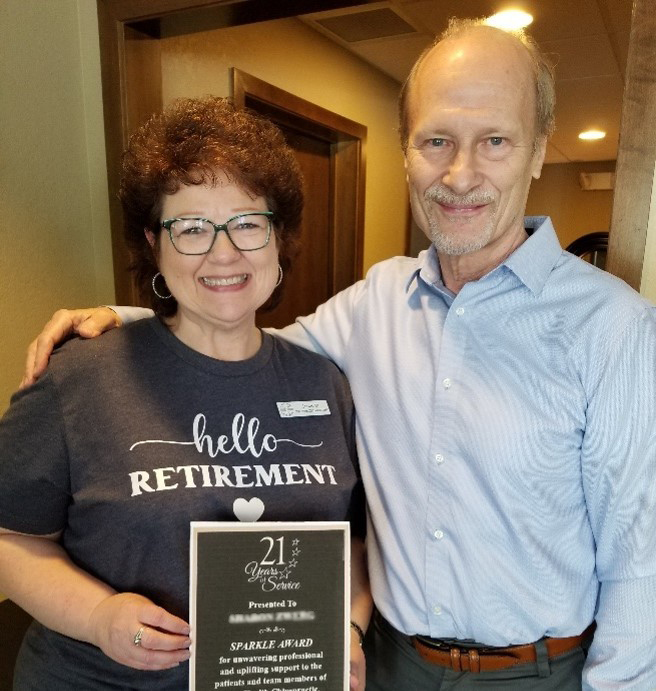 While she indeed does “sparkle,” so does the entire practice. And the sparkle of this office is a byproduct of its synergy.
 The cause of almost all relationship difficulties is rooted in conflicting or ambiguous expectations around roles and goals. Stephen Covey